
Getting cut off from your long-term disability (LTD) benefits is frightening. Bills don’t stop, and the last thing you need is to worry about whether a lawyer will take the little money you have left. The good news: most disability lawyers in Ontario work on a contingency fee basis, meaning you pay nothing unless your matter resolves with a recovery.
But “contingency fee” doesn’t mean “no limits.” Ontario law sets rules about what lawyers can charge, and understanding those rules puts you in a much stronger position when you sit down for that first consultation. You deserve to know exactly what a lawyer can — and cannot — take from your recovery before you sign anything.
This guide explains the maximum a disability lawyer can charge, the factors that influence the final percentage, and what questions you should always ask before retaining anyone to help with your long-term disability claim.

Table of Contents
- What Is the Maximum a Disability Lawyer Can Charge?
- What Is the Most a Disability Lawyer Can Charge?
- What Is the Maximum a Disability Lawyer Can Take From Your Settlement?
- How Do Contingency Fees Work in LTD Cases?
- What Factors Affect the Fee a Disability Lawyer Actually Charges?
- Can You Negotiate a Disability Lawyer’s Fee?
- What If You Disagree With Your Lawyer’s Bill After the Case?
What Is the Maximum a Disability Lawyer Can Charge?
In Ontario, the legal framework for lawyer fees is governed by the Law Society of Ontario (LSO) and the Solicitors Act. For contingency fee arrangements — the standard model in disability cases — the rules require that the agreement be fair and reasonable and that it be in writing, signed before work begins.
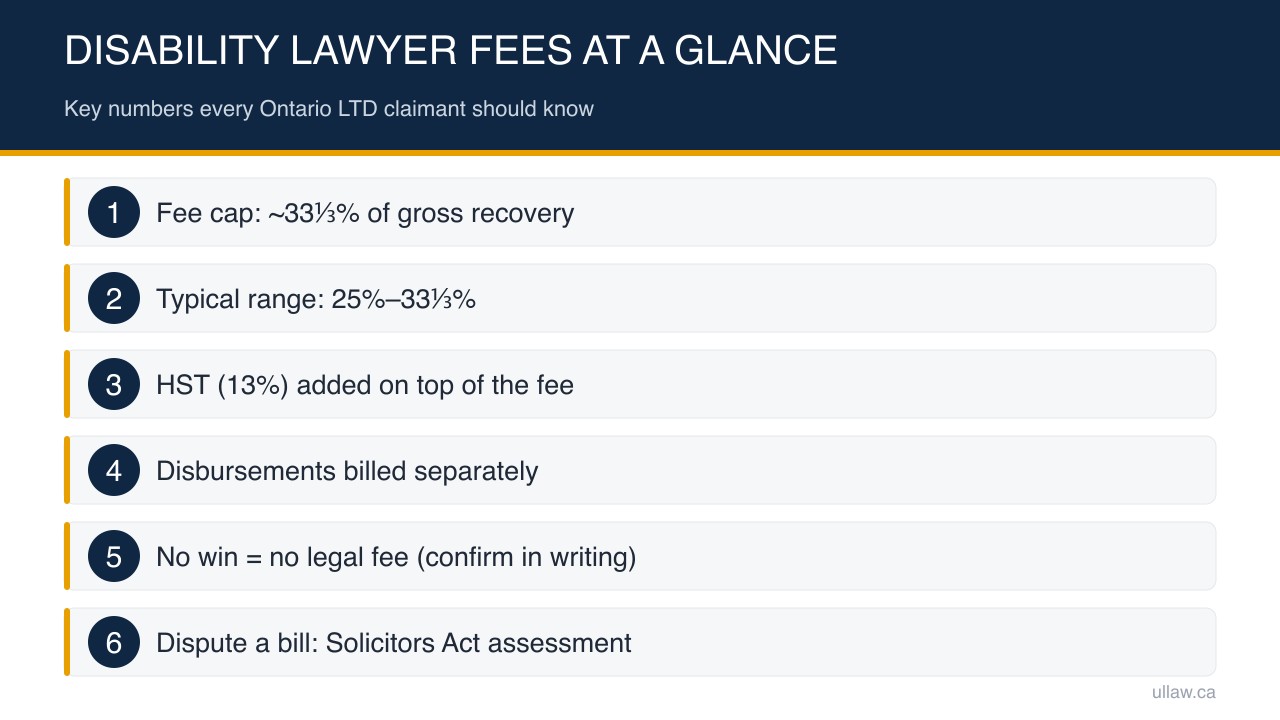
The Solicitors Act was amended to introduce a cap of 33⅓% (one-third) of the amount recovered as the presumptive maximum for contingency fees in most personal injury and related civil cases, including many disability claims. However, the specific cap and how it applies can depend on the type of matter, so it is always worth asking your lawyer to explain exactly how the Solicitors Act applies to your situation.
Practically speaking, most Ontario disability lawyers charge somewhere between 25% and 33⅓% of the total amount recovered, inclusive of HST unless stated otherwise. A lawyer cannot simply set whatever percentage they like — the LSO requires that contingency fee agreements be reviewed for reasonableness, and courts have the power to reduce fees they consider excessive.
Key points to remember:
- The fee cap is applied to the gross recovery (what you actually receive), not to future benefit streams.
- HST is charged on top of the legal fee, so factor that into your calculations.
- Disbursements (filing fees, medical reports, expert costs) are usually billed separately and are your responsibility regardless of outcome — confirm this upfront.
- Use our long-term disability benefits calculator to get a rough sense of what your claim may be worth before you meet with a lawyer.
What Is the Most a Disability Lawyer Can Charge?
The short answer: 33⅓% of the amount recovered is generally treated as the ceiling under Ontario’s current contingency fee rules — but context matters enormously.
When the Percentage May Be at the Higher End
Some cases are genuinely more complex and may justify a fee closer to the one-third mark:
- Denied claims with extensive litigation — if your insurer denies the claim and the matter goes through examinations for discovery, expert reports, and a full trial, the work involved is substantial.
- Claims involving multiple defendants or policies — sorting out which insurer is responsible can add layers of complexity.
- Appeals to the Court of Appeal — higher-level litigation typically involves more lawyer time and risk.
- Cases with weak medical evidence — lawyers take on more risk when the outcome is less certain.
When the Percentage May Be Lower
Conversely, some matters resolve earlier:
- A straightforward denial reversed at the internal appeal stage before litigation begins may attract a lower fee.
- If an insurer makes a strong early settlement offer, the lawyer’s work may be limited, and a reasonable lawyer will reflect that in the fee.
What the Law Requires
Under the Solicitors Act and LSO guidelines, every contingency fee agreement must be fair and reasonable having regard to all the circumstances. If you ever feel a fee is excessive, you have the right to have it assessed (taxed) by a court officer — a process that scrutinizes whether the amount charged was justified by the work done and the result achieved.
Always read your retainer agreement carefully. Ask specifically: Does this percentage include or exclude HST? What happens to disbursements if we lose?
What Is the Maximum a Disability Lawyer Can Take From Your Settlement?
This question gets at the practical reality: after the lawyer’s fee, HST, and disbursements are deducted, how much of your settlement actually lands in your pocket?
Let’s walk through a simplified example to illustrate (these are hypothetical numbers only and do not represent any specific case or guarantee of outcome):
| Item | Amount |
|---|---|
| Gross settlement | $100,000 |
| Lawyer fee (33⅓%) | – $33,333 |
| HST on fee (13%) | – $4,333 |
| Disbursements (estimated) | – $3,000–$8,000 |
| Net to client (approx.) | ~$54,000–$59,000 |
This illustrates why understanding the all-in cost — not just the headline percentage — matters so much.
What a Lawyer Cannot Take
- A lawyer cannot take more than what the retainer agreement specifies without your written consent to an amendment.
- A lawyer cannot take a fee that a court, on assessment, finds unreasonable.
- A lawyer cannot take a fee before providing you with a proper written contingency fee agreement signed by both parties.
Your Right to a Fee Assessment
If you believe your lawyer has taken too much, you can apply under the Solicitors Act for a court assessment of the bill. This is a formal process where an assessment officer reviews whether the fee was fair. There are time limits on when you can bring an assessment, so act promptly if you have concerns.
For a realistic picture of what your own claim may be worth — and therefore how the math works in your situation — try our long-term disability benefits calculator as a starting point.
How Do Contingency Fees Work in LTD Cases?
Most people facing a denied or terminated long-term disability claim have no idea how they could possibly afford a lawyer. That is exactly why the contingency fee model exists.
The Basic Structure
Under a contingency fee agreement:
- You pay nothing upfront to retain the lawyer.
- The lawyer does all the work — gathering medical evidence, writing demand letters, negotiating with the insurer, and if necessary, commencing litigation.
- If you recover money, the lawyer takes the agreed percentage.
- If you recover nothing, you owe no legal fee (though disbursements may still apply — confirm this in your agreement).
Why Disability Cases Are Well-Suited to Contingency Fees
LTD disputes are typically between an individual who has lost their income and a large insurance company with in-house legal teams. Contingency fees level the playing field. They also align the lawyer’s interests with yours: the more you recover, the more they earn.
What to Look for in the Agreement
- Clear percentage stated — not a range, a specific number.
- HST treatment — is HST included in the percentage or added on top?
- Disbursements — who pays them, and what happens if the case is lost?
- What constitutes a “recovery” — does a negotiated reinstatement of ongoing benefits count? Over what time period?
- Right to terminate — what happens if you want to change lawyers mid-way?
Other Fee Models (Less Common)
Most LTD claimants use a contingency fee, but Ontario disability lawyers occasionally offer:
- Flat rate — for limited scope work (for example, a policy review or a single appeal letter). Fees can range from a few hundred dollars to much more for complex file management, but full LTD litigation is rarely priced this way.
- Hourly rate — uncommon in LTD matters because clients who are off work often cannot fund fees month to month. Where used, Ontario rates often fall in the $250–$600+ per hour range depending on experience.
For a denied or terminated claim, contingency remains the practical default — it aligns incentives and removes the upfront cost barrier.
Learn more about your options and rights when pursuing a claim with the help of our long-term disability legal team.

What Factors Affect the Fee a Disability Lawyer Actually Charges?
Not every LTD case is the same, and the fee a lawyer quotes you will reflect the specifics of your situation. Here are the main factors that influence where on the spectrum a fee lands:
1. Complexity of the Medical Issues
Cases involving mental health conditions, chronic pain, or contested diagnoses (such as fibromyalgia or long COVID) often require multiple expert reports and more intensive preparation. This increases cost and risk for the lawyer — and may influence the fee percentage.
2. Stage at Which the Case Resolves
A case that settles after a few demand letters requires far less work than one that proceeds to a Superior Court trial. Some lawyers build a sliding scale into their agreements — ask whether yours does.
3. The Strength of the Policy Language
Some group benefit plans have favourable definitions of total disability. Others contain restrictive language that makes claims harder to prove. The harder the case, the higher the risk — and sometimes the fee.
4. How Long Benefits Have Been Denied
If your insurer stopped paying two years ago, the arrears owing can be substantial. The bigger the lump sum at stake, the more meaningful the percentage calculation becomes in absolute dollars.
5. Your Lawyer’s Experience
A lawyer with deep experience in LTD litigation may charge at the higher end of the range — but may also achieve better outcomes. Do not choose a lawyer on fee alone.
6. Whether the Matter Requires Litigation
Filing a statement of claim, proceeding through discoveries, and going to trial adds time, risk, and expense. Lawyers appropriately charge more when litigation becomes necessary.
Can You Negotiate a Disability Lawyer’s Fee?
Yes — within limits. The contingency fee agreement is a contract, and like most contracts, there is room to negotiate before you sign. Here is what you should know:
- Ask for a lower percentage if the facts of your case are strong, the denial reason seems weak, or the matter appears likely to resolve without litigation. A reasonable lawyer will engage with that conversation honestly.
- Ask about a tiered structure — for example, a lower percentage if the case settles before litigation, and a higher percentage only if the matter proceeds to trial.
- Do not negotiate so hard that you choose the wrong lawyer. A modest fee difference means very little if your lawyer lacks the expertise to win.
- Compare retainer agreements from two or three lawyers before committing. Initial consultations are almost always free, and you are entitled to shop around.
Under LSO rules, a lawyer who pressures you into signing immediately — without giving you a reasonable opportunity to review and seek independent advice — is not behaving appropriately. Take your time.
What If You Disagree With Your Lawyer’s Bill After the Case?
If your case concludes and you believe the amount deducted was too high, you have formal remedies under Ontario law.
The Assessment Process
The Solicitors Act gives you the right to have your lawyer’s bill assessed by a court assessment officer. During an assessment:
- The officer reviews the retainer agreement, the work done, and the result achieved.
- The officer has the power to reduce the bill if it is found to be excessive.
- Time limits apply — generally you must bring an assessment within one month of paying the bill, though the court may extend this in some circumstances. Act quickly.
The LSO Complaints Process
If you believe your lawyer engaged in professional misconduct — not just charged too much, but acted unethically — you can file a complaint with the Law Society of Ontario. The LSO investigates complaints and can impose discipline.
Practical Advice
- Keep copies of all invoices, correspondence, and your retainer agreement from day one.
- Ask for an itemized account of disbursements before funds are released.
- If something feels wrong, consult a second lawyer immediately — many will offer a brief consultation on fee disputes at no charge.
Talk to a UL Lawyers Team Member
If your long-term disability benefits have been denied, reduced, or terminated, you don’t have to face the insurance company alone — and you don’t need money upfront to get experienced legal help. Contact UL Lawyers today for a free, no-obligation consultation. We’ll review your situation, explain exactly what our fees would be, and give you an honest assessment of your options. There’s no pressure and nothing to lose.