Quick answer: Call 905-744-8888 or email info@ullaw.ca to hire an immigration lawyer before you file — or after an IRCC refusal. You can also book a free consultation. A permanent residence application starts with choosing the right program, proving eligibility, collecting documents, and avoiding inconsistent answers across forms, work history, travel history, family details, and proof of funds. No outcome is promised.
Getting started on your permanent residence application in Canada means choosing the right immigration pathway. This isn’t just a bureaucratic step; it’s the most critical decision you’ll make. Your success hinges on selecting the program that best fits your unique profile, whether that’s through your professional skills, family ties, or other specific circumstances.
From there, it’s a matter of meticulously gathering your documents and submitting a flawless application to Immigration, Refugees and Citizenship Canada (IRCC).
Your First Step: Navigating Canadian PR Pathways
Trying to figure out how to become a permanent resident can feel overwhelming. With over 100 different immigration streams, where do you even begin? Think of this section as your map. We’ll cut through the jargon and focus on the major pathways that lead to permanent residence, especially for those looking to settle in Ontario.
There’s no magic, one-size-fits-all solution here. The best route for you depends entirely on your personal story—your profession, work history, family situation, and even your connection to a particular province. Getting this first choice right sets the entire tone for your application.
Understanding the Main Immigration Categories
While the list of programs is long, most fall into a few core categories. Getting a handle on these will help you see where you fit in.
- Economic Immigration: This is the biggest category by far, designed for skilled workers who can jump into the Canadian economy. The famous Express Entry system lives here, as do the powerful Provincial Nominee Programs (PNPs).
- Family Sponsorship: If you have a close relative—like a spouse, common-law partner, parent, or grandparent—who is a Canadian citizen or permanent resident, they may be able to sponsor your application.
- Humanitarian and Compassionate Grounds: This is a less common pathway for people in exceptional situations. It’s for those who may not qualify under other programs but have compelling reasons why they should be allowed to stay in Canada.
This decision tree helps visualize how your personal circumstances point you toward the right stream.
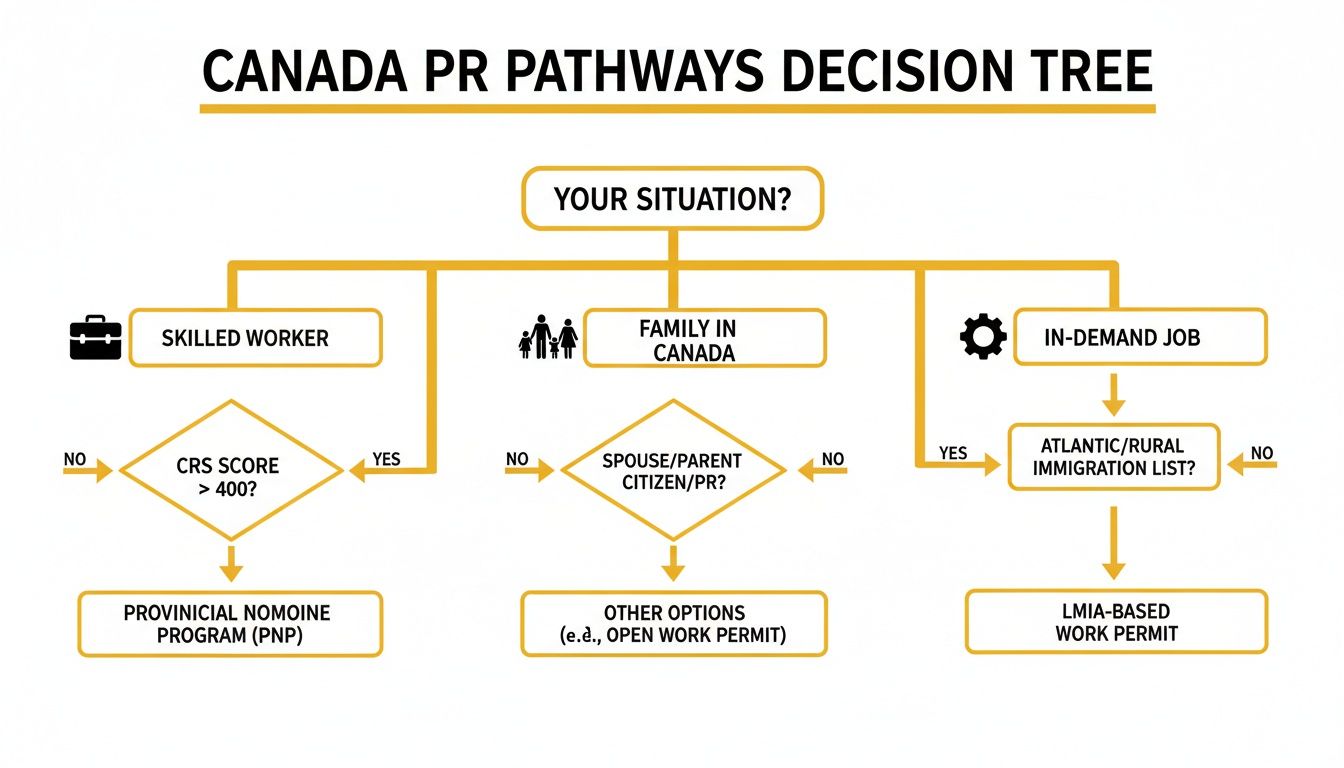
As you can see, the starting point is simple: are your strongest assets your professional skills, your family connections, or a specific job you’ve been offered?
To give you a clearer picture, here’s a quick comparison of the most common pathways people take.
Comparing Major Canadian Permanent Residence Pathways
| Pathway | Ideal Applicant Profile | Key Requirement | Primary Selection Method |
|---|---|---|---|
| Express Entry | Highly skilled professionals with strong language skills, education, and work experience. | Meeting the minimum criteria for one of the federal programs (FSWP, FSTP, CEC). | Comprehensive Ranking System (CRS) score and regular invitation rounds. |
| Provincial Nominee Program (PNP) | Workers with skills and experience that meet a specific province’s labour market needs. | A valid job offer or demonstrated intent to live and work in the nominating province. | Provincial nomination, which adds 600 points to an Express Entry profile or allows for a direct PR application. |
| Family Sponsorship | Spouses, partners, dependent children, parents, or grandparents of Canadian citizens/PRs. | A genuine relationship with an eligible sponsor who meets financial requirements. | Proving the relationship’s authenticity and the sponsor’s eligibility. |
| Humanitarian & Compassionate (H&C) | Individuals with compelling, exceptional reasons for needing to stay in Canada. | Demonstrating significant hardship if forced to leave Canada and strong establishment here. | Discretionary decision made by an IRCC officer based on the unique merits of the case. |
This table shows just how different the criteria and selection processes are. What works for one person is a non-starter for another.
Why Your Situation Matters Most
Your personal profile is everything. For example, a software developer with a master’s degree and top-tier English scores is a prime candidate for Express Entry. But a construction manager with a solid job offer in the GTA might have a much faster and more certain path through the Ontario Immigrant Nominee Program (OINP).
The key takeaway is this: stop looking for the “easiest” pathway and start searching for the “right” pathway for you. Aligning your profile with a program’s specific criteria from day one dramatically increases your odds of success.
It’s also crucial to understand that Canada’s immigration targets directly influence your application. The government sets annual goals for new permanent residents, which affects how many people are accepted into each program. Recently, there has been a major push to transition temporary residents already in Canada to permanent status. This trend underscores the immense value of getting Canadian work experience first.
For many applicants, securing a work permit is a powerful stepping stone toward permanent residence. If you’re considering this two-step approach, you can explore the different options in our guide to Canadian work visa types.
Mastering Economic Immigration Through Express Entry and PNPs
For skilled professionals around the world, Canada’s economic immigration programs are often the most direct path to a new life here. The cornerstone of this system is Express Entry, an online portal that manages applications for three major federal programs built for people with in-demand skills and work experience.
It helps to think of Express Entry less as a direct application and more as a sophisticated matching system. You begin by creating a detailed profile showcasing your qualifications. From there, the Canadian government invites the highest-ranking candidates in the pool to officially apply for permanent residence. It’s a competitive environment where every single point matters.
Your position in the pool is decided by the Comprehensive Ranking System (CRS). This system assigns you a score based on a handful of core factors, and understanding how these points are tallied is your first step toward building a profile that stands out.
Decoding the Comprehensive Ranking System
Your CRS score is what drives your entire Express Entry journey. While the formula behind it can seem complex, the points are awarded based on a very clear set of criteria. Your main objective is to maximize your score in every possible category to clear the bar in the regular invitation rounds.
The key components of your CRS score break down like this:
- Core Human Capital: This is where the bulk of your points come from. It looks at your age, education level, official language skills in English or French, and any Canadian work experience you have.
- Spouse or Common-Law Partner: If you’re applying with a partner, their education, language abilities, and Canadian work history can also add valuable points to your combined score.
- Skill Transferability: This section rewards powerful combinations of skills. For instance, having high language scores paired with a post-secondary degree, or foreign work experience matched with excellent language skills.
- Additional Points: This is where you can get a game-changing boost. Huge points are awarded for securing a provincial nomination, having a valid Canadian job offer, completing studies in Canada, or having a sibling who is a citizen or permanent resident.
A common pitfall we see is applicants underestimating the incredible impact of their language scores. Hitting a Canadian Language Benchmark (CLB) level of 9 or higher doesn’t just add a few points; it unlocks a cascade of extra points in the skill transferability section. It’s a powerful compounding effect that can dramatically increase your total CRS score.
For anyone serious about economic immigration, proving strong language skills is non-negotiable. It’s worth exploring the best ways to learn a new language to get ready for your official tests. Maximizing this one area is often the single most effective strategy for climbing the rankings.
The Power of Provincial Nominee Programs
While Express Entry is managed at the federal level, the provinces and territories have a massive say through their Provincial Nominee Programs (PNPs). These programs empower them to nominate people who have the specific skills and work experience their local economies desperately need.
For anyone hoping to settle in the Greater Toronto Area, the Ontario Immigrant Nominee Program (OINP) is an essential pathway to understand. The OINP has multiple streams, some of which are directly linked to the federal Express Entry system. If you’re in the Express Entry pool and receive a “Notification of Interest” from Ontario, a successful nomination will grant you an extra 600 CRS points. This is a golden ticket—it all but guarantees you’ll get an Invitation to Apply (ITA) for permanent residence in the next draw.
Other OINP streams work completely outside of Express Entry, offering direct routes for people with specific job offers or graduates from Ontario universities.
It’s also crucial to understand that having temporary status in Canada is a huge advantage. The government has a clear strategy of transitioning temporary residents to permanent ones, dedicating a large number of PR spots to those with Canadian work or study experience. Programs like the Canadian Experience Class (CEC) and specific OINP streams are built for this very purpose. This “two-step” immigration process often provides a clearer and faster path to PR for those already contributing to the Canadian economy.
Actionable Tips for a Stronger Profile
Knowing the system is one thing, but using that knowledge strategically is what gets results. Here are a few practical tips drawn from our experience helping clients across the GTA and throughout Ontario.
- Get Your ECA Done Yesterday: An Educational Credential Assessment (ECA) is a must for most economic streams. It’s an official report that confirms your foreign degree or diploma is equivalent to a Canadian one. This process can take months, so it should be the very first thing on your to-do list.
- Time Your Language Tests Strategically: Your language test results (IELTS or CELPIP for English; TEF or TCF for French) are only valid for two years. You need to plan this carefully so they don’t expire while your profile is active or while your application is being processed. Never hesitate to retake a test to bump up your score—even a small improvement can be the difference-maker.
For a complete breakdown of how to build your profile and gather your documents, take a look at our detailed guide on how to apply for Express Entry in Canada. It walks you through the entire process, step by step.
Sponsoring Loved Ones Through The Family Class
Bringing your family to Canada is a cornerstone of our immigration system, and the Family Class sponsorship programs are designed to do just that. Unlike the economic streams that focus on skills and work experience, this pathway is built entirely on the principle of family reunification. It allows Canadian citizens and permanent residents to sponsor their closest relatives to come and build a new life with them here.
In our practice, especially around the Greater Toronto Area, the most frequent applications we handle are for sponsoring a spouse, common-law partner, or dependent children. The entire success of these applications comes down to one critical thing: proving your relationship is genuine to the satisfaction of Immigration, Refugees and Citizenship Canada (IRCC). Forget about points systems; here, the authenticity of your bond is what matters most.
Who Can Sponsor and Who Can Be Sponsored
Before you even think about forms and photos, we need to make sure you, the sponsor, tick all the right boxes. This is the first gate your application has to pass through.
To be an eligible sponsor, you absolutely must:
- Be at least 18 years old.
- Hold status as a Canadian citizen, a permanent resident of Canada, or a person registered as an Indian under the Canadian Indian Act.
- Be living in Canada (or be a citizen able to prove you’ll return as soon as your loved one’s PR is approved).
- Be willing to sign a legal undertaking—a promise to financially support the person you’re sponsoring for a specific length of time.
Of course, the person you’re sponsoring has to be an eligible relative. This might sound simple, but the definitions IRCC uses are incredibly specific. For instance, a common-law partner isn’t just someone you’ve dated for a long time. It’s someone you’ve lived with in a marriage-like relationship for a minimum of 12 straight months. That consecutive detail is crucial.
Proving Your Relationship Is Genuine
This is where the real work begins, and frankly, where many applications fall short. IRCC officers are trained to spot “relationships of convenience”—partnerships created just for immigration purposes. Your task is to build a case file so strong and convincing that it leaves no room for doubt about the authenticity of your relationship.
Think of your application not as paperwork, but as the story of your relationship. You’re painting a picture for the officer, using a rich tapestry of evidence to show how your lives are completely intertwined, both emotionally and financially. A marriage certificate and a handful of vacation photos just won’t cut it.
I always advise clients to document the entire history of their relationship. We can organize the proof into a few key areas to make the case as clear and compelling as possible.
- Financial Interdependence: This is powerful evidence. We’re talking about joint bank account statements, shared credit cards, rental agreements or property deeds with both names, and life insurance policies that name each other as the beneficiary.
- Proof of Cohabitation: For common-law applications, this is non-negotiable. You need to gather things like shared utility bills (hydro, gas, internet), driver’s licences showing the same address, and any official mail sent to both of you at home.
- Communication Records: Show the officer how you keep your relationship alive, especially if you’ve had to spend time apart. Compile samples of your text messages, email chains, and call logs that demonstrate a consistent, ongoing connection.
- Social Recognition: You need to show that the world sees you as a couple. Letters of support from parents, siblings, or close friends can be incredibly effective. Add in photos from family gatherings, weddings you attended together, and travel itineraries from your trips.
The financial undertaking you sign is a serious legal contract. If you sponsor a spouse or partner, you are on the hook financially for three years after they become a permanent resident. For a dependent child, that commitment can last for 10 years or until they turn 25. This means if they receive provincial social assistance during that time, you are legally required to pay it back.
Getting a handle on the various steps and how long it all takes can be a challenge. You can get a better sense of what to expect by looking into the typical family sponsorship processing times in Canada, as these can shift based on the specific relationship and where the applicant is living.
Building Your Application Package: Getting it Right the First Time
You’ve navigated the maze of immigration programs and found the one that fits. Fantastic. Now comes the part where precision is everything: assembling your application package. Think of it less like filling out forms and more like building a legal case for your future in Canada.
This is where so many applications stumble. A single missing signature, a document that’s expired by a few days, or a tiny inconsistency between your forms can bring the whole process to a screeching halt. Immigration, Refugees and Citizenship Canada (IRCC) isn’t looking for “mostly correct”—they need “perfect.” Every detail you provide has to be spot-on from the moment they open your file.
The Must-Haves: Your Core Documents
No matter which path you’re taking to permanent residence, a handful of documents are non-negotiable. It’s smart to start gathering these right away, as some can take weeks, or even months, to get your hands on.
Here’s what you’ll almost certainly need:
- Identity and Civil Status Documents: This includes your passport, birth certificate, and if they apply to you, marriage certificates, divorce papers, or legal name change documents. Double-check that your passport has plenty of validity left—you don’t want it expiring mid-application.
- Police Certificates: This one catches a lot of people by surprise. You need a police clearance from every single country where you’ve lived for six months or longer consecutively since you turned 18. The time it takes to get these can vary wildly, so start this process early.
- Medical Examination: You can’t just go to your family doctor. An IRCC-approved panel physician has to conduct your immigration medical exam. They send the results directly to IRCC, but you’ll need to include the proof of completion in your package.
Getting these three things right is the bare minimum. If any are missing or incorrect, your application will likely be sent back without even being reviewed.
Backing It Up: The Supporting Evidence
Beyond the basics, you have to prove you meet the specific criteria for your chosen program. This is where you connect the dots for the immigration officer and show them why you’re a great candidate.
If you’re applying through an economic stream like Express Entry, for example, your evidence needs to be rock-solid.
- Proof of Funds: You’ll need to show you have enough money to support yourself and your family when you arrive. This can’t be money you owe someone. Expect to provide official letters from your banks that detail your account history and confirm the funds are readily available.
- Employer Reference Letters: A simple “John Doe worked here” letter won’t cut it. IRCC has a very specific list of what they need to see: your job duties, hours worked per week, salary, and employment dates, all printed on official company letterhead. A vague letter is a major red flag.
- Language Test Results: Your scores from an approved test like IELTS or CELPIP are mandatory. Make sure the test is still valid when you submit your application, as they do expire.
One of the most common tripwires we see is inconsistent information. A job title on your reference letter that doesn’t perfectly match what you put in your Express Entry profile can raise questions. Your goal is to create a perfectly aligned, crystal-clear narrative for the immigration officer.
How to Submit: Online vs. Paper
These days, almost all Canadian immigration applications are submitted online through the official IRCC portal. There’s a good reason for this—it’s faster, you get an immediate confirmation that it’s been received, and it’s much easier to track your application’s status.
While a few niche programs might still use paper applications, it’s becoming rare. Going the paper route introduces risks like postal delays, the chance of documents getting lost, and generally longer wait times just to get your file into the system.
For nearly everyone applying from the GTA and across Ontario, the online portal is the way to go. Take some time to get familiar with its requirements for uploading documents, like the specific file sizes and formats, before you’re ready to submit.
Putting together a bulletproof application is a demanding job. If you’re feeling overwhelmed by the paperwork or just want a second set of expert eyes on your file, getting professional advice is a smart move. You can learn more about how a legal expert can help by looking into an immigration lawyer near you offering a free consultation. That one step can make all the difference and give you invaluable peace of mind.
After You Submit: Navigating The Final Steps
Hitting the ‘submit’ button on your permanent residence application feels like the finish line, but it’s really the start of a whole new race. The next phase is all about waiting, watching, and responding. Knowing what’s happening behind the curtain at Immigration, Refugees and Citizenship Canada (IRCC) can make all the difference in managing the anxiety and ensuring you’re ready for whatever comes next.
This isn’t a time to sit back and relax. You need to stay engaged and informed to get your application over the line.
What to Expect Right After You Apply
Once your application is in the system, the first piece of mail you’ll get is the Acknowledgment of Receipt (AOR). This is an automated email from IRCC confirming they have your file. Think of it as your official ticket into the queue. Most importantly, it contains your unique application number, which you’ll need for everything from tracking your status to any future communication with IRCC.
Soon after, a Biometric Instruction Letter (BIL) will likely land in your inbox. This isn’t optional—it’s a mandatory step. You’ll need to schedule an appointment at a specific Service Canada centre to provide your fingerprints and have your photo taken. You only have 30 days from the date on the letter to get this done, so don’t put it off.
When IRCC Asks for More Information
It’s actually quite common for an IRCC officer to send a request for more information or clarification. This often comes in the form of a Procedural Fairness Letter. They might need an updated police check, or maybe they have questions about a specific job you listed in your work history.
How you handle this request is absolutely critical.
- Move Fast: You’ll be given a strict deadline, usually 30 or 60 days. If you miss it, you’re looking at an almost certain refusal.
- Be Precise: Read the letter multiple times. Provide exactly what they’re asking for, down to the last detail and format.
- Tell the Story: Don’t just dump documents on them. If the situation is complex, write a clear, concise letter of explanation to give the officer context. Make their job easy.
A request for more information isn’t a red flag. It’s actually a good sign. It means a real person is working on your file and giving you the chance to make it stronger. A lazy, late, or incomplete response is the fastest way to turn a minor issue into a major problem.
Common Reasons for Application Refusal
Knowing why applications get refused is your best defence. While every case has its own quirks, most rejections boil down to a few common mistakes.
The big one is misrepresentation. This is a very serious offence and includes providing false information or leaving out important details—even if you do it by accident. Something as simple as not mentioning a previous visa refusal from another country can lead to a five-year ban on applying to Canada.
Another common pitfall is failing to maintain eligibility. You have to meet the program requirements from the day you apply until the day a decision is made. For instance, if you’re an Express Entry candidate and your language test scores expire while you’re still in the queue, your application could be tossed out. A change in your job could also make you ineligible for the PNP stream you applied under.
If you’re waiting in Canada on a work permit that’s about to expire, it’s crucial to maintain your legal status. Our detailed guide on Bridging Open Work Permit eligibility can show you how to keep working legally while you wait for that final decision.
The Final Stretch: Your COPR and Landing
After what can feel like an eternity, the email you’ve been dreaming of finally arrives. It’s a portal request for your final details and photo, which leads to the issuance of your Confirmation of Permanent Residence (COPR). This document is the golden ticket—your official proof that you’ve been approved to become a permanent resident.
Your COPR comes with an expiry date, and you have to officially “land” before that date. For most people already in Canada, this is now a simple virtual process through an online IRCC portal. You just confirm you’re in the country, upload a recent photo, and IRCC finalizes your status and mails out your very first PR card.
This is the moment all your hard work pays off, officially marking the end of your application journey and the beginning of your new life in Canada.
Answering Your Top Questions About Applying for Permanent Residence
The path to permanent residence is paved with intricate rules and deadlines, so it’s completely normal to have a lot of questions. Drawing from our years of experience helping clients from Burlington and across the GTA, we’ve put together some straightforward answers to the questions we hear most often.
Getting clear, reliable information is the first step toward making smart decisions and tackling your application with confidence. Let’s dive into some of the key concerns that come up time and time again.
Can I Apply For PR While On A Visitor Visa?
This is probably one of the most common questions we get, and the short answer is usually no. A visitor visa (or a visitor record) is for temporary stays in Canada and, on its own, doesn’t offer a direct route to permanent residence.
But that doesn’t mean it’s a dead end. Being in Canada as a visitor can actually be a smart strategic move. For instance, it puts you on the ground where you can network, interview, and hopefully land a genuine job offer. That offer could be the key that unlocks a program like the Ontario Immigrant Nominee Program (OINP), which then becomes your actual pathway to applying for PR.
What Happens If My Work Permit Expires While My PR Application Is Processing?
This is a make-or-break situation that you absolutely must get ahead of. If you’ve already submitted your PR application under one of the economic streams and have your Acknowledgment of Receipt (AOR), you’re likely eligible for a Bridging Open Work Permit (BOWP).
A BOWP is a lifeline—it lets you continue working legally in Canada while you wait for the final word on your PR application. The catch? You need to apply for it before your current work permit expires, and your permit should have less than four months of validity remaining.
Never let your status lapse. Your legal standing in Canada is everything during this process. An expired work permit can derail your entire immigration dream, even if your PR application is otherwise perfect. Always, always plan ahead.
How Much Money Do I Really Need For Proof Of Funds?
The magic number for settlement funds (what immigration officials call proof of funds) changes every year and is set by the federal government. The amount you need depends on the size of your family, and this includes your spouse and children, even if they aren’t coming to Canada with you.
For 2024, a single applicant without dependents needs to show they have $14,690 in available funds.
This can’t be money you’ve borrowed. It has to be yours, free and clear, and available to you at a moment’s notice. IRCC will ask for official bank letters and a six-month history of your accounts to prove the funds haven’t just appeared overnight. They need to see that the money has been stable and is genuinely yours.
Will A Minor Criminal Charge Affect My Application?
Yes, it absolutely can, and this is a point many people underestimate. Canada’s inadmissibility rules are incredibly strict. Any criminal conviction, no matter how minor it seems in your home country, could make you ineligible to become a permanent resident. A common example we see is a DUI (driving under the influence), which is treated as a serious crime here.
If you have any kind of criminal record, you’ll likely need to go through a separate, often lengthy, process to apply for criminal rehabilitation or be deemed rehabilitated by an officer. Honesty is non-negotiable. Hiding a past charge is misrepresentation, a serious offence in Canadian immigration that comes with severe consequences, including a multi-year ban from Canada.
As you plan your big move, it’s also smart to think about the practical side of life here, like looking into health insurance options for expatriates in Canada, since you might face a waiting period for provincial health coverage after you arrive.
Working through the maze of a permanent residence application takes meticulous planning and a solid grasp of Canadian immigration law. At UL Lawyers, our Burlington, Ontario-based team serves the entire GTA and beyond, providing the expert guidance needed to build a powerful application. We help you move confidently toward your goal of making Canada your permanent home. Contact us today for a consultation.
Related permanent residence resources
If you are deciding which immigration path applies to you, these pages may help narrow the next step:
- Express Entry application steps — for applicants applying through Express Entry.
- Canada PR card renewal requirements — for permanent residents renewing proof of status.
- Immigration law services — service overview for application strategy, refusals, and complex files.
- Immigration lawyer consultation — resource for deciding when legal advice is useful.