Related service
AD&D claim review
When an insurer disputes whether a loss qualifies under an accidental death policy, we review the policy wording and evidence to clarify your rights.
Review an AD&D decisionLegal Guidance

When you first learn the details of a loved one’s will and something feels fundamentally wrong, it’s a difficult and often emotional moment. Perhaps the will doesn’t at all reflect the promises they made or the person you knew them to be. While that feeling is valid, launching a formal challenge in Ontario requires moving from emotion to strategy. It’s about taking clear, procedural steps to safeguard your rights and, ultimately, honour what you believe were the true wishes of the person who passed away.

So, where do you begin? The absolute first question you need to answer is whether you even have the legal right to bring a challenge forward. In the legal world, we call this having “standing.”
Not everyone who disagrees with a will can contest it. Ontario’s courts are quite specific about this, limiting the right to people with a direct, legitimate financial interest in the estate. Simply being a lifelong friend or feeling the will is unfair, unfortunately, won’t be enough to get you in the door.
Generally, the people who have standing are:
Figuring out which of these categories you fall into is the crucial first piece of the puzzle. If you’re not on this list, you likely can’t proceed.
Once you’ve confirmed you have standing and you’re convinced there are legitimate grounds for a challenge, you need to act. And you need to act fast. The estate administration process doesn’t wait around, and your opportunity to intervene is limited.
The single most important thing you can do right now is stop the estate from being distributed before your case is heard.
You do this by filing a Notice of Objection with the Ontario Superior Court of Justice. This document is a powerful tool. It effectively hits the pause button on the probate process—that’s the court procedure that officially validates a will and gives the estate trustee the authority to act. Filing the notice alerts the court and the person trying to become the estate trustee that there’s a serious dispute, legally preventing them from touching or distributing any of the estate’s assets.
Key Takeaway: Think of a Notice of Objection as your formal red flag to the entire court system. It creates a temporary but critical barrier, preserving the estate’s assets while the will’s legitimacy is properly investigated. If you don’t file it, the estate trustee could get appointed and start giving away property, which becomes incredibly difficult and expensive to claw back later.
This isn’t the time to wait and see what happens. Your next call should be to a lawyer who lives and breathes estate litigation. They can quickly assess the strength of your case, make sure the Notice of Objection is filed perfectly, and help you get your hands on a copy of the will and other crucial documents. For families across Ontario, getting this specialized advice right from the start can be the difference between a successful challenge and a lost opportunity.
To get a clear picture of your legal options, it’s always best to connect with an experienced estate litigation lawyer who can map out a path forward. Taking this step ensures your challenge begins on solid legal ground from day one.

Simply feeling a will is unfair or that you deserved a larger share isn’t enough to have it thrown out by an Ontario court. The legal system needs concrete, provable reasons—what we call “grounds”—to invalidate a document that’s presumed to be a person’s final wishes. The very first step is figuring out if your concerns actually have legal weight.
Any successful will challenge has to be built on a solid legal foundation. This means you and your lawyer need to pinpoint the specific ground that fits your situation and then start the hard work of gathering evidence to back it up.
This is probably the most common reason wills are challenged in Ontario. Testamentary capacity is all about the will-maker’s (the “testator’s”) mental state at the exact moment they signed the will. It has nothing to do with their general intelligence or memory—it’s about a specific set of cognitive abilities.
For the will to be valid, the testator had to understand three crucial things at that time:
Someone’s mental state can fluctuate, especially with age-related conditions. The court’s focus is laser-sharp: what was their capacity on the specific day and time the will was signed? Evidence of dementia, Alzheimer’s, or other serious cognitive impairments around that period is often the core of an incapacity claim.
This argument claims the testator wasn’t acting freely. Instead, someone else used manipulation, pressure, or even threats to completely overpower the testator’s own wishes, essentially forcing them to sign a will that benefits the influencer.
This is a far cry from simple persuasion or offering advice. We’re talking about coercion so intense that the testator couldn’t fight back. When I review these cases, I always look for common red flags that suggest something is wrong.
Proving undue influence is tough because it usually happens in private. A strong case is often built by piecing together many small bits of circumstantial evidence that, together, paint a clear picture of a vulnerable person being controlled. For a deeper look into the nuances of this area, you can find more information on wills and estate law.
Ontario’s Succession Law Reform Act has very strict, formal rules about how a will must be signed and witnessed. These aren’t just suggestions; they are mandatory legal requirements designed to prevent fraud and confirm the will is genuine.
If these formalities aren’t followed to the letter, the entire will can be declared invalid. For a typical will, the process must be precise:
One small mistake in this sequence can doom the entire document. For instance, if a witness takes the will home to sign later, or if one witness steps out of the room before the other one signs, the will is likely invalid.
A Real-World Scenario: Picture a son in Burlington helping his aging father with an online will kit. His father signs it at the kitchen table as one neighbour looks on. The next day, the son takes the will to the other neighbour’s house to get the second signature. Everyone meant well, but that will is invalid. The law in Ontario requires the testator and both witnesses to be in the same room, at the same time, for the signing process.
These grounds are less frequent but extremely serious. A will can be challenged for fraud if you can prove the testator was tricked into signing it—for example, being told it was just a power of attorney. A forgery claim means the signature on the will isn’t the testator’s at all.
Both fraud and forgery require powerful, direct evidence. This often means bringing in handwriting experts to analyze signatures or finding witnesses who can testify directly about the deception. Identifying the right grounds for your situation is the critical first move in deciding how to proceed with a will contest.
So, you’ve established solid grounds to contest a will. What’s next? The action moves into the formal setting of the Ontario Superior Court of Justice. This can sound daunting, but it’s really a structured process with clear stages. Knowing the roadmap ahead is crucial for managing your expectations and building a strong case.
This visual gives you a snapshot of the first moves you’ll need to make to get your challenge in front of a judge.
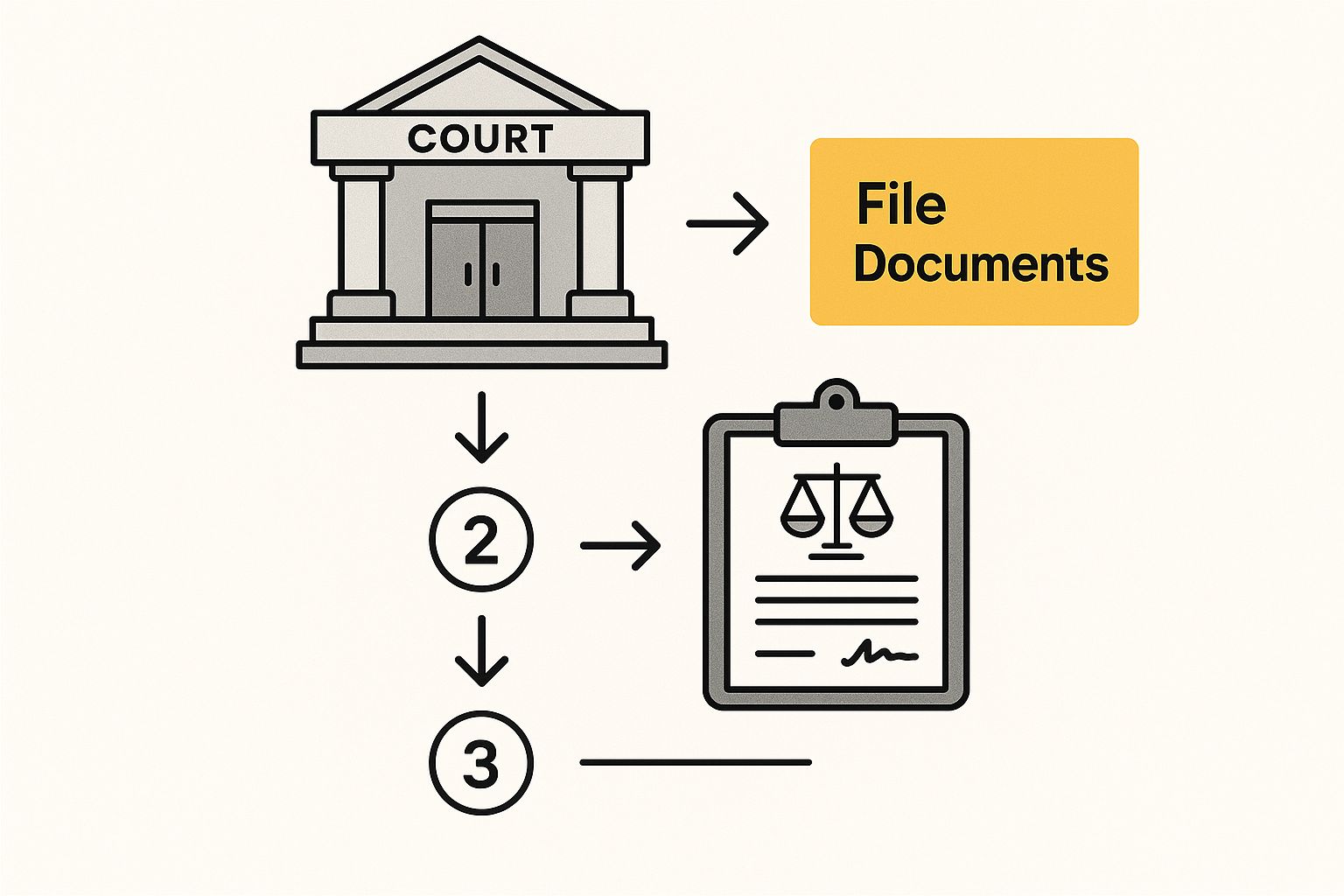
As you can see, kicking things off involves preparing and filing specific legal documents that state your claim clearly and formally.
After filing a Notice of Objection to press pause on the estate administration, your next move is to officially launch the court proceeding. This is done by issuing a Notice of Application. Think of this document as the formal announcement of your case—it lays out the grounds for your challenge and tells the court exactly what you’re asking for.
Let’s imagine a family from Burlington suspects their elderly mother was pressured by a new caregiver who, surprisingly, is now the sole beneficiary of her will. Their lawyer would draft a Notice of Application arguing the will is invalid due to undue influence. The application would ask the court to toss out the new will and recognize a previous, valid one instead. This document is then formally delivered (or “served”) to everyone with a stake in the outcome, including the estate trustee named in the will you’re contesting.
With the legal wheels in motion, the case enters the discovery phase. This is arguably one of the most important stages. It’s where both sides are required to lay their cards on the table, exchanging all the information and evidence relevant to the dispute. The whole point is to make sure there are no last-minute surprises if the case proceeds to a hearing.
This phase usually involves a couple of key steps:
It’s often during discovery that the true strengths and weaknesses of a case come to light. For instance, during questioning, the caregiver might not have a credible explanation for why the mother suddenly disinherited her children just weeks after the caregiver started managing her bank accounts.
A Note from Experience: Don’t think of discovery as a search for a single “smoking gun.” It’s about the slow, methodical work of building a compelling story. You’re assembling a factual puzzle, piece by piece, using documents and sworn testimony to support your legal position.
Before a dispute ever sees the inside of a courtroom for a trial, most estate matters in Ontario must go through mandatory mediation. This is a confidential meeting where a neutral professional—the mediator—sits down with both sides to help them negotiate a resolution.
Mediation can be incredibly powerful. It allows for flexible, creative solutions that a judge might not have the power to order. More importantly, it gives families a chance to resolve their issues in a less combative environment, which can save a tremendous amount of money, time, and emotional energy. If an agreement is reached, it’s formalized in a settlement that legally ends the dispute.
If you want to understand more about the court’s role in estate matters, our guide on how to probate a will in Ontario provides some excellent background on related procedures.
Of course, if mediation doesn’t lead to a resolution, the final stop is a formal court hearing or trial. At that point, a judge will review the evidence, hear the arguments, and make a final, binding decision on the will’s validity.
Your challenge to a will is only as strong as the evidence you bring to court. A judge in Ontario won’t set aside a will based on your gut feeling or suspicions; they need to see credible, concrete proof. This is where the process shifts from simply identifying the grounds for a challenge to methodically building the case to prove it.
Think of it less like finding a single “smoking gun” and more like weaving a tapestry. You’re collecting different threads of evidence—medical records, financial statements, personal accounts—that, when presented together, create a clear and compelling picture for the court.
If you’re arguing the will-maker lacked testamentary capacity, your entire focus needs to be on their state of mind when they signed the document. The most compelling evidence almost always comes from medical and healthcare sources.
Your legal team will focus on obtaining:
Imagine this scenario: a signed affidavit from a long-time neighbour in the GTA describes how the deceased was frequently confused about what year it was. When you pair that with a doctor’s diagnosis of moderate dementia from the same period, you have a very persuasive argument.
Proving undue influence is a different beast altogether, mostly because this kind of manipulation happens behind closed doors. The evidence here is usually circumstantial, which means you have to build a case by showing a pattern of suspicious behaviour and control.
You’ll need to look for evidence that points to manipulation:
An experienced estate lawyer knows exactly where to look. They can help you request specific financial records, interview key witnesses, and piece together a timeline that demonstrates how a vulnerable person’s free will was systematically overpowered.
Never underestimate what other people saw and heard. Statements from individuals who had regular contact with the deceased can provide invaluable context and support for your claims, no matter what your specific legal grounds are.
Cast a wide net when thinking about who might have useful information:
Pulling all this together can feel overwhelming, especially when you’re also grieving. This is why working with a skilled estate litigation lawyer is so critical. They not only know what evidence will be most compelling to a judge but also have the legal tools to formally request documents you can’t get on your own.
For those looking to get their own affairs in order, our estate planning checklist for Canada can give you a better sense of the kinds of documents that often become central in these disputes.
Challenging a will is a serious undertaking. It’s not just a legal battle; it’s a significant financial and emotional commitment. Before you dive in, it’s absolutely essential to have a frank conversation about the potential costs and how long this journey might take. This isn’t to discourage you, but to ensure you go in with your eyes wide open.
Let’s be clear: estate litigation in Ontario is rarely cheap. The final bill can swing wildly depending on how complex and contentious things get, but understanding where the money goes is the first step in preparing yourself.
When you start a will challenge, the costs are more than just what you pay your lawyer. A whole range of expenses can pop up along the way, and you need to be ready for them.
Here’s what you’re typically looking at:
The way your lawyer charges for their work has a huge impact on your budget. In Ontario, the most common model you’ll see in estate litigation is the hourly rate. Your lawyer meticulously tracks their time—often in six-minute increments—for every phone call, email, and document they draft.
A contingency fee agreement, where the lawyer takes a percentage of what you win, is less common in this area of law compared to, say, personal injury. It’s not impossible, but it’s usually only an option when there’s a straightforward fight over a specific sum of money.
A Crucial Point on Costs: Ontario operates under a “loser pays” system. This doesn’t mean the person who loses the case has to pay 100% of the winner’s legal bills. It means the court can order the unsuccessful party to pay a significant chunk of them, what we call “partial indemnity costs.” This rule exists to discourage people from launching frivolous claims and to push both sides toward a reasonable settlement.
“So, how long is this going to take?” It’s usually the first question I get, and the honest-to-goodness answer is always the same: it depends. The timeline for a will contest can be anywhere from a few months to, unfortunately, several years.
If you have a fairly straightforward case—maybe the will wasn’t signed correctly in front of two witnesses—it’s possible to resolve it through negotiation or mediation within six to twelve months. But I have to tell you, most cases aren’t that simple.
A more heated dispute, one involving accusations of undue influence with multiple family members and complex financial records, can easily stretch out for two to three years, or even longer, before you see a final resolution. Court backlogs, scheduling conflicts for examinations, and back-and-forth settlement talks all add delays. You have to prepare for a marathon, not a sprint.
The journey of an estate dispute is rarely a straight line. Many different elements can either speed things up and save money, or drag them out and drive up costs. The table below breaks down some of the most common factors I see in my practice.
| Case Factor | Potential Impact on Timeline | Potential Impact on Cost |
|---|---|---|
| Cooperation Level | When everyone is reasonable and cooperative, you get faster resolutions with fewer court dates. | More cooperation simply means fewer billable hours and lower legal fees for everyone involved. |
| Case Complexity | A simple issue like improper signing gets resolved much faster than a deep dive into undue influence. | Complex cases demand more investigation, more documents, and sometimes pricey expert witnesses, all of which drive up costs. |
| Number of Parties | The more beneficiaries or family members involved, the harder it is to schedule everything and get everyone to agree. | More parties often means more lawyers. This can dramatically increase the time and expense of every single step. |
| Willingness to Mediate | A genuine effort to settle at mediation can wrap up the entire dispute in a single day. | Reaching a settlement through mediation is always far, far less expensive than going through a full-blown court hearing. |
Ultimately, having a realistic grasp of these factors from the start helps you make strategic decisions and manage your own expectations as the case unfolds.
When you’re thinking about contesting a will, it’s natural to have a lot of questions. The uncertainty can be overwhelming. Families across Ontario, from Burlington to the GTA, often find themselves asking the same things. Getting straight answers is the first step to figuring out your path forward.
Let’s break down some of the most common questions we hear from clients every day.
Absolutely. Being completely disinherited doesn’t automatically prevent you from challenging a will in Ontario. The real question is why you’re challenging it and what your relationship was to the person who passed away.
For instance, a spouse or a dependant has specific rights under Ontario’s Succession Law Reform Act to claim support from the estate, no matter what the will says. For others, like an adult child who has been cut out, you can still challenge the will’s basic validity.
Your challenge has to be built on solid legal grounds, such as:
The key takeaway is this: your claim must be about the legitimacy of the will itself, not just that you feel the distribution was unfair.
This is a critical point, and the answer isn’t a simple calendar date. While Ontario doesn’t have a strict, black-and-white limitation period for challenging a will’s validity, you absolutely cannot afford to wait. Time is not on your side.
The most important deadline is a practical one: the court issuing a Certificate of Appointment of Estate Trustee. Most people know this as probate. Once the court grants this certificate, the estate trustee has the green light to start paying bills and handing out assets to the beneficiaries.
Waiting until after probate is granted makes a will challenge immensely more difficult and costly. By then, the assets might already be distributed, and trying to get them back is an uphill battle. To protect your rights, you need to act fast by filing a Notice of Objection before it’s too late.
So, you’ve successfully challenged the will, and the court has declared it invalid. What happens next depends entirely on whether there’s an older, valid will sitting in a file somewhere.
There are really only two possible outcomes.
If a previous, legally sound will exists, the court essentially brings it back to life. The estate will then be divided up according to the instructions in that older will, just as if the invalid one was never created.
But if there isn’t another valid will, the law considers the person to have died “intestate.” When that happens, Ontario’s intestacy rules from the Succession Law Reform Act kick in. These laws lay out a rigid, non-negotiable formula for splitting the estate among the surviving spouse, children, and other relatives.
For more in-depth answers, feel free to check out our comprehensive estate law FAQ page, where we cover a wider range of common concerns.
Walking through the complexities of a will challenge is tough, and it’s not something you should do alone. At UL Lawyers, we get the emotional and financial strain this puts on a family. We’re here to offer the compassionate and skilled support you need. If you have reason to believe a loved one’s will is not valid, get in touch with us for a consultation to protect your rights.
Frequently Asked Questions
When you're thinking about contesting a will, it's natural to have a lot of questions. The uncertainty can be overwhelming. Families across Ontario, from Burlington to the GTA, often find themselves asking the same things. Getting straight answers is the first step to figuring out your path forward.
Absolutely. Being completely disinherited doesn't automatically prevent you from challenging a will in Ontario. The real question is why you're challenging it and what your relationship was to the person who passed away. For instance, a spouse or a dependant has specific rights under Ontario's Succession Law Reform Act to claim support from the estate, no matter what the will says. For others, like an adult child who has been cut out, you can still challenge the will's basic validity. Your challenge has to be built on solid legal grounds, such as: The key takeaway is this: your claim must be about the legitimacy of the will itself, not just that you feel the distribution was unfair.
This is a critical point, and the answer isn't a simple calendar date. While Ontario doesn't have a strict, black-and-white limitation period for challenging a will’s validity, you absolutely cannot afford to wait. Time is not on your side. The most important deadline is a practical one: the court issuing a Certificate of Appointment of Estate Trustee. Most people know this as probate. Once the court grants this certificate, the estate trustee has the green light to start paying bills and handing out assets to the beneficiaries.
So, you've successfully challenged the will, and the court has declared it invalid. What happens next depends entirely on whether there's an older, valid will sitting in a file somewhere. There are really only two possible outcomes. If a previous, legally sound will exists, the court essentially brings it back to life. The estate will then be divided up according to the instructions in that older will, just as if the invalid one was never created. But if there isn't another valid will, the law considers the person to have died "intestate." When that happens, Ontario's intestacy rules from the Succession Law Reform Act kick in. These laws lay out a rigid, non-negotiable formula for splitting the estate among the surviving spouse, children, and other relatives. For more in-depth answers, feel free to check out our comprehensive estate law FAQ page, where we cover a wider range of common concerns. Walking through the complexities of a will challenge is tough, and it’s not something you should do alone. At UL Lawyers, we get the emotional and financial strain this puts on a family. We're here to offer the compassionate and skilled support you need. If you have reason to believe a loved one's will is not valid, get in touch with us for a consultation to protect your rights.
Relevant next step
If this guide affects probate, wills, or estate planning, get advice before you act on it.
Call 905-744-8888 or email info@ullaw.ca. Free consultation.
Related services
Related service
When an insurer disputes whether a loss qualifies under an accidental death policy, we review the policy wording and evidence to clarify your rights.
Review an AD&D decisionRelated service
A denied or delayed critical illness benefit can place unexpected financial strain on a family. We help clients understand their coverage and options.
Review a critical illness claimRelated service
When long-term disability benefits are denied or terminated, we examine the policy wording and medical evidence to identify a practical next step.
Review an LTD decisionWhy Us
Keep Reading
Hi, I'm Mira, the virtual assistant for UL Lawyers. Tell me what's going on in plain language — I'll help you understand your options and connect you with our 24/7 intake line when you're ready.
General information only — not legal advice.
General information, not legal advice. Messages may be saved to improve our service — please don't share sensitive personal details. Privacy.