Related service
AD&D claim review
When an insurer disputes whether a loss qualifies under an accidental death policy, we review the policy wording and evidence to clarify your rights.
Review an AD&D decision
Legal Guidance
So, you’re ready to create your will in Ontario. At its core, a will is a written document that lays out your final wishes. It needs to name an executor to manage everything, and you must sign it correctly in front of two valid witnesses. To be legally sound, you have to be of sound mind and over the age of majority when you create it, ensuring your assets go exactly where you want them to.

Before you start writing, it’s really important to get a handle on the legal rules that govern wills in Ontario. A will is much more than a simple list of who gets what; it’s a formal legal document with strict criteria. If you miss a step, your will could be declared invalid. Should that happen, the province decides how your estate is divided, which might be completely different from what you intended.
Think of this as building a solid foundation. Getting these basics right is the first step toward creating a document that gives your loved ones clarity and security. The rules are primarily laid out in Ontario’s Succession Law Reform Act, and they aren’t flexible.
Every will has three main roles, and it’s essential to understand what each one does so you can make smart decisions.
Choosing the right people, especially your executor, is one of the biggest calls you’ll make. It’s a job that demands a lot of trust and confidence in their ability to manage your affairs responsibly.
For a will to hold up in court, it must meet several non-negotiable conditions.
First, you (the testator) must be the age of majority, which is 18 years old in Ontario. There are some very narrow exceptions, like for members of the Canadian Forces on active service.
You also need to have testamentary capacity. This is a legal term meaning you must be of “sound mind” when you sign the will. Specifically, you need to understand:
Your will must be a true reflection of your wishes, free from any undue pressure or influence from others. If a court finds that someone coerced you into making certain decisions, that portion of the will—or even the entire document—could be invalidated.
Ontario law recognizes two main kinds of wills, and each has its own set of rules. The one you choose will likely depend on your personal situation and whether you can meet the legal formalities. You can learn more about the complexities of Ontario’s wills and estate law and how they apply to different family situations.
Here’s a side-by-side look at the two will formats to help you see the key differences at a glance.
| Feature | Formal Will (Standard) | Holograph Will (Handwritten) |
|---|---|---|
| Creation Method | Typically typed or computer-printed. | Written entirely in the testator’s own handwriting. |
| Signature | Must be signed at the end by the testator. | Must be signed at the end by the testator. |
| Witnesses Required? | Yes, two witnesses must be present. | No witnesses are required. |
| Common Use Case | The standard and most reliable method for estate planning. | Often used in emergencies or for very simple estates. |
| Potential Risks | Lower risk of being challenged if executed correctly. | Higher risk of challenges related to authenticity, interpretation, or capacity. |
A Formal Will is what most people have. It’s prepared (usually typed), then signed by you in front of two witnesses, who must also sign it right there with you.
On the other hand, a Holograph Will is one you write out entirely by hand. The critical difference is that it doesn’t need any witnesses. While this can be a lifesaver in an emergency, it’s also much easier for someone to challenge later on, arguing about whether it’s really your handwriting or what you actually meant.
Now that we’ve covered the ground rules, it’s time to get practical and start drafting your will. This is where you translate your intentions into clear, legally binding instructions. It’s about making sure your executor knows exactly what to do and your loved ones are provided for. The process is detailed, but if you approach it methodically, you can be confident that nothing—and no one—is overlooked.
The very first thing to do is a full inventory of everything you own. This isn’t just about the big-ticket items; you need to create a complete and honest picture of your estate. A detailed list is the best way to prevent confusion down the road and ensure assets don’t get lost in the shuffle.
Before you can decide who gets what, you need a crystal-clear picture of what you actually have. Your assets are everything you own that has value, and you might be surprised by the full extent of your estate once you lay it all out.
To keep things organized, we always advise clients to break it down into categories:
To make this step easier, our estate planning checklist for Canada is a great resource. It guides you through itemizing everything you own and owe, ensuring no critical details are missed.
With your asset list complete, your next job is deciding who will inherit them. These people or organizations are your beneficiaries. We can’t stress this enough: clarity here is absolutely paramount if you want to prevent disputes among your family.
You can give gifts, or “bequests,” in a few different ways:
It’s also smart to name alternate beneficiaries. Think of it as a backup plan. For instance, “I give my house to my spouse, but if my spouse does not survive me, I give it to my son.” This kind of contingency planning prevents that asset from falling back into the residue of your estate if your primary beneficiary passes away before you.
Key Takeaway: Vague wording is the enemy of a strong will. Instead of saying “I leave my jewellery to my daughters to share,” specify exactly who gets what piece. Your goal is to leave a legacy of care, not a legacy of confusion and potential conflict.
Your executor, who is officially called an estate trustee in Ontario, is the person or institution you appoint to carry out your will’s instructions. This is arguably the most critical decision you’ll make. Their job is to manage your entire estate from start to finish—a role that demands integrity, incredible organization, and a whole lot of patience.
An executor’s to-do list is extensive. They are responsible for:
When you’re thinking about who to choose, pick someone trustworthy, responsible, and who lives in Canada (preferably Ontario, to avoid legal and tax headaches). It’s often a spouse, an adult child, or a close friend. And always, always name an alternate executor in case your first choice can’t or won’t do the job.
For any parent with children under 18, this is the single most important reason to have a will in Ontario. If you and the other parent were to pass away, who would raise your kids? Your will is the only legal document where you can name a guardian.
If you don’t make this appointment, the court will decide who takes on this role, and their choice might not be what you would have wanted. Have a serious conversation with your potential guardian beforehand to make sure they are willing and able to accept this profound responsibility.
You should also set up a trust within your will for your children’s inheritance. This allows a trustee (who can be the guardian or someone else) to manage the funds for your children’s benefit until they reach a more mature age, like 21 or 25. For those looking to streamline the creation process, exploring legal document generation software can be highly beneficial, as these tools often include straightforward options for wills with trust provisions. This ensures their financial future is both secure and managed responsibly.
You’ve done the hard work of thinking through your wishes and putting them on paper. Now comes the final, crucial step: making it legally binding. Signing your will might seem like a simple formality, but this is where many DIY wills go wrong. In Ontario, the law is incredibly strict about how a will is signed and witnessed. One small mistake here can unravel everything you’ve planned.
This formal signing process, legally known as “execution,” is your final stamp of approval. It’s the legal system’s way of ensuring the document truly reflects your intentions and that you signed it free from any pressure or fraud. Getting this part right is absolutely non-negotiable.
Under Ontario’s Succession Law Reform Act, a standard will needs to be signed in the presence of two credible witnesses. This isn’t a friendly suggestion; it’s a hard-and-fast legal requirement.
The biggest pitfall to avoid is choosing the wrong people to witness your signature. It’s one of the most common—and heartbreaking—mistakes we see.
Here’s who your witnesses cannot be:
Why is this so important? If a beneficiary (or their spouse) acts as a witness, the gift to that specific beneficiary becomes void. The rest of your will might stand, but the very person you intended to provide for gets nothing. This rule exists to prevent any hint of conflict of interest or suspicion that a witness might have influenced you for their own benefit.
The law is crystal clear on the logistics. You (the person making the will, or the “testator”) and your two witnesses must all be physically in the same room, at the same time, and literally watch each other sign the will. This is the “in the presence of” requirement.
It means you can’t sign it one day and have your witnesses sign it the next. It also means you can’t have one witness in the room and another on a video call. Everyone has to be there, together, for the entire signing ceremony.
Here’s how it should play out in practice:
Pro tip: Have everyone initial the bottom of each page (except the final signature page). This simple act helps secure the document and prevents pages from being swapped out later on.
Finding two suitable people is easier than you think. You’re looking for neutral, independent adults who have nothing to gain from your will.
Think about people like:
The key is to pick reliable people who can be found years from now, just in case they’re needed to confirm the will’s validity. Remember, they don’t need to read the will or know its contents—their job is simply to confirm they saw you sign it.
This flowchart shows a similar thought process for a related, crucial decision: choosing your executor. Your choice depends heavily on your assets and the people you’re leaving them to.
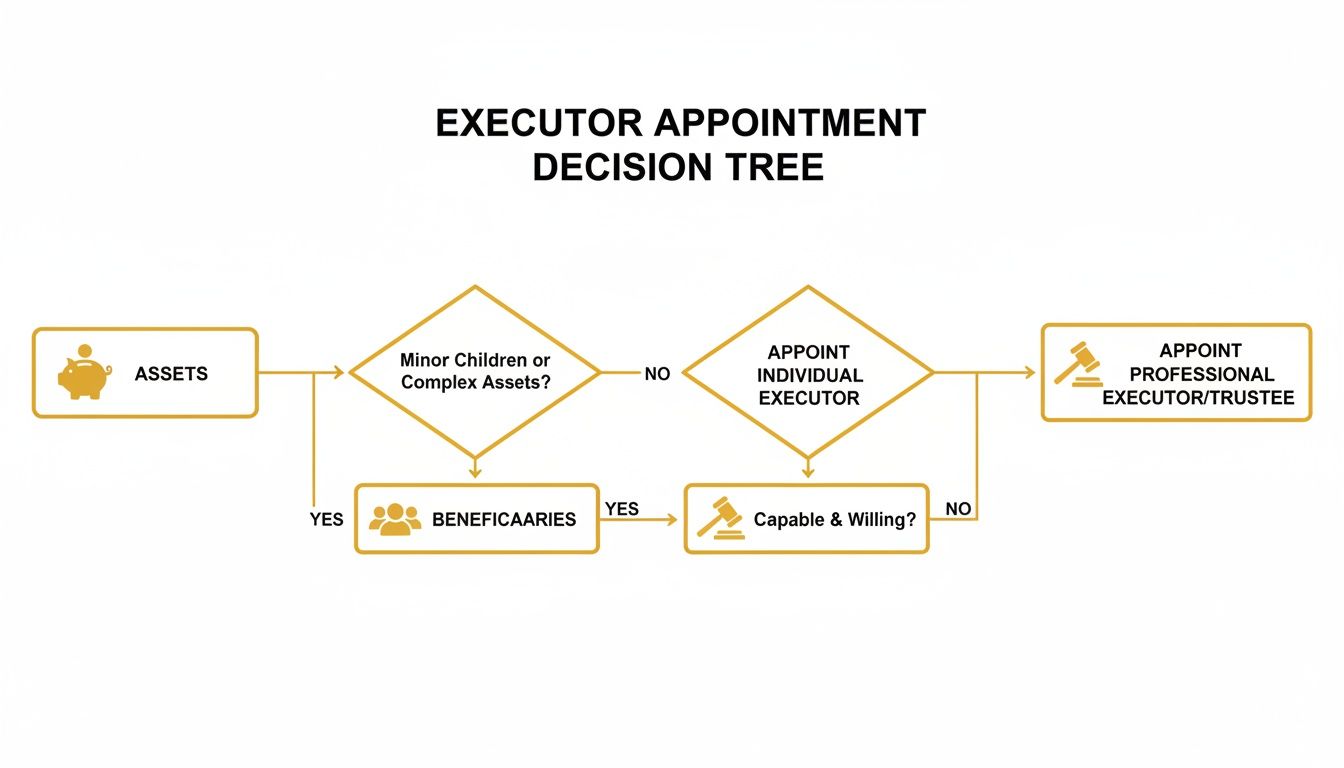 As the visual suggests, picking the right person to manage your estate is deeply connected to what you own and who your beneficiaries are.
This is one of those small steps that can make a huge difference down the road. An Affidavit of Execution isn’t technically required to make your will valid, but it’s something we strongly recommend. It’s a separate sworn statement, signed by one of your witnesses in front of a lawyer or notary public, confirming all the signing rules were followed perfectly.
Think of an Affidavit of Execution as pre-approved proof for the court. It makes the probate process infinitely smoother and faster for your executor because there’s already a sworn legal document on file confirming the will was properly signed.
Without it, your executor might have to hunt down one of the witnesses years or even decades later. If that witness has moved, forgotten the event, or passed away, it can create a massive headache and delay for your family. Taking an extra five minutes to get this affidavit signed can save your loved ones a world of time, money, and stress.

Life is messy. Our families and finances rarely fit into neat little boxes, and that’s a reality you have to face when creating your will in Ontario. You’re doing more than just listing off assets; you’re planning for real-life situations.
Whether you’re dealing with a jointly owned home in Burlington or a blended family in Toronto, a generic, one-size-fits-all will template just isn’t going to cut it. These unique circumstances demand careful thought to create a will that’s not only legally sound but also clear and fair to everyone involved. Getting this right is the key to preventing conflict down the road.
Let’s walk through how to tackle some of the most common complexities.
For most Ontarians, their home is their biggest financial asset. But what many people don’t realize is that how you own that property completely changes how it’s handled in your will. It’s a critical detail that can lead to some very unexpected outcomes if ignored.
In Ontario, there are two main ways to co-own property:
This distinction is massive. If you own your house as a joint tenant with your spouse, you can’t leave “your half” to your kids in your will. By law, it’s going directly to your spouse.
Adding another wrinkle is the ever-changing housing market. With Ontario’s market facing volatility, property values can shift significantly. This makes it crucial to keep your estate plan current to ensure the division of your assets still makes sense and reflects their real value.
Blended families are more common than ever, bringing together children from different relationships. Your will is the single best tool you have to make sure everyone is treated fairly and your wishes are honoured, but it takes careful planning to avoid hurt feelings and friction.
A frequent worry is how to provide for a new spouse while still protecting an inheritance for children from a previous relationship. A very effective and popular solution for this is creating a spousal trust, sometimes called a life interest trust.
A spousal trust is a great strategy. It allows your surviving spouse to live in the family home and use any income generated by your assets for the rest of their life. Once they pass away, the remaining assets—the “capital”—are then distributed to your children exactly as you laid out in your will. It’s a balanced approach that gives your partner security without disinheriting your kids.
Don’t underestimate the power of open communication, either. Talking about your decisions with your family while you’re still around can prevent a lot of misunderstanding later. It helps manage expectations and shows that your choices came from a place of love and careful thought for everyone.
These days, an estate is so much more than just a house and a bank account. Modern assets have crept into our lives, and they need specific instructions in your will.
Here are a few examples of assets that demand special attention:
As you design your will, especially one dealing with these kinds of complexities, it’s critical to understand the job you’re handing to your executor. Looking over a detailed Executor Duties Checklist can help you appreciate the scope of the role. And for anyone in an unmarried partnership, understanding your legal standing is crucial; you can learn more about what constitutes a common-law relationship in our guide.
When it comes to writing a will in Ontario, one of the first questions most people ask is, “Can I just do this myself?” It’s a fair question. You’ve probably seen ads for DIY will kits, online templates, and software that promise a cheap and easy way to get it done. While the low price tag is tempting, it’s crucial to understand what you’re giving up by going the DIY route instead of sitting down with a lawyer.
The biggest selling point for a DIY will kit is, without a doubt, the price. They’re much cheaper upfront than hiring a lawyer. For someone with a truly simple situation—say, you’re single with no kids and have very few assets—a basic kit might seem like it does the job. It feels good to check it off your list.
But here’s the thing: that upfront saving can be a trap. A will is arguably one of the most important legal documents you’ll ever sign, and the consequences of a mistake are huge. These kits are one-size-fits-all, and they just can’t offer the tailored advice your unique life requires.
A simple template can’t ask you probing questions or spot the legal landmines hidden in your plans. Modern life is complicated, and that often calls for a more sophisticated approach than a fill-in-the-blanks form can provide.
Think about these common scenarios where a DIY will is a real gamble:
Try to think of legal advice not as an expense, but as an investment. Paying a professional now is a small price to pay for your family’s peace of mind later. It can prevent incredibly expensive and emotionally devastating court battles down the road.
The cost to create a will in Ontario can vary quite a bit. Recent data shows the average price for a lawyer-drafted will is around $503, but this can climb depending on how complex your situation is. Looking at other options, a will can cost you nothing for a bare-bones template or a few hundred dollars for a more sophisticated DIY kit. That price gap really reflects the level of legal thinking and personalization involved—a critical factor in your decision. You can learn more about what impacts the cost of a will in Ontario and the reasons for price differences.
When you hire an experienced lawyer, you’re paying for more than just a document. You’re getting an expert who can ensure your will is not only legally sound but also strategically smart. They can see potential challenges you’d never think of, guide you through tricky family dynamics or financial structures, and make sure the language used is airtight. That’s a level of personalized guidance a template can never match.
In the end, it really comes down to your personal circumstances. If your life is truly straightforward, a DIY kit might feel like enough. But for most of us living in the GTA and across Ontario—with homes, families, and unique financial lives—the insight from a professional is priceless. If you’re weighing your options, our guide on finding a top wills lawyer in Toronto can help you take the next step.
When you start thinking about writing a will, a lot of questions pop up. It’s completely normal. From “what if I don’t have one?” to “how often does this thing need a refresh?”, getting straight answers is the first step. Let’s walk through some of the most common questions we hear from clients across Burlington, Toronto, and the GTA, so you can move forward with confidence.
If you pass away without a legally valid will, it’s called dying “intestate.” This is a situation you really want to avoid.
When you die intestate, you lose all control over who gets your property. The province steps in, and your estate gets carved up according to a strict, one-size-fits-all formula laid out in Ontario’s Succession Law Reform Act.
This means your assets are divided among your closest relatives based on a rigid hierarchy. Your true wishes become irrelevant. For instance, a common-law partner might be left with nothing, as the rules don’t automatically grant them the same rights as a legally married spouse. The whole process can become a slow, public, and expensive mess for your family, piling on more stress when they’re already grieving.
Think of your will as a living document, not something you create once and then tuck away forever. Life changes, and your will needs to keep up.
A good rule of thumb is to pull it out for a review every 3 to 5 years. But more importantly, you need to update it immediately after any major life event.
Here are some key triggers for an update:
Keeping your will current is the only way to ensure it actually reflects your life and your intentions.
A failure to update your will after a divorce can be disastrous. An old will could inadvertently leave everything to a former spouse, creating a legal and emotional nightmare for your actual loved ones.
This is a very common myth, and the answer is a hard no. Getting a document notarized does not, by itself, create a legally valid will in Ontario.
A notary public’s job is simply to verify your identity and confirm you signed the document. Their seal doesn’t satisfy the strict legal requirements for a will. For a will to hold up in court, it must be either a formal will (signed by you in front of two qualified witnesses who also sign) or a holograph will (written entirely, from start to finish, in your own handwriting). A notary’s stamp can’t replace these critical steps.
With the current economic climate, this isn’t just a legal technicality—it’s about security. While Ontario’s real GDP is forecasted to grow by 2.1 per cent in 2025, the province is also dealing with challenges like a rising unemployment rate. This kind of uncertainty is exactly why locking down your family’s future with a properly drafted will is so crucial. You can discover more about these economic forecasts and their implications.
Legally, no, you aren’t required to use a lawyer. But is it a good idea? Absolutely.
Hiring a legal professional is about so much more than filling out forms. An experienced lawyer provides strategic advice to make sure your will is not only legally sound but also tax-efficient and difficult to challenge in court. If your family situation is complex or you have significant assets, a lawyer’s guidance is invaluable.
Once the will is in place, your executor’s next step will be to have it validated by the court. To get a clearer picture of what that involves, you can read our guide on how to probate a will in Ontario.
At UL Lawyers, we understand that creating a will is a profound act of care for your family. As a firm based in Burlington, we proudly serve clients across the entire GTA and Ontario. If you have more questions or are ready to create a will that protects your legacy and your loved ones, our experienced team is here to help. Contact us today for a consultation. https://ullaw.ca
The earlier section of this guide explains that Ontario recognizes two types of wills under the Succession Law Reform Act, R.S.O. 1990, c. S.26: the formal (attested) will and the holograph will. Understanding the difference on paper is one thing — knowing which one actually fits your life is another. Here is a practical framework to help you decide.
A formal will is typed or printed, signed by the testator, and witnessed by two people who are both present at the same time. It is the right choice when:
Practical tip: Even if your estate seems simple today, a formal will built with room to grow is almost always worth the modest additional effort.
A holograph will — entirely in your own handwriting from start to finish, signed by you, with no witnesses required — can be valid under the Succession Law Reform Act. It may make sense when:
Critical cautions:
| Factor | Formal Will | Holograph Will |
|---|---|---|
| Witnesses required | Yes — two, present simultaneously | No |
| Typewritten content allowed | Yes | No — must be entirely handwritten |
| Complexity handled well | Yes | Limited |
| Risk of successful challenge | Lower | Higher |
| Best for urgent situations | Less practical | Can work as a stopgap |
| Recommended for most Ontarians | ✓ | Only as a last resort |
Once you have decided on a formal will, the steps covered throughout this guide — inventorying assets, naming beneficiaries precisely, choosing an executor, arranging two qualified witnesses, and registering an affidavit of execution — apply directly to your process. If you opt for a holograph will as a temporary measure, write the entire document by hand, state the date in your own writing, sign it clearly, and store it somewhere known to your executor. Then prioritize converting it to a formal will as soon as circumstances allow.
Frequently Asked Questions
When you start thinking about writing a will, a lot of questions pop up. It’s completely normal. From "what if I don't have one?" to "how often does this thing need a refresh?", getting straight answers is the first step. Let's walk through some of the most common questions we hear from clients across Burlington, Toronto, and the GTA, so you can move forward with confidence.
If you pass away without a legally valid will, it’s called dying "intestate." This is a situation you really want to avoid. When you die intestate, you lose all control over who gets your property. The province steps in, and your estate gets carved up according to a strict, one-size-fits-all formula laid out in Ontario's Succession Law Reform Act. This means your assets are divided among your closest relatives based on a rigid hierarchy. Your true wishes become irrelevant. For instance, a common-law partner might be left with nothing, as the rules don't automatically grant them the same rights as a legally married spouse. The whole process can become a slow, public, and expensive mess for your family, piling on more stress when they're already grieving.
Think of your will as a living document, not something you create once and then tuck away forever. Life changes, and your will needs to keep up. A good rule of thumb is to pull it out for a review every 3 to 5 years. But more importantly, you need to update it immediately after any major life event. Here are some key triggers for an update: Keeping your will current is the only way to ensure it actually reflects your life and your intentions.
This is a very common myth, and the answer is a hard no. Getting a document notarized does not, by itself, create a legally valid will in Ontario. A notary public's job is simply to verify your identity and confirm you signed the document. Their seal doesn't satisfy the strict legal requirements for a will. For a will to hold up in court, it must be either a formal will (signed by you in front of two qualified witnesses who also sign) or a holograph will (written entirely, from start to finish, in your own handwriting). A notary's stamp can't replace these critical steps. With the current economic climate, this isn't just a legal technicality—it's about security. While Ontario's real GDP is forecasted to grow by 2.1 per cent in 2025, the province is also dealing with challenges like a rising unemployment rate. This kind of uncertainty is exactly why locking down your family's future with a properly drafted will is so crucial. You can discover more about these economic forecasts and their implications.
Legally, no, you aren't required to use a lawyer. But is it a good idea? Absolutely. Hiring a legal professional is about so much more than filling out forms. An experienced lawyer provides strategic advice to make sure your will is not only legally sound but also tax-efficient and difficult to challenge in court. If your family situation is complex or you have significant assets, a lawyer's guidance is invaluable. Once the will is in place, your executor's next step will be to have it validated by the court. To get a clearer picture of what that involves, you can read our guide on how to probate a will in Ontario. At UL Lawyers, we understand that creating a will is a profound act of care for your family. As a firm based in Burlington, we proudly serve clients across the entire GTA and Ontario. If you have more questions or are ready to create a will that protects your legacy and your loved ones, our experienced team is here to help. Contact us today for a consultation. https://ullaw.ca
For most Ontario residents, a formal (attested) will is the stronger choice. It requires two witnesses but offers built-in safeguards: it can cover typed instructions, complex asset structures, and is harder to challenge on grounds of capacity or undue influence. A holograph will — entirely handwritten and signed, no witnesses needed — can work in a pinch, but even a small typewritten element (a printed date, a pre-printed form) can void it entirely. Unless you face an urgent situation with no access to witnesses, a properly executed formal will gives you the most protection and flexibility.
Relevant next step
If this guide affects probate, wills, or estate planning, get advice before you act on it.
Call 905-744-8888 or email info@ullaw.ca. Free consultation.
Related services
Related service
When an insurer disputes whether a loss qualifies under an accidental death policy, we review the policy wording and evidence to clarify your rights.
Review an AD&D decisionRelated service
A denied or delayed critical illness benefit can place unexpected financial strain on a family. We help clients understand their coverage and options.
Review a critical illness claimRelated service
When long-term disability benefits are denied or terminated, we examine the policy wording and medical evidence to identify a practical next step.
Review an LTD decisionWhy Us
Keep Reading
Hi, I'm Mira, the virtual assistant for UL Lawyers. Tell me what's going on in plain language — I'll help you understand your options and connect you with our 24/7 intake line when you're ready.
General information only — not legal advice.
General information, not legal advice. Messages may be saved to improve our service — please don't share sensitive personal details. Privacy.