When you hear the term “personal injury law,” it’s easy to get bogged down in legal jargon. But at its heart, it’s a civil system designed to help people who’ve been hurt—physically, emotionally, or psychologically—because someone else was careless.
It’s not about sending anyone to jail; that’s the job of criminal law. Instead, personal injury law is focused on providing financial compensation to help you get back to the life you had before the accident.
What Is Personal Injury Law in Ontario
Picture this: you’re driving along the QEW in Mississauga when a distracted driver slams into you. Or maybe you’re just walking down a Burlington sidewalk in January and take a hard fall on a patch of black ice that should have been salted.
These aren’t just unfortunate accidents; they are precisely the situations where personal injury law steps in. It’s a legal framework built to restore a sense of balance when someone else’s negligence upends your life.
This area of law essentially creates a path for victims to claim financial compensation for everything they’ve lost. It’s a safety net, really, ensuring the person responsible for the harm is held accountable for the fallout. Think of it as a tool for fairness, designed to cover the unexpected and often overwhelming costs that come with an injury.
The Purpose of a Personal Injury Claim
The main goal isn’t to punish the person at fault. It’s to make the injured person “whole” again, at least from a financial standpoint. The law recognizes that an accident can throw your entire life into chaos, creating serious burdens like:
- Financial Strain: Suddenly you’re facing medical bills, therapy costs, and a loss of income because you can’t work.
- Physical Suffering: You’re dealing with pain, discomfort, and maybe even long-term limitations you never had before.
- Emotional Distress: The accident can leave behind anxiety, stress, and a loss of enjoyment in activities you once loved.
Take a car accident, for example. In Ontario, we have a hybrid system. Your own insurer provides immediate “no-fault” accident benefits to cover things like initial medical treatments and lost wages. But you also have the right to sue the at-fault driver for losses beyond what those benefits cover. It’s a two-pronged approach. You can get a deeper understanding by reading about what no-fault insurance is in Ontario and how it fits into the bigger picture.
A personal injury claim is about more than just money; it’s about acknowledging the full scope of your losses and securing the resources you need to rebuild your life.
Whether you’re dealing with a minor fracture or a life-altering condition, the law provides a structured way to pursue justice. This guide will walk you through exactly how that works right here in the GTA and across Ontario.
The Four Pillars: What Makes an Injury Claim Successful?
Think of a successful personal injury claim like a sturdy, four-legged table. If any one of those legs is wobbly or missing, the whole thing comes crashing down. To resolve your matter, you and your legal team must prove four specific things. We call these the “elements of negligence.”
Let’s break down each one, so you can see exactly what it takes to build a strong claim in Ontario.
Pillar 1: Duty of Care
First, we have to establish that the person who hurt you had a Duty of Care. This is a legal way of saying they had a responsibility to act in a way that wouldn’t cause harm to others. It’s a concept that’s woven into the fabric of our society.
It’s usually the easiest pillar to prove. For example, every driver on the Queen Elizabeth Way has a clear duty to pay attention and drive safely to protect other motorists, cyclists, and pedestrians. A shop owner in Oakville has a duty to keep their floors clear of spills so customers don’t slip and get hurt.
This duty exists almost everywhere you look. Doctors owe a duty to their patients. Dog owners have a duty to keep their pets from attacking people. The law recognizes that we all have a basic obligation to not be careless and put others in harm’s way.
Pillar 2: Breach of Duty
Once we’ve shown a duty existed, we have to prove it was broken. This is the Breach of Duty, and it’s the specific act of carelessness—or negligence—that caused the problem.
How do we prove it? The law uses something called the “reasonable person” standard. We ask: What would a reasonably careful and sensible person have done in that exact situation? If the other person’s actions fell short of that standard, they’ve breached their duty.
Let’s look at our examples again:
- The Driver: A driver sending a text message while merging onto the 401 has definitely breached their duty of care. A reasonable driver would have their eyes on the road and both hands on the wheel.
- The Shop Owner: If a store manager sees a puddle from a leaking cooler but just ignores it for an hour, they’ve breached their duty. A reasonable manager would have cleaned it up or at least put up a bright yellow “wet floor” sign.
The breach is the mistake, the bad decision, or the reckless act that violated the duty of care and created a dangerous situation.
A breach of duty isn’t about proving someone is a bad person—it’s about showing they failed to act with the ordinary, reasonable care the law requires of everyone.
Pillar 3: Causation
This third pillar, Causation, is all about connecting the dots. It’s not enough to show that someone was careless; we have to prove that their specific carelessness directly caused your injuries.
The link has to be clear. If you slip on that puddle in the grocery store and fracture your hip, the line from the owner’s negligence to your injury is pretty straight. One thing clearly led to the other.
But sometimes it gets tricky. Let’s say a distracted driver rear-ends you in a minor fender-bender. You feel fine at first, but two weeks later, you develop severe back pain. The at-fault driver’s insurance company will probably argue that something else must have caused your pain in the meantime. To prove causation, we would need to use your medical records and even expert opinions to draw a direct, unbroken line from the force of that collision to the back injury you’re now dealing with.
Pillar 4: Damages
The final pillar is Damages. This means proving you suffered actual, measurable losses because of the injury. If there are no losses, there’s nothing for the law to compensate you for.
“Damages” is the legal term for how we quantify what you’ve lost. They come in a few different forms:
- Economic Damages: These are the losses you can track with receipts and bank statements—things like medical treatment costs, prescription fees, lost wages from missing work, and the cost of future therapy or care.
- Non-Economic Damages: This covers the very real but non-financial impact of the injury. It’s compensation for your pain and suffering, emotional distress, and the loss of your ability to enjoy your life, hobbies, and activities.
- Family Law Act Damages: Sometimes, the injury is so severe that it impacts your loved ones. Your family members might also be able to claim for the loss of the care, guidance, and companionship they now miss out on.
Proving damages requires careful and thorough documentation. We’re talking about everything from pay stubs to specialist reports. This last pillar is what ensures the compensation you receive is fair and truly reflects the full impact this injury has had on your life.
Common Types of Personal Injury Cases in Ontario
When we talk about personal injury law in Ontario, it’s not just one thing. The field casts a wide net, covering all sorts of situations where someone’s carelessness ends up hurting another person. Every case has its own unique story, but most claims tend to fall into a few key categories.
From the hectic Gardiner Expressway in Toronto to a quiet sidewalk in Oakville, accidents happen. Knowing which type of claim you have is the first step, as each is guided by a different set of legal rules. Let’s walk through the most common personal injury claims we handle for clients across the GTA and beyond.
Motor Vehicle Accidents
Car, truck, and motorcycle collisions are, by far, the most frequent reason people seek our help. The system in Ontario for dealing with these accidents can feel a bit complicated at first because it has two distinct parts.
First, there are Statutory Accident Benefits (SABS). Think of these as your first line of defence. Anyone hurt in an accident, no matter who was at fault, can claim these benefits from their own auto insurer. They’re designed to kick in quickly to help cover things like medical treatments, rehab, and a portion of your lost income.
Second, if the accident was caused by another driver’s negligence, you have the right to sue them. This is called a tort claim. This lawsuit is where you can seek compensation for the losses SABS doesn’t cover, like your pain and suffering, future care costs, and the full extent of your lost earning capacity. This two-track system ensures you get immediate support while preserving your right to hold the at-fault party fully accountable.
Slip and Fall Incidents
It’s amazing how a simple slip on an unsalted patch of ice in Brampton or a trip on a cracked tile in a Mississauga store can cause devastating injuries. These cases aren’t just bad luck; they fall under a specific law called the Occupiers’ Liability Act.
This provincial act places a clear legal responsibility on property owners and managers—from homeowners to big-box stores and municipalities—to keep their premises reasonably safe for people. To win a claim, we have to show that the “occupier” failed in that duty. Maybe they knew about a recurring spill and did nothing, or they simply failed to follow a reasonable winter maintenance plan. For a closer look at these cases, our guide on slip and fall compensation breaks it all down.
At its heart, the Occupiers’ Liability Act is about one simple idea: property owners must take reasonable care to prevent predictable harm to visitors.
Dog Bite Injuries
Ontario law takes a very firm stance when it comes to dog bites. The Dog Owners’ Liability Act is refreshingly straightforward: if a dog bites or attacks someone, the owner is responsible for the damages. Period.
This is what lawyers call “strict liability,” and it’s a game-changer. It means the injured person doesn’t have the burden of proving the owner was negligent or that the dog had a “mean streak.” The owner is automatically liable, with only a couple of very rare exceptions, like if the person was trespassing to commit a crime.
Workplace Injuries and WSIB
When you get hurt at work in Ontario, the process is usually handled by the Workplace Safety and Insurance Board (WSIB). It’s a no-fault system that provides benefits for lost wages and medical expenses, but in return, the Workplace Safety and Insurance Act generally bars you from suing your employer for the injury.
But here’s a crucial exception many people miss: what if your injury was caused by a “third party”? This could be a contractor from another company working on your site, a negligent driver who hit you while you were making a delivery, or the manufacturer of faulty equipment. In those cases, you may still have the right to file a personal injury lawsuit against that third party, in addition to your WSIB claim. These “third-party claims” are complex, but they can be a vital source of proper compensation. For more on a common workplace issue, you can read about preventing repetitive strain injury.
To help you see how these pieces fit together, here is a quick overview of the most common claim types in Ontario.
Ontario Personal Injury Claim Types at a Glance
| Claim Type | Governing Legal Framework | Common Example |
|---|---|---|
| Motor Vehicle Accident | Insurance Act (for SABS) & Common Law (for tort) | A driver is rear-ended at a red light and suffers whiplash and psychological trauma. |
| Slip and Fall | Occupiers’ Liability Act | A shopper slips on a wet floor in a grocery store that had no warning sign posted. |
| Dog Bite | Dog Owners’ Liability Act | A child is bitten by a neighbour’s dog while playing in a public park. |
| Workplace Injury | Workplace Safety and Insurance Act & Common Law | A construction worker is injured by a faulty crane operated by an independent contractor. |
Understanding these distinctions is key, as the laws and deadlines for each type of claim can vary significantly.
Navigating the Ontario Injury Claim Process
Thinking about a personal injury claim can feel like staring at a complex, tangled roadmap. But once you understand the key stages, that confusing map turns into a clear, step-by-step path. The claim process in Ontario isn’t random; it follows a structured timeline designed to make sure everyone involved has what they need to reach a fair outcome.
Knowing what’s coming next can take a lot of the fear and uncertainty out of the equation. It empowers you to take control. And it all starts with what you do right after the incident happens.
The First Steps Are Crucial
The actions you take in the first few hours and days after an accident can make or break your claim down the road. Your first priority, always, is your health.
-
Get Medical Help Immediately: This isn’t just for your own well-being. It creates an official medical record that directly links your injuries to the accident. Even if you think you’re fine, some serious injuries like concussions or internal damage don’t show symptoms right away.
-
Report the Incident: If you were in a car crash, call the police. If you slipped and fell, notify the property owner or manager. This generates an official report that documents the who, what, where, and when of the incident.
-
Gather Evidence on the Spot: If you’re able to, use your phone. Take photos of the scene, your injuries, and any vehicle or property damage. Get the names and numbers of anyone who saw what happened. This raw, immediate evidence is incredibly powerful later on.
This initial phase is all about protecting yourself and preserving the facts. Every little piece of information helps build the strong foundation needed for the legal steps to come.
The Formal Legal Journey Begins
Once you’ve taken care of your immediate needs and decided to seek compensation, the formal legal process kicks into gear. This part is much more structured, with specific procedures and critical deadlines you can’t afford to miss.
The journey can start in many ways, from a car accident to a slip and fall, as shown below.
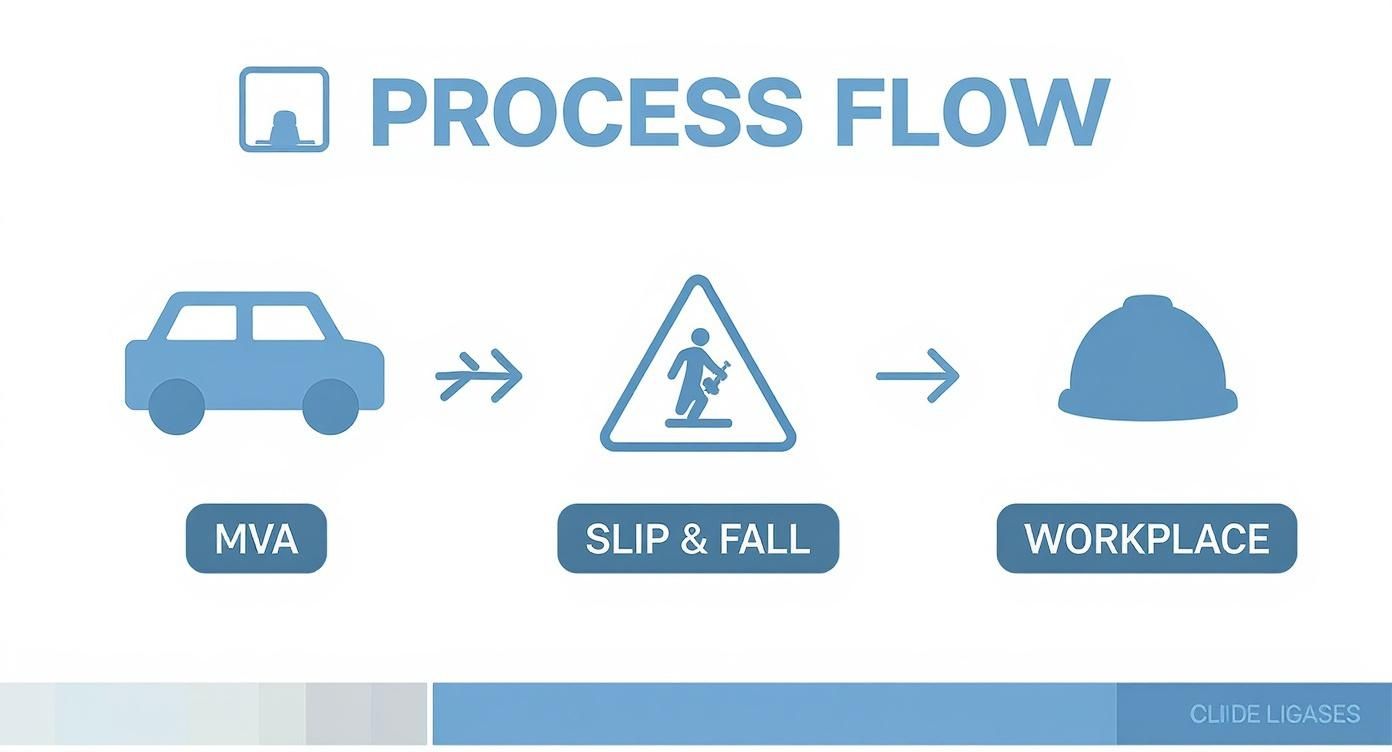
While the starting points differ, the legal path that follows is remarkably similar. It’s worth pointing out that motor vehicle accidents have an extra layer—you also have to navigate a separate claim for no-fault benefits. You can get the full story on that process in our guide on accident benefits in Ontario.
The single most important deadline in Ontario is the two-year limitation period. In most cases, you have just two years from the day you discovered your injury to file a lawsuit. If you miss that deadline, your right to sue is gone for good.
Discovery and Moving Toward a Resolution
After your claim is filed, the case moves into what’s called the discovery process. This is where both sides lay their cards on the table, exchanging all relevant information and evidence. It’s a transparent process that typically involves a few key steps:
- Written Questions: Lawyers from each side will send formal lists of questions to the other party to answer in writing.
- Document Exchange: This is where everything gets shared—medical records, expert reports, pay stubs, and any other relevant paperwork.
- Examinations for Discovery: You and the at-fault person will be questioned, under oath, by the opposing lawyers. It’s a chance for them to hear your story in your own words.
As part of discovery, you will receive formal notices for these examinations. If you’ve never seen one, looking at examples is helpful for understanding deposition notices so you know what to expect.
After discovery wraps up, most cases in Ontario are required to go to mediation. This is a confidential meeting where a neutral professional—the mediator—helps both sides try to negotiate a settlement. The vast majority of personal injury cases actually get resolved at mediation, saving everyone the stress and cost of a trial. If an agreement can’t be reached, the final step is going to trial, where a judge or jury will make the final call.
How Is Compensation Calculated in Ontario?
When you’ve been injured, one of the first questions that comes to mind is, “What is my claim actually worth?” It’s a completely fair and crucial question. In Ontario’s personal injury law, we don’t guess at the answer. Calculating your compensation—legally known as “damages”—is a detailed process of evaluating every single loss you’ve experienced.
The entire point of damages isn’t to create a lottery win. It’s about trying to put you back in the financial and personal position you were in just before the accident happened. To get this right, the law sorts compensation into different categories, making sure everything is accounted for—from the stack of medical bills on your table to the invisible pain you live with every day.
Pecuniary Damages: Covering Your Financial Losses
First up are pecuniary damages. The simplest way to think about these is as the tangible, calculable financial hits you’ve taken. These are the black-and-white numbers you can prove with receipts, pay stubs, and invoices.
This category covers a lot of ground, including:
- Loss of Income: This isn’t just about the paycheques you’ve already missed. It also covers your reduced ability to earn a living in the years to come.
- Medical and Rehabilitation Costs: Think of anything not covered by OHIP or your private benefits plan—physiotherapy, prescriptions, specialized equipment, or mental health support.
- Future Care Costs: For life-altering injuries, this is absolutely critical. It provides the funds needed for long-term support like in-home nursing, home modifications, and ongoing therapies.
- Other Out-of-Pocket Expenses: This is a catch-all for related costs, from gas money for doctor’s appointments to hiring someone to help with yard work or cleaning.
Calculating these amounts isn’t just about adding up receipts. We often rely on expert reports from economists and occupational therapists to project your future needs and build a solid, evidence-based case for what you truly need to recover financially.
Non-Pecuniary Damages: Compensation for Pain and Suffering
The next major category is non-pecuniary general damages. This is where the law acknowledges the human side of your injury—the parts that don’t have a clear price tag. This compensation is for your physical pain, emotional distress, and the loss of enjoyment you get from life.
Non-pecuniary damages recognize that an injury is more than just a set of medical bills. It’s a profound disruption to your well-being, affecting your ability to enjoy your hobbies, spend time with your family, and simply live your life without pain.
Here in Canada, there’s a limit on what can be awarded for pain and suffering. Back in 1978, the Supreme Court of Canada set a cap. Adjusted for today’s inflation, that cap is around $450,000 and is reserved for only the most catastrophic, life-destroying injuries. Even in the worst possible cases, this part of the compensation can’t go higher.
Figuring out where your specific injury falls on that scale is complex. To get a better sense of how it works, you can read our detailed guide on pain and suffering damages in Ontario.
Family Law Act Damages
Finally, Ontario law gets that a serious injury doesn’t just happen to one person. The Family Law Act allows certain close family members—spouses, children, grandchildren, parents, and siblings—to file their own claims. This is to compensate them for the loss of care, guidance, and companionship they’ve experienced because of your injury. It’s a recognition that an accident sends shockwaves through an entire family.
When to Hire a Personal Injury Lawyer

After an accident, deciding whether to call a lawyer can feel like a massive step. But honestly, it’s one of the most critical decisions you can make to protect your rights and your future. While you might be able to handle a minor fender-bender yourself, some situations absolutely demand professional legal guidance.
Knowing the red flags can be the difference between getting fair compensation and walking away with a major upfront cost burden.
One of the biggest indicators is the severity of your injuries. If you’ve suffered anything that could be long-term or permanent—like a traumatic brain injury, spinal cord damage, or serious fractures—the stakes are just too high to go it alone. The true costs of future care, lost earning capacity, and the toll on your quality of life are incredibly complex to calculate and need an expert’s touch.
Then there’s the insurance company. The moment they start giving you the runaround, it’s time to bring in a professional. Remember, this is a business for them, and their primary goal is to pay out as little as possible.
Key Moments to Seek Legal Advice
If you run into any of these situations, take it as a clear signal that you need a legal expert to level the playing field. These are common tactics that a seasoned personal injury lawyer knows how to handle.
- Liability is Disputed: The other party or their insurer is pointing the finger at you, claiming you were at fault or their client did nothing wrong. A lawyer will immediately start gathering the evidence needed to build a strong case and prove what actually happened.
- You Receive a Low Settlement Offer: Insurers are notorious for making quick, lowball offers, hoping you’ll take the money before you realize what your claim is truly worth. An experienced lawyer will properly assess your total damages—past, present, and future—to make sure any offer is fair.
- Your Claim is Denied: An outright denial can feel like a punch to the gut. A lawyer can dig into the reason for the denial, identify any mistakes, and launch a formal appeal to fight the decision.
Having an experienced lawyer means you have a professional advocate managing all communication, gathering expert reports, and fighting for your best interests, allowing you to focus completely on your recovery.
How Can You Afford a Lawyer?
A lot of people in the GTA worry about the cost of hiring a lawyer, but personal injury law in Ontario is structured to make justice accessible to everyone. Most personal injury lawyers, including our team at UL Lawyers, work on a contingency fee basis.
What does that mean for you? You pay zero upfront fees.
Your lawyer’s payment is simply a pre-agreed percentage of the final settlement or court award they recover for you. To put it plainly, if your matter does not result in a recovery, you do not pay legal fees. This model removes the financial barrier, ensuring that anyone, regardless of their bank account, can have a powerful advocate on their side.
Figuring out the next steps is tough, but knowing when to ask for help is the most important first move. For more tips on finding the right local expert, you can learn about what to look for when choosing a personal injuries lawyer near me.
Your Top Questions About Ontario Injury Law, Answered
After an injury, your mind is probably racing with questions. The legal side of things can feel overwhelming and confusing, but getting clear answers is the first step to regaining control. We’ve put together answers to the most common questions we hear from people just like you, from all across Ontario.
Our aim is to cut through the legal jargon and give you the straightforward information you need to understand your rights and figure out your next steps.
How Long Do I Have to File a Claim?
This is, without a doubt, one of the most critical questions. The general rule in Ontario, laid out in the Limitations Act, gives you two years to file a lawsuit. That two-year clock usually starts on the day you realized (or reasonably should have realized) you had a claim.
But don’t let that two-year window give you a false sense of security. The deadlines can be much, much shorter. For instance, if you’re making a claim against a city or town, you might have to give them formal written notice in as little as 10 days. If you miss a deadline, you could lose your right to seek compensation forever.
What if I Was Partially at Fault?
It’s a common worry. Many people think that if they share even a tiny bit of the blame, they can’t get any compensation. Thankfully, that’s not how it works in Ontario. Our laws on Contributory Negligence mean you can still pursue a claim even if you were partially responsible for the accident.
What happens is that the court will assign a percentage of fault to everyone involved. Your total compensation is then simply reduced by whatever percentage of fault is assigned to you.
Here’s a quick example: Imagine you’re awarded $100,000 for injuries from a car accident. The court finds you were 25% at fault because you were going slightly over the speed limit. Your compensation would be reduced by that 25%, leaving you with $75,000.
A skilled lawyer’s job is to build a case that minimizes your share of the fault, fighting to get you the full and fair compensation you’re entitled to.
How Much Does a Personal Injury Lawyer Cost?
This is a huge source of stress for many people, but the system is actually set up to help. Almost every personal injury lawyer in Ontario works on what’s called a contingency fee basis.
This arrangement means you pay zero legal fees out of your own pocket to get started. Your lawyer fronts all the costs required to build and pursue your case. They only get paid at the very end, as an agreed-upon percentage of the settlement or court award they recover for you.
It’s simple: if you don’t get paid, your lawyer doesn’t get paid. This removes the financial barrier, allowing anyone who has been hurt to get dedicated legal help, regardless of their bank balance. We always start with a free consultation to walk you through this so you feel completely clear and comfortable before making any decisions.
We know that dealing with an injury claim feels like a steep mountain to climb, but you don’t have to do it alone. The team at UL Lawyers is here to be your guide, protecting your rights and fighting for the fair compensation available under the law. We proudly serve clients across the GTA and throughout Ontario with compassionate and expert legal support.
Reach out today for a free, no-pressure consultation to talk about your situation. Let us help you take that first crucial step toward recovery. You can learn more and get in touch with us at https://ullaw.ca.