
Understanding Notice and Severance Rights in Ontario: ESA vs. Common Law
Introduction
Losing a job can be stressful, and understanding your rights is crucial. In Ontario, two sets of rules determine what compensation you should receive when you’re terminated without cause: the minimum standards under the Employment Standards Act, 2000 (ESA) and the broader common law rules developed by courts. Knowing the difference between ESA entitlements and common law reasonable notice can mean the difference between a few weeks of pay and several months of pay. This article explains those differences in clear terms, highlights recent Ontario cases, and discusses how our firm can help you navigate your options.

ESA Minimum Notice and Severance Entitlements
The ESA sets the baseline obligations for Ontario employers when terminating employees. These are the minimum notice and severance amounts that must be given, and they depend mainly on your length of service and the size of your employer:
Notice of Termination: You are entitled to advance notice of termination or pay in lieu of notice, up to a maximum of 8 weeks’ worth of notice pay. The exact amount is 1 week per year of service up to 8 weeks. (For example, 4 years of service = 4 weeks’ notice minimum.)
Severance Pay: In addition to notice, severance pay under the ESA is required only for longer-term employees of larger employers. If you have at least 5 years of service and your employer’s Ontario payroll is $2.5 million or more (or 50+ employees are terminated at once), you qualify for severance pay of 1 week per year of service, up to a maximum of 26 weeks.
These ESA amounts are mandatory minimums. They are the floor, not the ceiling, of what you could receive. Importantly, ESA notice and severance are cumulative: if you qualify for statutory severance, it is on top of the termination notice/pay. Also, ESA payments are not reduced by new employment – even if you find a new job right away, your former employer must still pay these minimum amounts.
Common Law Reasonable Notice (Wrongful Dismissal)
Ontario courts recognize that the ESA minimums are often not enough to compensate someone who loses their job. Outside of the ESA, the common law (judge-made law) may entitle dismissed employees to “reasonable notice” – which is usually much more generous than the ESA minimum. If you’re terminated without cause and do not have an enforceable contract limiting you to ESA minimums, the employer must provide common law reasonable notice (or pay in lieu) as damages for wrongful dismissal.
How is reasonable notice decided? Courts look at several factors (known as the Bardal factors, from a leading case) to decide how many months of notice (or pay in lieu) you should get. Key factors include your age, your length of service, the character or seniority of your employment, and the availability of similar jobs in the market. The idea is to estimate how long it will likely take you to find comparable new employment. For example, someone with 6 years of service might be entitled to only 6 weeks’ pay under the ESA, but roughly 6 to 9 months of pay under common law if that is a reasonable period to find a new job.
Common law notice awards are uncapped (unlike the 8-week ESA cap). In Ontario, many wrongful dismissal awards fall in the range of a few months up to about 24 months’ pay for very long-service or older employees. In exceptional cases, courts can exceed 24 months. For instance, in Lynch v. Avaya Canada Corp (2023 ONCA), the Court of Appeal upheld a 30-month notice period for an employee with 38 years of service, citing “exceptional circumstances” like his specialized role and scarce re-employment prospects. However, such cases are rare, and 24 months is often viewed as a practical upper limit in normal circumstances.
ESA vs. Common Law: What’s the Difference?
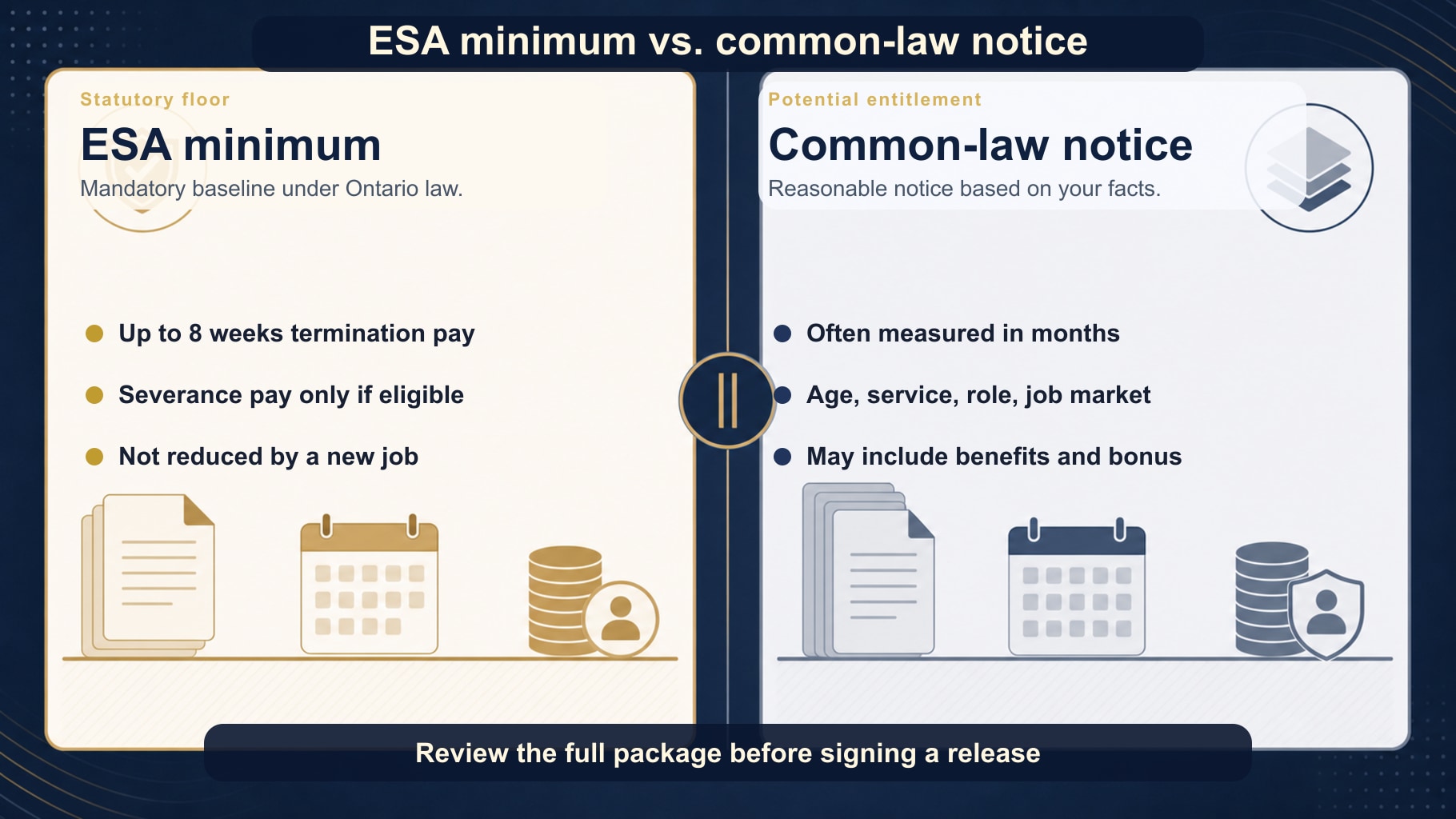
To put it simply, ESA notice/severance is the minimum you must receive; common law notice is the potential maximum you could receive. If you are let go:
At Minimum (ESA): You get at least the ESA-required notice pay (up to 8 weeks) and possibly severance pay if eligible.
Potential at Common Law: You could be owed a significantly longer notice period (months instead of weeks) based on your situation. Common law notice includes all components of compensation (salary, benefits, bonus, etc.) for that period, as if you had continued working.
Example: A 10-year employee aged 50 in a specialized job might get 8 weeks’ pay under the ESA, but common law might entitle them to perhaps 10–12 months of pay (or more, depending on circumstances). The ESA acts as a safety net, but the common law aims to “make you whole” for the time it reasonably takes to land a new job.
It’s important to note that you don’t automatically receive common law notice – you usually need to negotiate or sue for it if your employer only offers the ESA minimum. Many employers will initially offer only ESA amounts, hoping you won’t realize that you could ask for more. This is why understanding your rights (or consulting a lawyer) is critical before accepting any severance package.

The Role of Employment Contracts (Termination Clauses)
Your entitlement to common law notice can be modified by a written employment contract. Many contracts include a termination clause that tries to limit your severance to the ESA minimum amounts. If such a clause is valid and enforceable, then you are stuck with only the ESA minimum notice/severance and cannot claim more at common law.
However, Ontario courts scrutinize these clauses very closely. A termination clause must comply with the ESA at all times. If a contract’s termination clause violates the ESA (even in a small way or in a hypothetical scenario), or if it is ambiguous or unfair, courts will strike it down and instead apply common law rules. For example, in Tan v. Stostac Inc. (2023 ONSC), the employer’s termination provision was ruled void because its “just cause” section allowed termination without notice in broader situations than the ESA permits. Even though the contract had language saying the ESA would prevail if it provided greater benefits, the court followed the precedent in Waksdale v. Swegon (2020 ONCA) and found that the illegal just-cause part poisoned the entire clause, making the employee eligible for common law notice (the court awarded about 7 months’ pay in lieu of notice).
Courts may also refuse to enforce a contract if the employment relationship fundamentally changed over time. In Celestini v. Shoplogix Inc. (2023 ONCA), a 2005 contract’s termination clause was not enforced because the employee’s role had evolved dramatically over 18 years. The Court of Appeal applied the “changed substratum” doctrine – since the job’s nature changed substantially and the contract didn’t specify that it would still apply after such changes, the employee was entitled to common law notice (the court assessed it at 18 months).
On the other hand, a well-drafted termination clause can be enforceable. In Bertsch v. Datastealth Inc. (2025 ONCA), the Ontario Court of Appeal upheld a clause that clearly limited the employee’s termination entitlements to ESA minimum standards. The clause explicitly stated the employee would get only the ESA payments (notice, termination pay, severance if applicable) and it excluded any common law notice. The ONCA found the clause was unambiguous, compliant with the ESA, and therefore enforceable. This decision provides a helpful example to employers of how to draft a termination clause that will hold up in court.
Recent example: In Timmins v. Artisan Cells Inc. (2025 ONSC), an employer tried to offer only part of the contractually promised severance and demanded a signed release for the rest. The court found the employer’s conduct was a repudiation of the contract, allowing the employee to claim common law damages – in this case, about 9 months’ pay instead of the 3 months stated in the contract. This illustrates that employers must honor at least the contract and ESA minimums, or risk owing much more.
Bottom line: If you have no written contract or the contract has no termination clause, you automatically default to full common law notice. If you have a termination clause, it might restrict you to ESA minimums – but if that clause is poorly drafted or violates the ESA in any way, a court can set it aside. Each case depends on the specific contract wording and the evolving case law.
The Duty to Mitigate Damages
One concept tied to common law notice is mitigation. Mitigation means that a wrongfully dismissed employee is expected to make reasonable efforts to find a new job to “mitigate” (reduce) their losses. In practical terms, if you sue for common law notice, the court will usually subtract any new earnings you made during the notice period from what your old employer must pay. You cannot simply wait out the notice period without trying to find work. If you unreasonably refuse or avoid new employment, a court might reduce the notice period it would otherwise award.
For example, if you were entitled to 6 months’ notice but you found a comparable new job after 3 months, your former employer may only owe you 3 months’ pay (plus, in some cases, compensation for lost benefits or bonuses for those 3 months). The duty to mitigate applies to virtually all wrongful dismissal cases. Even individuals on fixed-term contracts are not automatically exempt – the Ontario Court of Appeal ruled in Monterosso v. Metro Freightliner (2023 ONCA) that a fixed-term independent contractor had a duty to mitigate when his 72-month contract was cut short, rather than simply collect the entire remaining salary.
The only exception is if an employment contract explicitly waives the duty to mitigate, which is rare and must be clearly written. It’s important to note that ESA minimum payments are not subject to mitigation. Termination pay and severance pay under the ESA must be paid regardless of new employment. Mitigation mainly affects the additional common law damages. If you’re an employee, you should still actively job-hunt after termination – both to move forward in your career and to fulfill your legal obligations in case you pursue a claim. Keeping records of your job search will help demonstrate your efforts if needed.
How Our Firm Can Help
Facing a termination can be overwhelming, especially when figuring out your true entitlements. Our employment law team is here to help you navigate these issues. We offer guidance to employees by:
Reviewing severance packages: We assess whether your severance offer meets ESA requirements and whether you might be owed more under common law. Many employees are surprised to learn they have rights to a larger payout than initially offered.
Negotiating fair compensation: If you’ve been offered only the minimum or an inadequate package, we can negotiate with your employer (or take legal action if necessary) to seek the full reasonable notice you deserve.
Explaining your obligations: We’ll advise you on your duty to mitigate and how to document your job search, so that you maximize your chances of a successful claim and don’t unintentionally reduce your entitlement.
Drafting and reviewing contracts: For employers and employees alike, we review or draft employment contracts to ensure termination clauses are clear, enforceable, and compliant with the latest law. This helps prevent costly disputes down the road.
Recent case law is constantly shaping the landscape of notice and severance rights, and our firm stays up-to-date on these developments. Whether it’s understanding a new Court of Appeal decision or leveraging precedents like those mentioned (from Waksdale to Lynch), we use that knowledge to protect your interests.
Related UL Lawyers resources
If your situation is moving from general research to a real legal problem, these service pages may help you choose the next step:
- Burlington employment law services — local help with termination and severance reviews.
- Employment contract review — focused service page.
- Termination for cause support — focused service page.
Conclusion
Knowing the difference between ESA minimums and common law rights can make a huge difference in an employee’s post-termination outcome. The law in Ontario provides a safety net but also the potential for much more, depending on your situation. If you’ve been terminated – or if you’re an employer planning a termination – reach out for advice. We can help ensure that notice and severance are handled fairly and legally, and that your next steps (whether negotiating a better severance or structuring a lawful termination) are on solid ground. With the right guidance, you won’t leave your rights (or money) on the table.
Disclaimer: This article is provided for informational purposes only and does not constitute legal advice. Each case depends on its own facts. If you are dealing with a termination or severance issue, you should seek advice from a qualified employment lawyer.
What Is the Common Law Termination Entitlement in Ontario?
When an employer in Ontario ends employment without cause, the employee is generally entitled at common law to reasonable notice of termination, or pay in lieu of notice. This applies unless a valid employment contract says otherwise. The purpose is to give the employee a fair amount of time, or the money that would have been earned in that time, to find comparable work.
There is no fixed formula. Courts usually set the length of reasonable notice using the Bardal factors:
- Age: older employees may face a harder job search.
- Length of service: longer tenure tends to support a longer notice period.
- Type of job: the employee’s role, seniority and level of responsibility.
- Availability of similar work: how easily comparable jobs can be found, given the employee’s experience, training and qualifications.
Courts may also look at other circumstances, such as whether the employer recruited the employee away from a secure job. Each case depends on its own facts. For typical ranges and an estimate, see our severance calculator guide.
What Pay in Lieu of Notice Usually Includes
Common law damages generally aim to put the employee in the position they would have been in had they worked through the notice period. Depending on the facts and the wording of the relevant plans, this may include:
- Base salary for the full notice period.
- Benefits: health, dental, life and disability coverage continued, or their value paid out. Where coverage stops early, an employer may be exposed to claims for losses the coverage would have paid, such as a disability that begins during the notice period.
- Bonus or commission, where it was an integral part of compensation. Courts often expect plan language to clearly and unambiguously remove this entitlement during the notice period before they will enforce such a limit.
- Pension accrual: employer contributions or credited service the employee would have earned.
- Stock options or RSUs, where the plan allows vesting during the notice period, or where the plan’s limiting language is not clear enough to cut it off.
- Other regular perks, such as a car allowance, phone or vacation pay accruing on the amounts above.
How these amounts are calculated, structured and taxed is covered in our guide to severance payouts.
Is There a 24-Month Cap?
Ontario courts tend to treat roughly 24 months as the upper end of reasonable notice. This is not an absolute cap, though. Courts have said that awards above 24 months may be justified in exceptional circumstances, for example a long-service, older employee in a specialized role with very limited prospects of re-employment, or an employee who was induced to leave secure employment. Such awards are uncommon, and outcomes vary.
When a Termination Clause Limits the Entitlement
A valid termination clause in an employment contract can limit an employee’s entitlement, sometimes down to the minimums in the Employment Standards Act, 2000 (ESA). Ontario courts read these clauses closely. A clause that could breach the ESA in any situation may be unenforceable, and if it is, common law reasonable notice may apply again. See The Role of Employment Contracts (Termination Clauses) above.
Even without a clause, common law damages may be reduced by what the employee earns from new work during the notice period. See The Duty to Mitigate Damages.