
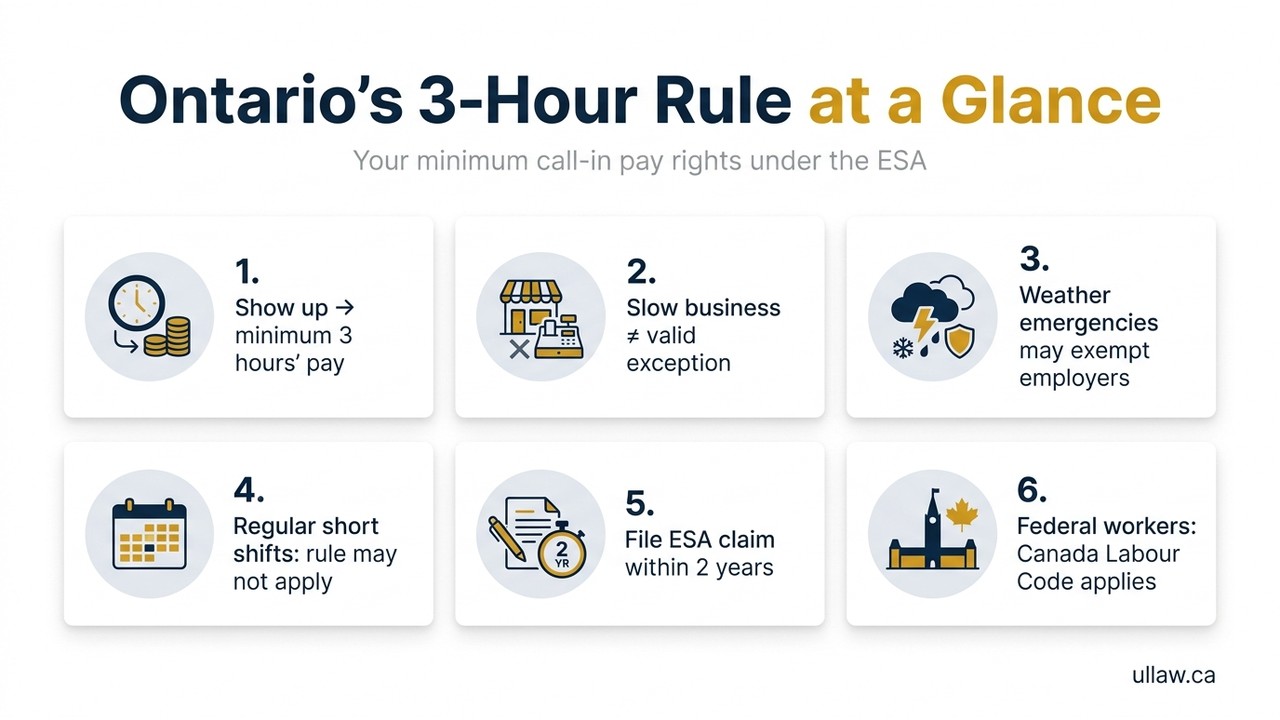
Ontario’s 3-hour rule is minimum call-in pay under the Employment Standards Act, 2000, s. 21.2. If you regularly work more than three hours a day and your employer sends you home after 30 minutes, you are generally still owed three hours at your regular rate. A slow Tuesday is not an exception.
Quick answer: The rule applies if you regularly work more than three hours a day, were required to report, showed up, and worked less than three hours even though you were available to stay. It does not usually apply if your regular shift is three hours or less, or if work stopped for a cause beyond the employer’s control (for example, a power failure). Unpaid call-in wages? ESA claims generally have a two-year window. Call 905-744-8888 or email info@ullaw.ca for a free employment consult. You can also book a free consultation.
Call, email, or book a free employment consult: 905-744-8888 · info@ullaw.ca · Book an employment consult. Peel workers can start with employment lawyer Mississauga. Ontario-wide: employment lawyers.

Table of Contents
- What Is the 3-Hour Rule in Ontario?
- What Is the 3-Hour Rule in Canada (Federal)?
- What Is Minimum Call-In Pay in Ontario?
- Does the 3-Hour Rule Apply to On-Call Employees?
- When the 3-Hour Rule Does Not Apply
- What Happens to Minimum Call-In Pay When You Are Terminated or Laid Off?
- What To Do if You Haven’t Received Minimum Call-In Pay
- Breaks, Maximum Shift Length, and Other ESA Basics
What Is the 3-Hour Rule in Ontario?
The 3-hour rule in Ontario is a minimum pay guarantee found in the Employment Standards Act, 2000. It says that if an employee is required to report to work and actually shows up, the employer must pay them for a minimum of three hours at their regular rate of pay — even if the employee is sent home after working a shorter time.
Here is the practical situation it addresses: imagine you are scheduled for an eight-hour shift and you arrive on time, but your manager tells you the store is quiet and sends you home after 45 minutes. Without this rule, you would only be paid for 45 minutes of work. With the rule in place, your employer must pay you for three full hours.
The Basic Formula
- If you worked less than 3 hours: you receive pay for 3 hours at your regular rate.
- If you worked 3 hours or more: you are paid for the actual hours worked — the rule simply sets the floor.
- The three-hour minimum is calculated at your regular rate, not a reduced or special rate.
Who Is Covered?
Most employees covered by the ESA qualify. This includes full-time, part-time, and many casual workers. Independent contractors and certain federally regulated employees (like those in banking or interprovincial transportation) are generally not covered by provincial rules — they fall under federal legislation instead.
The goal of the rule is straightforward: it protects workers from bearing the cost of an employer’s scheduling or business decisions. You arranged childcare, paid for transit, and showed up. Ontario law says that commitment deserves at least three hours of pay.
What Is the 3-Hour Rule in Canada (Federal)?
Canada also has a parallel protection at the federal level. Employees in federally regulated industries — such as banking, telecommunications, inter-provincial trucking, and federal Crown corporations — are covered by the Canada Labour Code, not the Ontario ESA.
Under the Canada Labour Code, a comparable minimum call-in pay provision requires that an employee who reports to work at the employer’s request must be paid for a minimum of three hours, even if the work available is less than that. The federal rule mirrors Ontario’s intent: showing up for work has a minimum value that the employer must honour.
Key Differences to Keep in Mind
| Ontario ESA | Canada Labour Code | |
|---|---|---|
| Who it covers | Provincially regulated employees | Federally regulated employees |
| Minimum guaranteed | 3 hours at regular rate | 3 hours at regular rate |
| Enforcement body | Ontario Ministry of Labour | Employment and Social Development Canada |
If you are unsure whether your job is provincially or federally regulated, the Government of Canada’s official guidance offers a starting point — or you can speak with an employment lawyer who can confirm your status quickly.
What Is Minimum Call-In Pay in Ontario?
Minimum call-in pay is the official ESA term for what most workers call the 3-hour rule. It is not a bonus or a courtesy — it is a legal entitlement.
The rule applies when:
- You are required to attend work (i.e., you were scheduled or called in by your employer).
- You actually show up and are ready to work.
- You work fewer than three hours during that shift.
In that scenario, you must be paid for at least three hours at your regular rate of pay. Your employer cannot substitute a lower training rate or a different pay band to satisfy the minimum.
How Minimum Call-In Pay Is Calculated
The math is simple. Take your regular hourly rate and multiply it by three. That is the floor payment.
Example: You earn $18.00/hour. You are sent home after 90 minutes. Your employer must pay you $54.00 (3 × $18), not $27.00 (1.5 × $18).
If You Earn Commission or a Different Rate of Pay
If your pay varies — for example, you earn commission on top of a base rate — the three hours are calculated using your regular rate, which is typically your base hourly wage. If your employment agreement does not specify a base hourly rate and your compensation is entirely commission-based, the calculation becomes more nuanced and it is worth getting legal advice to determine what you are owed.
Does the 3-Hour Rule Apply to On-Call Employees?
This is one of the most common questions workers ask — and the answer is it depends on how the on-call arrangement works.
If you are on-call and your employer actually requires you to come in, the 3-hour rule applies. You showed up at the employer’s direction; the minimum pay guarantee kicks in.
However, if you are on-call and your employer never actually calls you in — you simply waited at home in case they needed you — the 3-hour rule generally does not apply to those waiting hours. Whether those waiting hours are compensable at all is a separate question governed by other parts of the ESA.
The key trigger is physical attendance at work. If your employer called you in, you drove there, you arrived, and then you were sent home early — you almost certainly have a minimum call-in pay claim.
When the 3-Hour Rule Does Not Apply
The ESA builds in specific exceptions. Even if you worked fewer than three hours, your employer may not owe you the minimum call-in pay in these circumstances:
1. Weather or Other Emergencies
If it was impossible to carry out the work due to weather or another cause completely outside the employer’s control, the exception may apply. Think of a sudden ice storm that forces a worksite to shut down immediately after workers arrive. However, this exception is interpreted narrowly — a slow sales day or poor scheduling does not qualify.
2. Employees Who Regularly Work Shifts of Three Hours or Less
If your normal scheduled shift is less than three hours — for example, you are a part-time employee regularly scheduled for two-hour shifts — the rule does not apply in the same way. The ESA recognizes that some roles are genuinely structured as short shifts from the outset.
3. “Sent Home Early for Low Business Volume”
Many employers tell employees they are being sent home because it is “slow.” This does not qualify as an exception. Slow business is foreseeable and within the employer’s control. If you were sent home early simply because foot traffic was low, your employer still owes you minimum call-in pay.
4. Remote Workers
The 3-hour rule was designed with physical attendance in mind. For remote workers, the application can be less clear. If a remote employee logs on for a scheduled shift and is immediately told there is no work and to log off, whether the rule applies may depend on how the employment contract is structured. This is an evolving area, and getting specific legal advice is worthwhile.

What Happens to Minimum Call-In Pay When You Are Terminated or Laid Off?
If you are terminated or placed on a temporary layoff while a minimum call-in pay claim is outstanding, that claim does not disappear. You may be able to file a complaint with the Ontario Ministry of Labour for any unpaid minimum call-in wages, along with any other termination entitlements owed under the ESA.
In fact, a termination might actually increase your leverage: all outstanding ESA wage claims — including unpaid minimum call-in pay — can be included in a single complaint. There are time limits for filing, so acting promptly matters. Generally, you have two years from the date the wages were owed to make a claim.
If the unpaid call-in pay is sitting beside a termination, layoff, or misclassification fight, call 905-744-8888 or email info@ullaw.ca so the ESA claim and the employment file are handled together.
What To Do if You Haven’t Received Minimum Call-In Pay
If you believe your employer has violated the 3-hour rule, here is a practical path forward:
- Document everything. Keep records of your scheduled shifts, the time you arrived, the time you were sent home, and what you were paid. Text messages, scheduling apps, and pay stubs all help.
- Raise it internally first (optional). Some violations are honest errors. A polite written question to HR or your manager may resolve it quickly and creates a paper trail.
- File a claim with the Ministry of Labour. If internal resolution fails, you can file an Employment Standards claim through Ontario’s Ministry of Labour. An employment standards officer will investigate and can order your employer to pay wages owed — plus interest.
- Talk to an employment lawyer. If the unpaid shifts stack up, you were terminated, or the employer is calling you a contractor, call 905-744-8888 or email info@ullaw.ca before the limitation window runs.
You can also book a free consultation or start on our employment law page.
Breaks, Maximum Shift Length, and Other ESA Basics
Since workers researching the 3-hour rule often have broader questions about their shift rights, here are a few related ESA basics:
Do You Legally Have to Have a Break on a 4-Hour Shift?
Under the ESA, employers must provide at least a 30-minute eating period after no more than five consecutive hours of work. If your shift is four hours, there is no strict legal requirement for an eating break — though many employers provide one as good practice or per a collective agreement.
What Is the Longest Shift You Can Legally Work?
The ESA sets a general limit of eight hours per day (or the number of hours in an established regular workday if that is longer) and 48 hours per week, unless there is a written agreement to work more. An employee can agree in writing to exceed these limits, but they cannot be forced to. There are also requirements around daily and weekly rest periods — at least 11 consecutive hours off each day, and at least 24 consecutive hours off each week.
These protections exist alongside the 3-hour rule as part of Ontario’s broader framework for fair work conditions under the Employment Standards Act, 2000.
Talk to a UL Lawyers Team Member
If you were sent home early and shorted on minimum call-in pay, or you have a broader Ontario employment issue (termination, unpaid wages, misclassification), call 905-744-8888 or email info@ullaw.ca before the two-year ESA window runs. UL Lawyers serves clients in Burlington, across the GTA, and throughout Ontario. You can also book a free consultation or visit employment law services. Halton employees can start on employment lawyer Burlington.