Quick answer: Injured passengers in Ontario can usually apply for accident benefits regardless of who caused the crash, and may also have a claim against an at-fault driver. The key is to identify every available insurer early and preserve medical, police, and witness evidence.
If you were injured as a passenger in an Ontario car accident, you may be wondering whether you have a claim at all. You were not the driver. You may not own a car. The at-fault driver may even be a friend, co-worker, rideshare driver, or family member.
The short answer is this: a passenger injured in an Ontario motor vehicle accident may have access to accident benefits and, in more serious cases, a lawsuit for additional losses. The first step is usually not blaming anyone. It is getting medical care, preserving evidence, and starting the right insurance process before deadlines become a problem.
Quick answer: what is different about a passenger injury claim?
A passenger claim is different because you usually did not control either vehicle. That can make fault feel less personal, but it can also make the insurance path confusing. A passenger may need to deal with:
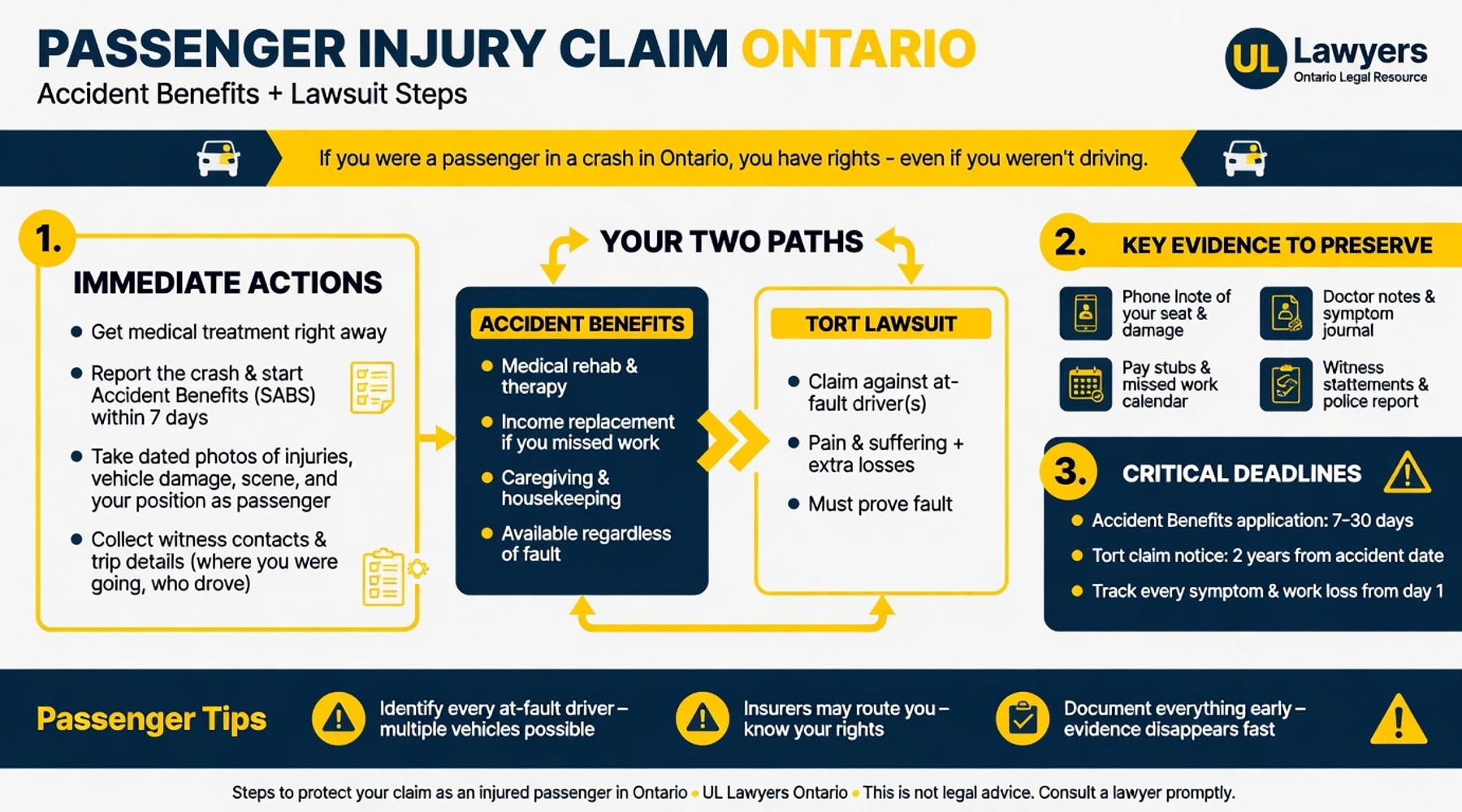
- an accident-benefits claim for immediate treatment, income replacement, caregiver, attendant care, or other available benefits;
- a possible tort claim against the at-fault driver or drivers;
- questions about which insurer should receive the accident-benefits application;
- medical evidence proving how the crash changed work, school, home life, or daily function; and
- limitation periods that keep running while you are recovering.
Ontario’s no-fault accident-benefits system means you do not have to prove fault before applying for initial benefits. Fault still matters later if you need to pursue a lawsuit for pain and suffering, future care, income loss, or other damages that accident benefits do not fully cover.

Step 1: get treatment and create a clear medical record
Passenger injuries are sometimes minimized at the scene. People may say they are “fine” because adrenaline is high or because they do not want to escalate the situation. That can become a problem if pain, concussion symptoms, anxiety, or mobility issues appear days later.
After the crash, try to document:
- when symptoms first appeared;
- every clinic, hospital, physiotherapy, chiropractic, psychological, or specialist visit;
- missed work or reduced hours;
- help needed at home;
- medication, devices, or treatment expenses; and
- how symptoms affect sleep, driving, childcare, school, or ordinary tasks.
A consistent treatment record can matter as much as photos of the vehicle damage. The insurer and any defence lawyer will look for gaps or inconsistencies. If your symptoms changed over time, write that down rather than trying to force the story into a single snapshot.
Step 2: start the accident-benefits claim
Ontario uses standard accident-benefits forms. The Financial Services Regulatory Authority of Ontario publishes the OCF-1 Application for Accident Benefits, which is usually the main application form. A passenger may also need medical forms, employer forms, treatment plans, or disability certificates depending on the benefits being claimed.
The correct insurer is not always obvious. Some passengers apply through their own auto policy. Others may need to apply through a spouse’s or parent’s policy, the vehicle’s insurer, another involved vehicle’s insurer, or a fallback mechanism. Do not assume there is no coverage just because you were not driving or because you do not personally own a vehicle.
For a broader explanation of Ontario accident-benefits categories, see UL Lawyers’ guide to accident benefits in Ontario and our motor vehicle accident services.
Step 3: identify whether there is also a tort claim
Accident benefits are only part of the system. They can help with immediate treatment and income-related support, but they do not always cover the full impact of a serious injury.
A passenger may also have a tort claim if another person was negligent. That can include:
- the driver of another vehicle;
- the driver of the vehicle you were riding in;
- multiple drivers who share fault;
- a commercial vehicle operator or employer;
- a municipality or road-maintenance party in some road-condition cases; or
- another party connected to the crash.
This can feel uncomfortable when the driver was someone you know. In many cases, the claim is handled through insurance rather than as a personal demand for payment from that person. A lawyer can explain that distinction and help you avoid missing a claim because the social situation feels awkward.
Step 4: preserve passenger-specific evidence
Passengers often have evidence that drivers do not. You may have seen speed, distraction, alcohol or cannabis use, weather conditions, seatbelt use, rideshare app details, traffic signals, or conversations right before the collision.
Save or collect:
- photos and videos of the vehicles, road, intersection, weather, and your injuries;
- driver names, insurance details, licence plates, and police report information;
- rideshare receipts, taxi receipts, or trip screenshots;
- names and contact information for other passengers or witnesses;
- text messages about the trip or collision;
- dashcam or security-camera leads; and
- damaged personal property such as glasses, phone, clothing, or child seats.
Do this early. Vehicles get repaired, apps overwrite details, and witnesses become harder to find.
Step 5: watch the deadlines
Ontario car accident claims involve multiple deadlines. Some are tied to accident-benefits forms and insurer notices. Others relate to lawsuits. The exact timeline can depend on the facts, but waiting is risky.
A useful working checklist is:
| Timeline | Why it matters |
|---|---|
| As soon as possible | Get medical care, report the crash, and notify the relevant insurer. |
| When forms arrive | Complete the accident-benefits package carefully and keep copies. |
| Early in the file | Identify whether more than one insurer or at-fault party is involved. |
| Before limitation periods expire | Preserve the right to sue if accident benefits do not fully address the loss. |
Ontario’s Limitations Act, 2002 sets a general two-year basic limitation period for many civil claims, but do not treat that as permission to wait. Accident-benefits disputes, notice issues, medical evidence, and insurer communications can create much earlier practical deadlines.
When should a passenger call a lawyer?
Consider getting legal advice early if:
- you missed work or may not be able to return to your job;
- symptoms are continuing beyond the first few days;
- the insurer is questioning treatment, income loss, or injury severity;
- more than one driver or insurer is involved;
- the crash involved a rideshare, taxi, commercial vehicle, impaired driver, hit-and-run, or uninsured driver;
- you were a child passenger or were travelling with a child who was injured; or
- you are being pressured to give a recorded statement or sign a release.
Passenger claims can look simple at first and become complicated quickly. UL Lawyers can help identify the right insurer, preserve deadlines, coordinate the accident-benefits and tort paths, and explain what compensation may be available for your specific injuries.
If you were injured as a passenger in Ontario, contact UL Lawyers for a free consultation. We help injured passengers across Burlington, the GTA, and Ontario understand the next step before deadlines or insurer decisions narrow their options.