Motor Vehicle Accidents
Quick answer: Catastrophic impairment designation can unlock much higher Ontario accident-benefit limits, but it is evidence-heavy. Medical records, specialist opinions, functional evidence, and the SABS criteria all need to line up.
Call 905-744-8888 or email info@ullaw.ca to hire for the CAT claim before the insurer closes the OCF-19 file. The hire page is motor vehicle accident lawyer.
A serious car crash can fracture more than bones. It can upend your ability to work, care for yourself, or enjoy life as you knew it. When injuries cross a certain threshold, Ontario’s Statutory Accident Benefits Schedule (SABS) recognizes them as “catastrophic”—unlocking enhanced medical and rehabilitation funding that can mean the difference between barely coping and rebuilding.
But getting that CAT designation isn’t automatic. It requires navigating a complex medical and legal process, often starting with an OCF-19 form and, if denied, a dispute before the Licence Appeal Tribunal (LAT). The stakes are high: without the designation, treatment and care funding may be exhausted much sooner.
Ontario overview: A catastrophic impairment under the SABS can include severe brain injury, spinal cord damage, amputation, loss of vision, or a combination of physical and mental impairments that meet the regulatory criteria. The OCF-19 application must be supported by compelling medical evidence, and insurers may dispute the designation, which can require a LAT application to resolve.
Understanding what qualifies—and how to build a case that stands up to scrutiny—can help you avoid delays and denials. This guide walks you through the CAT designation process from injury to tribunal.
Table of Contents
- Catastrophic Injury vs Catastrophic Impairment: The Ontario Legal Distinction
- Why CAT Designation Matters: Enhanced Accident Benefits
- The SABS Categories for Catastrophic Impairment
- The OCF-19 Application Process: Step by Step
- Evidence You’ll Need to Support Your CAT Designation Claim
- Building a Long-Term Care and Evidence Plan After a Catastrophic Injury
- When the Insurer Refuses: Disputing a Denial at the Licence Appeal Tribunal
- Accident Benefits vs Tort Claim: How CAT Designation Changes Your Rights
- Deadlines and Limitation Periods: What You Must Know
- How a Catastrophic Injury Lawyer in Ontario Can Help
- Key Legal Sources
Catastrophic Injury vs Catastrophic Impairment: The Ontario Legal Distinction
When you hear “catastrophic injury,” you probably imagine a devastating, life-altering harm—something like a spinal cord injury, a severe traumatic brain injury, or loss of a limb. That’s an accurate starting point, but in Ontario’s no-fault insurance system, the language matters.
The everyday phrase “catastrophic injury” describes the physical and psychological devastation. The legal phrase “catastrophic impairment” (often shortened to CAT designation) is the technical threshold defined in the Statutory Accident Benefits Schedule (SABS), O. Reg. 34/10. That regulation sets out the precise medical and functional criteria used by an insurance company to decide whether you qualify for enhanced accident benefits.
In other words:
- A catastrophic injury is the real-world event.
- A catastrophic impairment is the regulatory label your insurer must apply if your condition meets the SABS definition.
A person can be living with a devastating injury but still be denied CAT designation if the insurer’s medical review concludes the SABS criteria are not met. The reverse can also happen: a condition that seems less outwardly dramatic but meets the specific SABS thresholds can be legally classified as catastrophic impairment.
Why does the distinction matter so much? Because it unlocks benefits that the standard policy limits simply cannot cover.
Why CAT Designation Matters: Enhanced Accident Benefits
Catastrophic impairment is not a trophy; it’s a lifeline. Under Ontario’s standard auto insurance policy, the medical, rehabilitation, and attendant care benefits you can access are capped. Once you receive a CAT designation, those caps multiply dramatically.
The table below summarizes typical coverage limits under the standard SABS as they stand at the time of writing (subject always to your specific policy, the date of your accident, and any optional benefits purchased).
| Benefit Type | Non-Catastrophic Treatment | Catastrophic Impairment Treatment |
|---|---|---|
| Medical, rehabilitation, and attendant care benefits | Standard combined limits apply under the SABS, subject to the policy and accident date | The standard combined limit is substantially higher for catastrophic impairment claims |
| Housekeeping and home maintenance | Often depends on optional coverage and the specific policy period | May be available in different circumstances, but the answer is policy- and date-specific |
| Income replacement, non-earner, caregiver, and other weekly benefits | Standard eligibility rules and weekly limits apply | CAT designation does not automatically increase every weekly benefit; it mainly changes the scale of treatment and care funding |
Important: FSRA describes standard medical, rehabilitation, and attendant care coverage as $65,000 for non-catastrophic injuries and $1,000,000 for catastrophic injuries, with optional increased coverage available in some policies. That does not mean a person receives an automatic payment. Benefits are paid only for reasonable and necessary expenses that are supported by the evidence, and the available amount depends on the policy, accident date, and any optional coverage purchased. The FSRA coverage guide is a useful starting point, but your own policy documents still matter.
Still, the difference is transformative. Without CAT designation, a young survivor of a severe brain injury might burn through the $65,000 medical/rehab cap in months, leaving them without funding for ongoing physiotherapy, cognitive therapy, or psychological support. With CAT designation, the road to maximum recovery is much longer and better funded.
This is why insurance companies scrutinize CAT applications vigorously. The financial exposure is enormous. That’s also why you need experienced legal guidance from the very start of your motor vehicle accident claim.
The SABS Categories for Catastrophic Impairment
Ontario’s SABS sets out a detailed list of medical conditions and functional outcomes that can trigger catastrophic impairment. The regulation is O. Reg. 34/10, sections 3(1)(c) to (e). We summarize the main gateways at a high level—without offering legal advice on whether your specific injury qualifies—because the definitions are intricate and require sophisticated medical interpretation.
Broadly, the categories include:
- Spinal cord injury resulting in paraplegia or quadriplegia, or severe impairment of ambulatory function.
- Severe traumatic brain injury with specific Glasgow Coma Scale scores, post-traumatic amnesia durations, or marked cognitive and physical impairments.
- Amputation of an arm, a leg, or another significant impairment similar in nature.
- Loss of vision in both eyes that meets the statutory criteria.
- A marked (class 4) or extreme (class 5) impairment in three or more areas of function due to mental or behavioural disorder, according to the American Medical Association’s Guides to the Evaluation of Permanent Impairment, 4th edition.
- A physical impairment that results in 55% or more whole-person impairment, as measured under the AMA Guides.
- A combination of physical and mental impairments that, when combined, meet the catastrophic threshold.
- Certain child-specific catastrophic definitions for young accident victims.
Because the thresholds blend precise medical ratings with functional assessments, the opinion of an experienced catastrophic injury lawyer—working with a network of medical experts—often makes the difference between a denied application and a successful CAT designation.
The OCF-19 Application Process: Step by Step
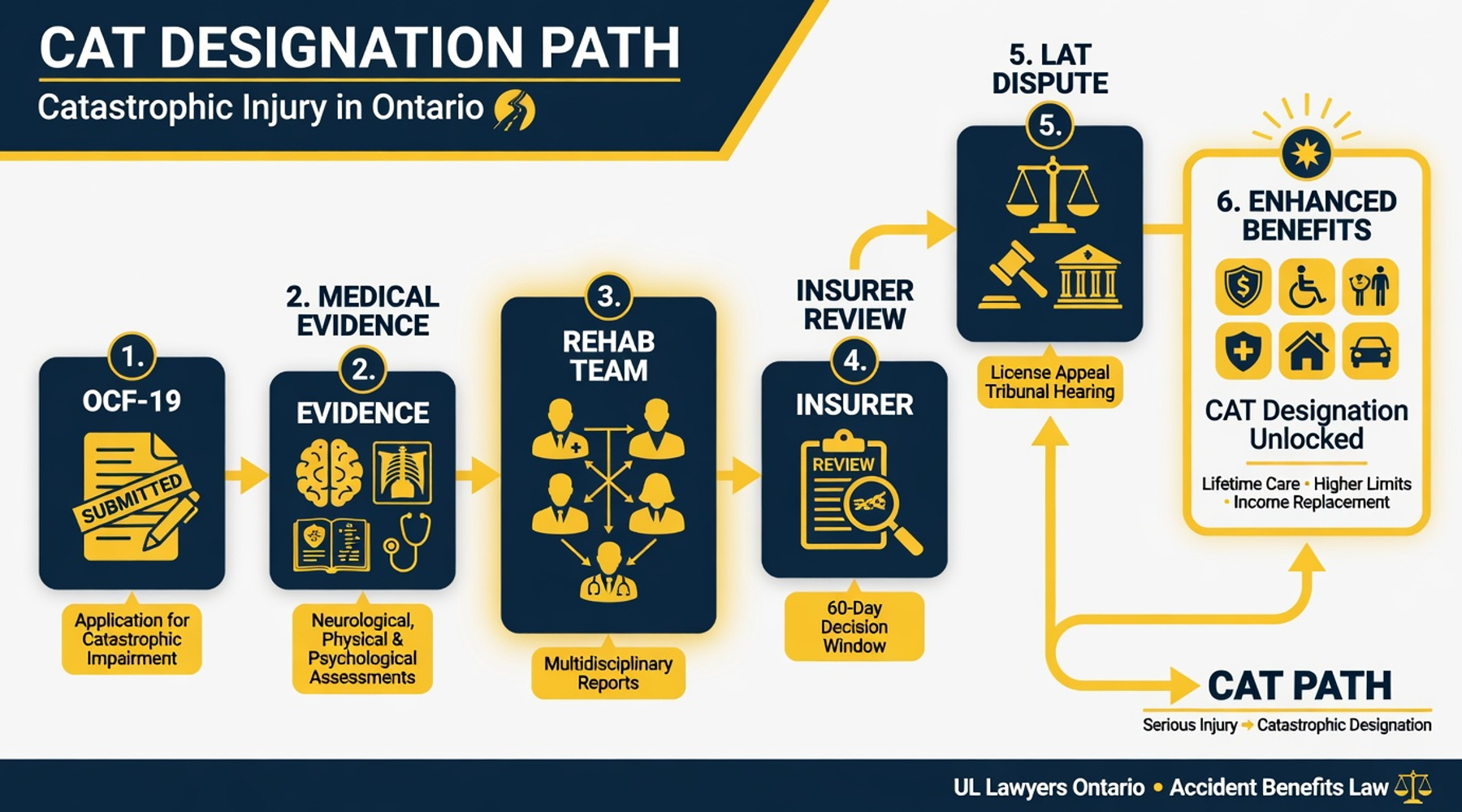
The path to CAT designation formally begins with a document called the Application for Determination of Catastrophic Impairment — the OCF-19. This form is a creature of the SABS and must be completed and submitted to your insurer.
Here is a practical overview of the process. Every case is different, and a lawyer can manage this on your behalf, but knowing the framework helps you understand what lies ahead.
Step 1: Complete and Submit the OCF-19 You (or your legal representative) fill out the OCF-19 form, identifying the injured person, the accident details, and the grounds you’re relying on for catastrophic impairment. The form must be accompanied by medical evidence that supports your position.
Step 2: Insurer Reviews and May Request an Examination Once received, the insurer has a statutory time frame—generally 10 business days—to acknowledge receipt and begin its review. The insurer will almost certainly request an insurer’s examination (IE) conducted by a medical professional of its choosing. You are required to attend, and the insurer’s expert will offer an opinion on whether you meet the catastrophic impairment criteria.
Step 3: Insurer Issues a Determination The insurer must give you its decision in writing, usually within 30 business days after receiving all requested information and the IE report. In practice, the process often stretches longer because of disputed evidence or scheduling delays. The insurer’s response will state either that you are designated as catastrophically impaired or that your application is denied.
Step 4: If Approved, Benefits Are Adjusted Once CAT designation is confirmed, your medical and rehabilitation benefit limits immediately increase to the catastrophic level. Insurers may still challenge individual treatment plans, but you gain access to the enhanced funding pool.
Step 5: If Denied, You Have a Right to Dispute A denial is not the end of the road. You can take the dispute to the Licence Appeal Tribunal (LAT), which we cover later in this guide.
Checklist: OCF-19 Submission Essentials
- Completed OCF-19 form, signed and dated
- Supporting medical reports from treating physicians and/or specialists (physiatrist, neurologist, psychiatrist, etc.)
- Standardized assessments (AMA Guides ratings, Glasgow Coma Scale, functional independence measures, etc.)
- Any relevant clinical notes, diagnostic imaging, and treatment records
- Proof of compliance with insurer’s requests for additional information
Evidence You’ll Need to Support Your CAT Designation Claim
A successful CAT application does not rely on one doctor’s opinion. It demands a constellation of evidence that proves, on a balance of probabilities, that your condition fits into a statutory category.
The evidence package typically includes:
-
Expert medical reports from specialists who understand the SABS definitions. For a brain injury, a neuropsychologist or physiatrist’s report can be critical. For spinal cord injuries, a neurosurgeon or rehabilitation specialist’s opinion is key. At UL Lawyers, we work with a network of qualified experts who provide independent, legally defensible assessments.
-
AMA Guides impairment ratings – the 4th edition is required for many categories. A properly completed impairment rating by a certified assessor is often the linchpin of a CAT application.
-
Functional assessment reports from occupational therapists, physiotherapists, or speech-language pathologists documenting daily limitations.
-
Pre-accident medical records to show your baseline health and rule out pre-existing conditions that might otherwise be argued as the cause.
-
Lay witness statements from family, employers, or friends that describe the dramatic changes in your ability to function.
-
Video or documentary evidence of your day-to-day struggles, in appropriate cases.
Without this layered evidence, an insurer can—and often will—seize on gaps to deny CAT designation and keep benefits at the lower tier.
Building a Long-Term Care and Evidence Plan After a Catastrophic Injury

Securing a catastrophic impairment (CAT) designation under Ontario’s Statutory Accident Benefits Schedule (SABS) unlocks enhanced medical, rehabilitation, and attendant care benefits—up to $1,000,000 each, with no time limit. However, accessing those benefits and sustaining them over a lifetime requires more than a medical opinion. Insurers scrutinize every expense, and disputes frequently end up before the Licence Appeal Tribunal (LAT-AABS). Building a coordinated, evidence-based care plan from the earliest stages is the single most effective way to protect your entitlement and avoid gaps in treatment.
Coordinating the Rehabilitation Team
A CAT injury rarely involves a single discipline. You may need physiatrists, occupational therapists, speech-language pathologists, psychologists, and personal support workers. Early coordination among these professionals prevents fragmented care and contradictory reports. Designate one lead clinician—often a physiatrist or a case manager—to oversee the treatment plan, ensure goals align, and communicate with the insurer. This person should document how each therapy addresses a specific functional impairment and how the interventions interrelate. When the insurer requests an examination under s. 44 of the SABS, a unified team record is far more persuasive than isolated clinical notes.
Structured Treatment Plans with Measurable Goals
Insurers rarely approve open-ended funding. Every treatment plan submitted (OCF-18) must link the proposed intervention to a documented impairment, set realistic timelines, and include objective outcome measures. For example, a physiotherapy plan might target a 20% improvement in range of motion over 12 weeks, measured by goniometry. A psychological treatment plan could use validated scales like the PHQ-9 or PCL-5 to track progress. Vague goals such as “improve mood” invite denial. Keep copies of all OCF-18s, insurer responses, and clinical notes. If a dispute reaches the LAT, the tribunal will examine whether the plan was reasonable and necessary at the time it was submitted—not with hindsight.
Attendant Care Records and Form 1 Assessments
Attendant care benefits are often the largest long-term expense. The Form 1 (Assessment of Attendant Care Needs) completed by an occupational therapist or registered nurse quantifies the hours and types of assistance required. However, the Form 1 is only a snapshot. You must supplement it with daily logs that detail the care actually provided, by whom, and for what activities. These logs become critical if the insurer argues that the need has diminished or that family members are providing gratuitous care beyond the “incurred expense” threshold. Record the date, time, task (e.g., bathing, toileting, supervision), and the provider’s name. Even if a family member provides care informally, contemporaneous logs can support a claim for economic loss or future care costs.
Navigating Insurer Examinations (IEs)
Insurers routinely schedule independent examinations under s. 44 to challenge the severity of impairments or the necessity of treatment. You are required to attend, but you have the right to prepare. Before the IE, review your medical history, current treatment plan, and functional limitations with your own treating team. You may bring a support person, and you should take notes immediately after the examination about what was asked, what tests were performed, and how long each component lasted. If the IE report contradicts your own experts, the LAT will weigh the credibility of each side. A well-documented daily record of your limitations often carries more weight than a one-time examination.
Family Caregiving Logs and Future Care Cost Evidence
Family members frequently step in to fill care gaps, especially while disputes are pending. Maintain a separate log for family-provided care, noting the same details as attendant care logs. This evidence can support a claim for retroactive attendant care benefits or demonstrate the need for professional replacement care in a future care cost analysis. For long-term planning, a future care cost report prepared by a qualified occupational therapist or life care planner will project the lifetime cost of medical equipment, home modifications, therapies, and personal support. That report must be grounded in current clinical findings and updated as your condition evolves. Without it, an insurer may cap benefits at the policy limits without accounting for inflation or changing needs.
Why Early Organization Matters
The months following a catastrophic injury are overwhelming, but disorganization can permanently weaken your claim. Insurers may deny benefits based on gaps in documentation, and the LAT gives significant deference to contemporaneous records. Start a binder—digital or physical—that contains all OCF forms, insurer correspondence, clinical notes, care logs, and IE reports. If you later increase your optional accident benefits coverage through [FSRA’s guidance](https://www.fsrao.ca/consumers/auto-insurance/purchasing-your-policy/increasing-your-liability-and-accident-benefits-co
When the Insurer Refuses: Disputing a Denial at the Licence Appeal Tribunal
Insurance companies in Ontario routinely deny CAT applications. The reasons often hinge on competing medical opinions—your expert says you meet the catastrophic threshold; their expert says you don’t.
When you receive a denial, the path forward is through the Licence Appeal Tribunal – Automobile Accident Benefits Service (LAT) . The LAT is Ontario’s specialized tribunal for resolving accident benefits disputes.
Here’s what to expect:
-
File an application with the LAT: You must initiate the dispute within the prescribed limitation period (generally two years from the insurer’s refusal to pay a benefit). The application outlines your position and requests that the LAT adjudicator overturn the denial.
-
Case conference and hearing: The LAT holds a case conference to explore settlement and set a hearing schedule. If the matter does not settle, a dedicated hearing (often written, but sometimes oral) will be held.
-
Independent adjudication: A LAT adjudicator reviews all evidence, applies the SABS definitions, and makes a binding decision. The standard is the civil balance of probabilities.
-
Legal representation is essential: CAT disputes are complex. They involve cross-examining insurer medical experts, marshalling your own evidence, and arguing statutory interpretation. Attempting this alone dramatically reduces your chances of success.
We have extensive experience representing clients at the LAT. Our team handles CAT disputes from initial OCF-19 submission through final hearing, ensuring your evidence is as strong as the regulation allows. Learn more about our approach to accident benefits disputes and how we fight denied claims.
Accident Benefits vs Tort Claim: How CAT Designation Changes Your Rights
In Ontario, you pursue two parallel paths after a car accident: the accident benefits claim (no-fault, paid by your own insurer regardless of fault) and the tort lawsuit (against the at-fault driver, for damages beyond what no-fault covers).
CAT designation primarily affects your accident benefits, but it also influences the tort side in important ways.
Accident benefits: As discussed, CAT designation unlocks the higher medical and rehabilitation limits. It may also affect the availability of certain attendant care benefits and the duration of housekeeping and home maintenance benefits. These benefits are paid even if you were partially or fully at fault.
Tort claim: In a lawsuit against the at-fault driver, you can claim damages for pain and suffering, loss of past and future income, housekeeping, and other losses. However, Ontario’s Insurance Act imposes a threshold: you can only recover pain and suffering if your injury involved “permanent serious disfigurement” or “permanent serious impairment of an important physical, mental or psychological function.” Being designated as catastrophically impaired is powerful evidence that you meet that threshold, but it does not automatically guarantee you will succeed. A court still must find the injury crosses the statutory line. For a deeper dive, see our comprehensive guide to the Ontario pain and suffering threshold.
A CAT designation also tends to increase the potential value of your tort claim because the severe nature of the injury supports larger awards for future care, loss of earning capacity, and noneconomic damages.
If you’re unsure about the interplay between accident benefits and tort, speaking with a catastrophic injury lawyer who handles both streams is critical. We advise on full motor vehicle accident compensation to coordinate your claims strategically.
Deadlines and Limitation Periods: What You Must Know
The law sets time limits that can permanently extinguish your rights if you miss them. While the SABS does not prescribe a hard deadline for submitting the OCF-19 itself, other limitation periods lurk.
-
Accident benefits denials: If your insurer denies a benefit—including denial of CAT designation—you typically have two years from the date of the insurer’s refusal to apply to the LAT. Missing this deadline can bar you from ever obtaining the enhanced benefits. See the Insurance Act, s. 281.1(1) and LAT practice directions.
-
Tort claim limitation: Under the Limitations Act, 2002, you generally have two years from the date you discovered (or ought to have discovered) your injury to file a lawsuit against the at-fault driver. Section 4 of the Limitations Act sets this out. If your injuries evolve and you only later realize they are catastrophic, the limitation clock may start running from that later discovery date—but you cannot rely on this without timely legal advice.
-
Notice requirements: You must notify your insurer of the accident and your intention to claim benefits within tight timeframes. These are detailed in the SABS and your policy.
The safest path is to consult a lawyer immediately after a serious accident. At UL Lawyers, we calendar all deadlines and build your CAT application without delay. Procrastination is the enemy of fair compensation.
How a Catastrophic Injury Lawyer in Ontario Can Help
Obtaining CAT designation is not a paperwork exercise. It is a legal-medical battle that tests your ability to meet precise statutory definitions against an insurance corporation with deep resources and expert lawyers.
Here is what we do for our clients at UL Lawyers:
- Comprehensive file review: We examine the accident facts, your pre-accident health, and your treatment records to identify the strongest CAT gateway early.
- Assemble the right medical team: We retain specialists who understand SABS definitions and know how to produce reports that withstand insurer scrutiny and cross-examination at the LAT.
- Prepare and submit the OCF-19: We ensure the application and all attachments are complete, compliant, and persuasive.
- Manage insurer communications: We handle all correspondence, adjuster meetings, and requests for insurer examinations so your rights are protected.
- Dispute denials aggressively: We litigate at the LAT with thorough preparation, expert testimony, and tenacious advocacy.
- Coordinate your tort claim: We build your lawsuit in parallel, using CAT designation to unlock access to the courts for pain and suffering and full damages.
Every step is taken with a singular goal: to secure the funding you need for lifelong recovery and to hold the responsible parties accountable.
If you or a loved one has suffered what you believe is a catastrophic impairment from a motor vehicle accident, contact UL Lawyers. Our team guides clients across Ontario through the CAT designation process, accident benefits claims, and serious injury lawsuits. You can begin with our accident benefits resource page, review the focused Ontario accident benefits lawyer service page, or learn about the LAT dispute process. If you’re wondering about the monetary value of your claim, our Ontario personal injury settlement calculator offers a starting point, and the UL Lawyers legal calculator hub groups the firm’s injury, disability, and employment calculators in one place—though no calculator can replace a nuanced lawyer review of a catastrophic claim.
Key Legal Sources
-
Statutory Accident Benefits Schedule (SABS) – O. Reg. 34/10: https://www.ontario.ca/laws/regulation/100034
-
FSRA – Increasing your liability and accident benefits coverage (optional benefits): https://www.fsrao.ca/consumers/auto-insurance/purchasing-your-policy/increasing-your-liability-and-accident-benefits-coverage
-
Licence Appeal Tribunal – Automobile Accident Benefits Service (LAT-AABS): https://tribunalsontario.ca/lat/automobile-accident-benefits-service/
-
Insurance Act, R.S.O. 1990, c. I.8 (particularly sections on accident benefits and tort thresholds): https://www.ontario.ca/laws/statute/90i08
-
Limitations Act, 2002, S.O. 2002, c. 24, Sched. B (limitation periods): https://www.ontario.ca/laws/statute/02l24
Disclaimer: This article is for general information only and does not constitute legal advice. Every injury claim depends on its specific facts, the date of the accident, the applicable insurance policy, and the current law. Catastrophic impairment designation is never guaranteed, and benefit limits may change through legislation or optional coverage. For advice about your own situation, consult a qualified Ontario personal injury lawyer.