
Some injuries are obvious. A broken leg shows up on an X-ray, and nobody argues that a cast is fake. Many of the injuries that change people’s lives the most leave nothing behind on a scan. Chronic pain, concussion, whiplash, depression and PTSD are real and can be disabling, but they are also the injuries insurers question most often.
If you are reading this, you may already be living with it. Maybe a friend or family member wonders why you are “still” in pain, or an insurer has written to say your injury is “minor.” You may feel you have to prove you are not exaggerating. That is exhausting, and it is not your fault.
This guide explains which injuries are hardest to prove in Ontario, why insurers push back on them, the tactics they often use, and the kinds of evidence that can make an invisible injury visible to an adjuster, a tribunal or a judge. Every case depends on its facts, but knowing how proof works can help you protect your claim from the very beginning.
Table of Contents
- What Is the Hardest Injury to Prove?
- Why Are Some Injuries Harder to Prove in Ontario Personal Injury Claims?
- Why Is Chronic Pain So Difficult to Prove?
- Are Whiplash and Soft Tissue Injuries Hard to Prove?
- Are Concussions and Brain Injuries Hard to Prove?
- Are Psychological Injuries Hard to Prove After an Accident?
- Are Some Injuries More Likely to Be Denied by Insurance Companies?
- How Do You Prove a Hard-to-Prove Injury in Ontario?
- Does a Hard-to-Prove Injury Affect Compensation?
What Is the Hardest Injury to Prove?
Quick answer: In most Ontario personal injury claims, the hardest injuries to prove are the ones that cannot be clearly seen on objective medical testing. That usually means:
- Chronic pain (including fibromyalgia-type and widespread pain conditions)
- Soft tissue injuries such as whiplash, sprains and strains
- Mild traumatic brain injury and concussion, including post-concussion syndrome
- Psychological injuries such as PTSD, depression, anxiety and driving phobia
- Complex regional pain syndrome (CRPS) and other nerve-related pain
Many lawyers would put chronic pain at the top of that list. It is mostly measured by what you report, it can last long after tissues have “healed,” and its severity often seems out of step with the original accident. An insurer may accept that you were hurt and still argue that you should have recovered by now.
These injuries are also the hardest to diagnose. Doctors often reach the diagnosis by ruling other things out rather than pointing to one clear test result. That makes it easier for an insurer’s doctor to disagree.
“Hard to prove” does not mean “impossible to prove.” It means the evidence has to be collected on purpose, kept consistent, and explained by the right professionals. Ontario courts and the Licence Appeal Tribunal do recognize subjective injuries. Whether a particular claim succeeds depends on the quality of the evidence and the specific facts.
Why Are Some Injuries Harder to Prove in Ontario Personal Injury Claims?
Every claim has to answer two basic questions: Are you injured, and did the accident cause it? Some injuries make those questions easy to answer. Others make them hard.
The “objective evidence” gap
Insurers favour findings they can point to, such as fractures, torn ligaments on an MRI or a bleed on a CT scan. When your scans come back normal, an adjuster may treat that as proof that nothing is wrong. Medically, it often proves nothing of the kind. Standard imaging is not designed to detect many soft tissue, nerve and brain injuries.
Self-reporting and credibility
If pain, fatigue, dizziness or anxiety are mostly measured by what you say, your credibility becomes the centre of the case. Insurers look for inconsistencies between what you told your family doctor, your physiotherapist, the insurer’s assessor and what you post online.
Causation disputes
Insurers often argue that your symptoms come from something else, such as a pre-existing condition, earlier injury, age-related degeneration or life stress unrelated to the accident. Ontario law does allow recovery when an accident makes an existing condition worse. Still, sorting out what came before and what came after usually takes careful medical evidence.
Delayed symptoms
Concussion and psychological symptoms may take days or weeks to appear. A gap between the accident and your first complaint is one of the most common reasons insurers give for doubting a claim.
Why Is Chronic Pain So Difficult to Prove?
Chronic pain is pain that continues beyond the expected healing time, often three to six months or longer. For many people it becomes a condition in its own right. It can affect sleep, mood, concentration and the ability to work.
It is hard to prove because:
- No single test confirms it. Diagnosis relies on history, examination and ruling out other causes.
- It fluctuates. You may manage a family event one day and be unable to get out of bed the next. Insurers often use surveillance of a “good day” to suggest you are fine.
- It looks disproportionate. An insurer may argue that a low-speed collision “couldn’t” cause lasting pain. The legal question is how you were affected, not how a typical person might have been.
- It overlaps with mental health. Chronic pain and depression often go together, which gives insurers room to blame one on the other.
What tends to help
Consistent reports from your family doctor over time, records from a pain specialist or physiatrist, treatment records showing you tried to get better, and evidence of functional limits (what you can no longer do at work and at home) usually carry more weight than any one diagnosis. Statements from co-workers, employers and family describing the change in you can also matter a great deal.
Are Whiplash and Soft Tissue Injuries Hard to Prove?
Yes, and in Ontario car accident claims they face an added hurdle.
Under the Statutory Accident Benefits Schedule (SABS), which sits under the Insurance Act, many sprains, strains, whiplash-associated disorders and similar injuries are placed in the Minor Injury Guideline (MIG). Being placed in the MIG caps the medical and rehabilitation funding available to you at an amount set by the SABS. Insurers have a strong financial reason to classify injuries this way. You can read the regulation itself on Ontario’s e-Laws site.
The MIG is not always the end of the story. You may be able to move out of it if:
- Your injury is not actually minor, for example if there is nerve involvement, a concussion or a psychological injury
- You have a pre-existing condition, documented by a doctor, that will stop you from recovering within the MIG limits
- You develop chronic pain or other complications
Disputes over MIG placement go to the Licence Appeal Tribunal (LAT). Winning those disputes usually depends on medical evidence that explains why the injury goes beyond a simple sprain or strain.
For a lawsuit against the at-fault driver, soft tissue injuries must also meet the Insurance Act threshold for pain and suffering damages, discussed below. Whiplash is a common reason claims are challenged on that point.

Are Concussions and Brain Injuries Hard to Prove?
Moderate and severe brain injuries often show up on CT or MRI scans. Mild traumatic brain injuries and concussions often do not. That is why they are some of the most disputed injuries in Ontario litigation.
Common challenges include:
- No loss of consciousness. Many people believe you must black out to have a concussion. Medically, you do not, but insurers still raise it.
- Missed at the hospital. Emergency staff focus on life-threatening injuries. A concussion may not be recorded at all, especially if other injuries were more visible.
- “Invisible” symptoms. Headaches, light sensitivity, memory problems, irritability, fatigue and trouble concentrating can look like stress or depression.
- Personality changes are often noticed first by family, not by the injured person.
Evidence that can help
- Neuropsychological testing, which measures memory, processing speed and attention against expected norms
- Assessment by a neurologist or concussion clinic
- Records of symptoms from the first days, including ambulance and emergency notes
- “Before and after” evidence from family, employers and teachers
In accident benefits claims, a serious brain injury can also affect whether an injury is assessed as catastrophic under the SABS, which opens access to much higher benefit limits. That assessment involves specific criteria and expert evidence.
Are Psychological Injuries Hard to Prove After an Accident?
Psychological injuries such as post-traumatic stress disorder, depression, anxiety and travel or driving phobia are real, diagnosable conditions. They can be as disabling as physical injuries. They are also frequently minimized by insurers.
The difficulties usually come from:
- Stigma. Many people, especially those raised to “tough it out,” delay getting help or downplay symptoms to their doctor.
- Life stressors. Insurers may point to divorce, money trouble or a past mental health history as the “real” cause.
- Diagnosis by interview. Psychological diagnoses rest on clinical interviews and validated testing, which insurers sometimes characterize as subjective.
Strengthening a psychological injury claim
A diagnosis from a psychologist or psychiatrist, with standardized testing that includes validity measures, often carries real weight. Validity measures are tools designed to check whether responses are consistent and genuine. Ongoing counselling records showing your symptoms and your efforts to recover are also valuable.
It also helps to tell your family doctor about emotional symptoms early, even if they seem minor. A record made close to the accident is often far more persuasive than one created months later, once the claim is already in dispute.
Are Some Injuries More Likely to Be Denied by Insurance Companies?
Insurers do not publish denial rates by injury type, so be careful with anyone who quotes them. In practice, however, claims built on subjective symptoms are challenged far more often than claims involving visible, objectively measured injuries. Common tactics include:
Insurer examinations (IMEs)
Under the SABS and in litigation, insurers can require you to attend examinations with health professionals they choose. These are sometimes called independent medical examinations, although the assessor is retained and paid by the insurer. Reports may be brief, may rely on a single visit, and may conclude that you have recovered or are exaggerating. You generally must attend. Your lawyer can obtain your own expert opinions in response.
Surveillance and social media
Investigators may video you carrying groceries or attending a child’s game. Photos of a vacation or a smile at a party can be taken out of context. Avoid posting about your activities, and assume anything public may be seen.
“Gap in treatment” arguments
Missed appointments or long stretches without treatment are often presented as proof that you recovered, even when the real reason was cost, transportation or waitlists.
Minor injury classification
As noted above, placing soft tissue injuries in the MIG limits funding from the start. Knowing these tactics in advance can help you avoid handing an insurer the evidence it is looking for.

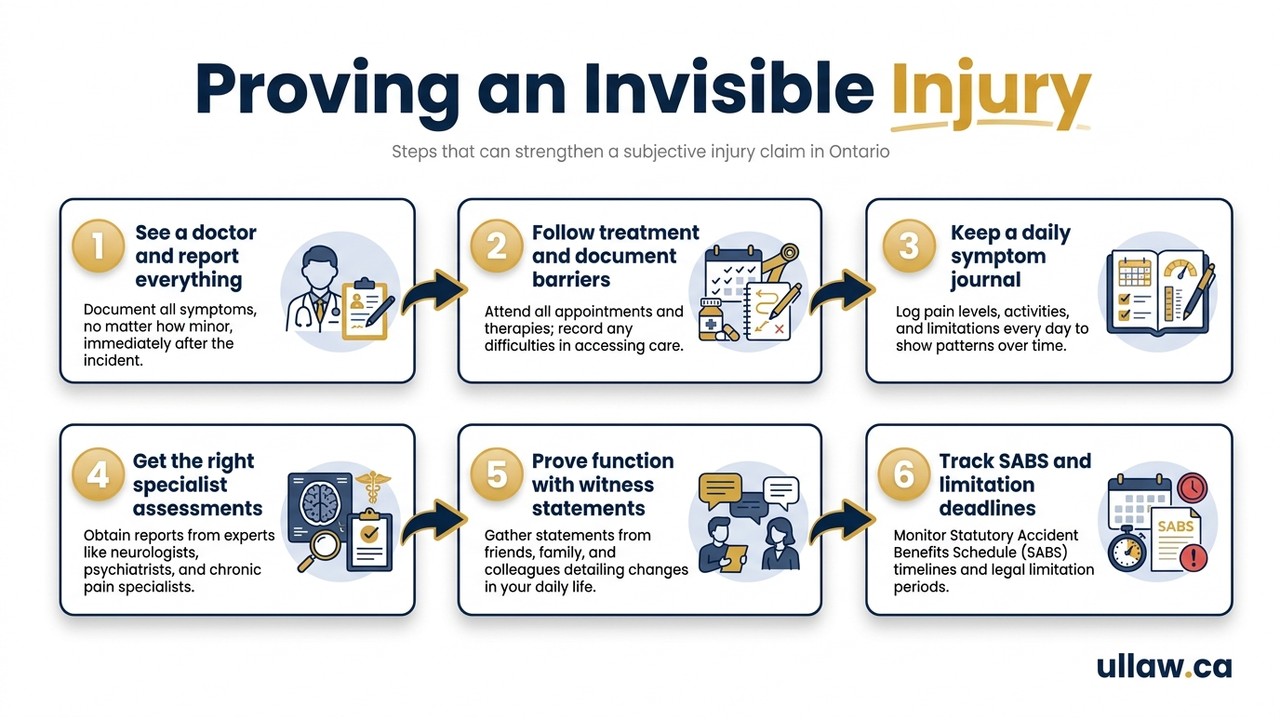
How Do You Prove a Hard-to-Prove Injury in Ontario?
No single document wins a subjective injury claim. Strong cases are usually built from consistent, overlapping evidence gathered over time.
- See a doctor promptly and report everything. Mention every symptom, including headaches, sleep problems and mood changes, even if they seem small.
- Follow treatment recommendations. Attend physiotherapy, counselling and specialist appointments. If you cannot afford treatment or cannot get there, tell your doctor and your lawyer so the reason is documented.
- Keep a pain and symptom journal. Brief daily notes about pain levels, sleep, missed activities and bad days can show patterns that one appointment cannot.
- Get the right specialists. Depending on the injury, that may mean a physiatrist, neurologist, neuropsychologist, psychologist or pain specialist.
- Document function, not just diagnosis. Functional abilities evaluations, employer records and statements from family and co-workers show how your life has actually changed.
- Gather “before” evidence. Past performance reviews, sports records and photos can show who you were before the accident.
- Be consistent and honest. Never exaggerate, but do not downplay either. Inconsistency, not the injury itself, is often what damages credibility.
- Watch your deadlines. Accident benefits have short notice requirements, and the Limitations Act, 2002 generally sets a two-year limit for starting a lawsuit, subject to exceptions.
An experienced litigation lawyer can identify gaps in the evidence early and arrange expert reports that respond directly to an insurer’s assessments.
Does a Hard-to-Prove Injury Affect Compensation?
It can, but mainly because of how much evidence is needed, not because the injury is worth less.
The Insurance Act threshold
In Ontario motor vehicle lawsuits, you can generally recover damages for pain and suffering only if your injury meets the Insurance Act threshold: a permanent serious impairment of an important physical, mental or psychological function, or permanent serious disfigurement. Subjective injuries can meet this test, and chronic pain and psychological injuries sometimes do. Meeting it, however, usually requires detailed medical evidence about permanence and real-life impact. A statutory deductible, set and indexed under the Act, may also reduce pain and suffering awards below a certain level.
Other heads of damages
Income loss, future care costs and loss of housekeeping capacity are not subject to the threshold in the same way. They depend heavily on proving functional limitations, often through vocational and economic experts.
Accident benefits
Regardless of fault, SABS benefits for income replacement, medical and rehabilitation care, and attendant care each have their own eligibility tests. Disputes go to the Licence Appeal Tribunal. Published decisions, which you can search on CanLII, show how much each case turns on its own evidence.
Hypothetical example: Two people suffer similar whiplash in similar collisions. One reported symptoms right away, saw specialists and kept a journal. The other waited months and had large treatment gaps. Even with the same injury, the first person will often be in a stronger position to show impact. That illustrates how evidence works. It is not a prediction of any result.
Talk to a UL Lawyers Team Member
If an insurer is questioning an injury you live with every day, you do not have to deal with it alone. You can book a free, no-obligation consultation with our Ontario litigation team to talk about what evidence your claim may need and what options may be open to you. We serve Burlington, the GTA and clients across Ontario.