Wrongful dismissal in Ontario is too little notice or pay in lieu—not an “unfair” reason for firing. Without-cause termination is allowed. It becomes wrongful when the package is short, benefits are cut early, or a termination clause fails the ESA. ESA minimums are the floor. Common-law notice (Bardal factors) is often months. Do not sign.
Package in hand? Call 905-744-8888 or email info@ullaw.ca. Book a free consultation. Hire path: wrongful dismissal lawyer Ontario · Ontario severance calculator. Kitchener-Waterloo employees can start on employment lawyer Kitchener. UL Lawyers meets at 552 Brant Street, Burlington, or by video across Ontario.
On this page: ESA vs common law · Bardal factors · Just cause vs constructive dismissal · What to do · Limitation period
Ontario’s termination of employment guide sets the statutory floor. Then get the common-law number checked.
Termination Without Cause in Ontario: Quick Answer
Termination without cause in Ontario means your employer is ending your job without alleging serious misconduct. For most non-unionized employees, that is allowed only if the employer provides the notice, pay in lieu, benefits continuation, and severance required by law.
The key point is this: a without-cause termination is not automatically illegal. It becomes a wrongful dismissal when the employer gives you less than your full entitlement, relies on an unenforceable termination clause, stops benefits too early, pressures you to sign a release, or handles the dismissal in bad faith.
Before signing a termination package, ask three practical questions:
- Does the offer meet at least the Employment Standards Act minimums?
- Could common law reasonable notice make the package worth much more?
- Does your employment contract actually limit you to the amount being offered?
If the answer to any of those questions is unclear, get legal advice before the employer’s deadline. Signing a release can end your ability to claim more later.
The Core of a Wrongful Dismissal Claim
Think about it this way: you’ve been a dedicated employee for 10 years. You come in one morning, and your boss tells you it’s your last day, handing you a cheque for two weeks’ pay. While that might tick the box for the absolute bare minimum, it doesn’t feel fair—and in Ontario, it usually isn’t legally sufficient.
That gap between the minimal amount you were given and what you are actually owed is the entire basis of a wrongful dismissal claim.
The real issue is almost always about the compensation package, not the reason you were let go. Unless you did something truly serious, like theft or fraud, your employer owes you a fair runway to land on your feet. This is meant to give you time to find a similar new job without suffering a major financial blow.
The Two Tiers of Your Rights
When it comes to termination pay in Ontario, your rights are built on two distinct legal foundations. Getting a handle on the difference is key to understanding what you’re truly owed.
-
The Employment Standards Act, 2000 (ESA): This is the rulebook that sets the absolute minimum notice or pay your employer has to provide. Think of it as the legal floor—the safety net. Unfortunately, many employers stop here, counting on the fact that you might not know about your greater rights.
-
Common Law: This isn’t a written statute but a massive body of law built from decades of Canadian court decisions. Common law provides for “reasonable notice,” which is almost always a much longer period—and a much larger payout—than the ESA minimums. Factors like your age, length of service, the type of job you had, and the availability of similar work all play a role in this calculation.
To quickly see the difference, here’s a simple breakdown.
Lawful vs Wrongful Dismissal at a Glance
| Element |
Lawful Termination |
Wrongful Dismissal |
| Notice Provided |
Employee receives full reasonable notice or pay in lieu, as determined by common law. |
Employee receives less than their full reasonable notice entitlement. This includes receiving only ESA minimums. |
| Just Cause |
Firing is for serious misconduct (e.g., theft, fraud), proven by the employer. No notice is required. |
No just cause exists, but the employer provides inadequate or no notice. |
| Legal Status |
The employer has met all their legal obligations under both the ESA and common law. |
The employer has breached the implied term of the employment contract to provide reasonable notice. |
| Employee’s Recourse |
No legal grounds for a wrongful dismissal claim. |
The employee can sue for damages equal to the pay and benefits they would have earned during the proper notice period. |
The bottom line is that a termination becomes “wrongful” the moment your employer fails to provide the full notice period required by common law.
Simply put, wrongful dismissal means your employer broke your employment contract by not giving you reasonable notice or pay in its place, assuming they didn’t have just cause. The most critical factor in these cases is figuring out that “reasonable” notice period, and Ontario courts are constantly refining how they do it.
When this happens, you have the right to sue for damages. The goal is to get compensation equal to the full salary, commissions, bonuses, and benefits you would have earned if you had been allowed to work through that proper notice period.
Understanding Your Termination Rights in Ontario
When you’re let go from a job in Ontario, it’s easy to feel like your employer holds all the power. But the law provides a strong safety net for employees. Your rights are actually protected by two different layers of law, and understanding how they fit together is the key to getting the fair compensation available under the law.
Think of your termination entitlements like building a house.
The first layer is Ontario’s Employment Standards Act, 2000 (ESA). This is the absolute legal minimum—the foundation and the basic building code. Every employer has to follow it, no exceptions. It sets out the bare minimum notice and, in some cases, severance pay.
But a house that only meets the minimum code isn’t finished. That’s where the second layer, common law, comes in. Common law builds on that ESA foundation, adding the walls, roof, and finishes to create a complete and fair package.

The ESA: The Legal Minimum
The Employment Standards Act is a straightforward, formula-based safety net. It tells your employer the absolute minimum amount of written notice—or pay instead of notice—they must give you.
Here’s a quick rundown of the ESA’s minimum notice periods:
- Less than 3 months of service: 0 weeks’ notice
- 3 months up to 1 year of service: 1 week’s notice
- 1 year of service or more: 1 week for each year, up to a maximum of 8 weeks.
The ESA also requires statutory severance pay for some long-term employees. You might qualify for this extra lump sum if you’ve been with the company for at least five years and their provincial payroll is $2.5 million or more.
But here’s the most important thing to remember: the ESA is the starting point, not the final word. Many employers will offer a package based only on these minimums, hoping you’ll sign it without realizing you’re entitled to more.
Common Law: The Path to Fair Compensation
While the ESA provides the floor, common law determines what’s truly fair in your specific situation. For most non-unionized employees in Ontario, common law offers a far more substantial entitlement known as “reasonable notice.”
Unlike the ESA’s simple formula, reasonable notice is a tailored assessment. It’s not capped at eight weeks; in fact, common law notice periods can go all the way up to 24 months, and sometimes even longer in exceptional situations. The goal is to give you a realistic financial cushion while you look for a similar job.
An employment lawyer determines your reasonable notice period by looking at the whole picture: your age, how long you worked there, your role and seniority, and the type of work you did.
The heart of almost every wrongful dismissal claim in Ontario is the gap between what the employer offers (usually just the ESA minimums) and what the employee is truly owed under common law. When an employer fails to provide that full common law notice, the dismissal is considered “wrongful.”
This is exactly why you should never accept a termination package without getting legal advice first. An offer that looks perfectly legal under the ESA could be leaving tens of thousands of dollars of your common law entitlements on the table.
The Employer’s Duty of Good Faith
Your employer’s obligations don’t stop at providing proper notice. In Ontario, they also have a duty to act in good faith when they let you go. This means they can’t be dishonest, misleading, or unnecessarily cruel in how they handle your termination.
If an employer acts in bad faith—by inventing a false reason to fire you, harming your reputation, or refusing to give you a Record of Employment, for example—you may be entitled to extra damages. These are called “moral” or “punitive” damages, and they’re awarded on top of your regular termination pay.
Under the Canada Labour Code, which applies to federally regulated employees, you have the right to ask for answers. If you request it, an employer must provide a written explanation for your termination within 15 days. You can find more details on federal labour standards and termination rights on the Government of Canada’s website. This rule reinforces the employer’s responsibility to be transparent and treat you fairly.
How Is Common Law Notice Calculated in Ontario?
When you’re let go from your job without proper cause, one of the biggest questions is: what am I actually owed? It’s a common misconception that there’s a simple formula, like one month of pay per year of service. The reality is far more nuanced.
Calculating your rightful notice period is more of an art than a science. It all comes back to a landmark court case from 1960, Bardal v. The Globe & Mail Ltd., which established the core principles that courts in Ontario still use today. These are known as the “Bardal factors.”
Think of these factors not as a rigid checklist, but as a set of considerations that help a judge understand your specific situation. The ultimate goal is to determine a “reasonable notice” period—basically, a fair amount of time (and pay) to help you bridge the gap while you search for a comparable new job.
The infographic below illustrates how the Bardal factors are used by Ontario courts to determine reasonable notice in wrongful dismissal cases.
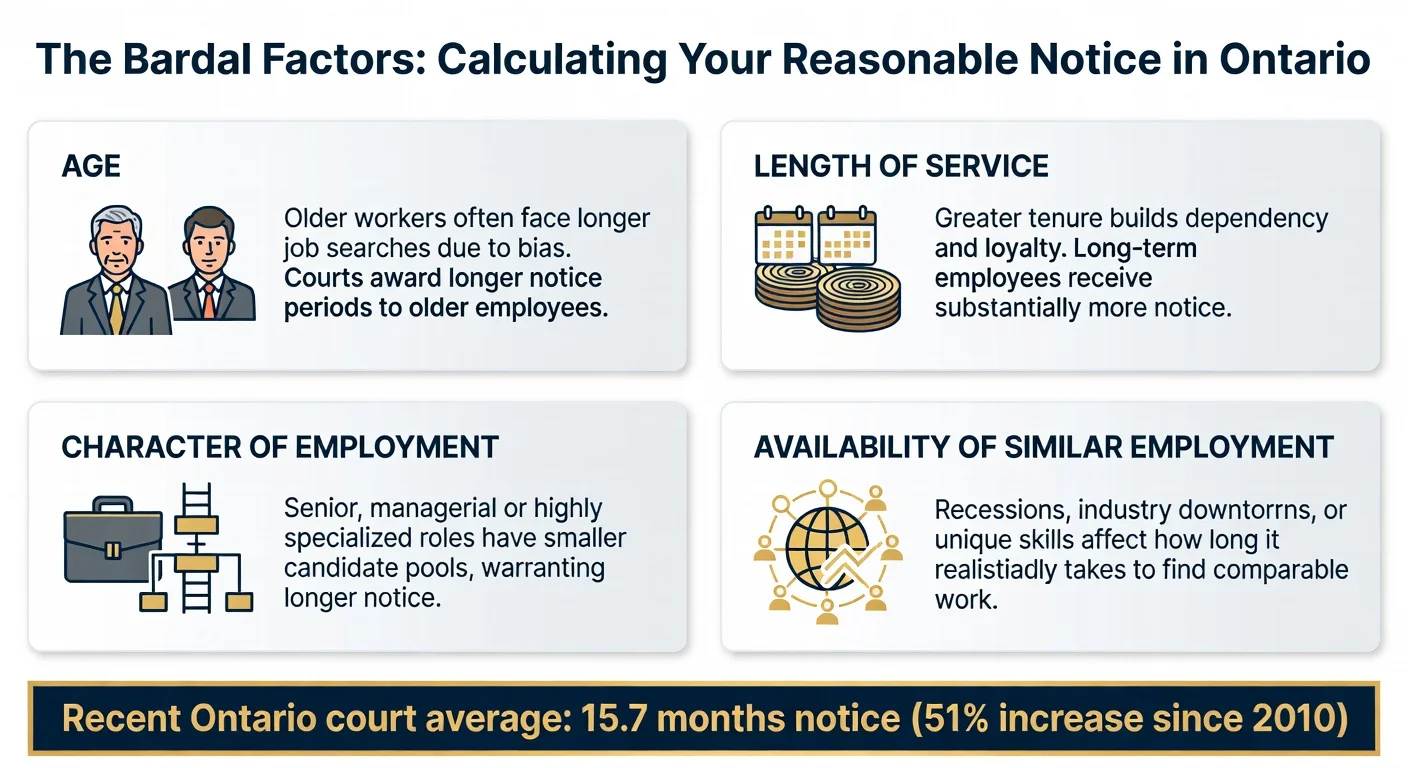
This helps put the entire process into perspective, showing that when a fair resolution can’t be reached, the courts step in to apply these very factors to your case.
The Four Key Bardal Factors
Ontario courts carefully weigh four main factors to figure out what’s fair. They all interconnect, painting a full picture of your circumstances.
1. Your Age
Let’s be blunt: age matters in the job market. Courts are not naive to this reality. They consistently recognize that older workers often have a much tougher time finding new, comparable employment. Age-related biases are real, and the pool of available senior-level jobs is naturally smaller.
- Real-world example: A 58-year-old marketing director with 15 years at a company will almost certainly be awarded a longer notice period than a 28-year-old marketing coordinator with the same 15 years of service. It’s understood that the 58-year-old faces a steeper uphill battle to replace their income and seniority.
2. Your Length of Service
This one is pretty straightforward. The longer you’ve been with an employer, the more you are generally owed. The law acknowledges that long-term employment creates a level of dependency and loyalty that deserves greater protection when it’s suddenly taken away.
- Real-world example: An accountant who has dedicated 22 years to one firm has built their entire professional life there. Their notice period would be substantially longer than that of a colleague who joined just three years ago. The long-serving employee has lost a significant amount of stability and career investment.
3. The Character of Your Employment
This factor looks at your role and seniority within the company. Were you a senior executive, a manager with direct reports, or someone in a highly specialized, niche field? The more specialized or senior your role, the longer your notice period is likely to be.
Why? Because the job hunt is fundamentally different. There are simply fewer comparable positions available at that level.
The bottom line is this: The more unique or senior your job was, the smaller the pool of potential new employers. The courts provide a longer runway to account for the time it will realistically take to find a similar opportunity.
- Real-world example: A Chief Financial Officer (CFO) will be entitled to a much longer notice period than a junior data entry clerk from the same company. The market for C-suite talent is incredibly small and competitive compared to the market for entry-level administrative roles.
4. The Availability of Similar Employment
Finally, the courts look at the world outside the company’s doors. What did the job market look like when you were terminated? If you were let go during a recession or when your entire industry was contracting, it’s obviously going to take you longer to find work.
- Real-world example: An automotive engineer let go during a major downturn in the auto sector would likely receive a longer notice period. On the flip side, if their skills were in exceptionally high demand with companies actively recruiting, the notice period might be slightly moderated (though still significant).
It’s clear that courts are adapting these decades-old factors to modern realities. In fact, in the three years leading up to 2024, the average notice period awarded in court climbed to 15.7 months. That’s a staggering 51% increase from the baseline average between 1970 and 2010.
This trend shows that judges are increasingly aware of the genuine challenges people face when trying to find new work today.
Just Cause vs. Constructive Dismissal: Understanding the Nuances
When we talk about wrongful dismissal in Ontario, two terms inevitably pop up and often cause confusion: just cause and constructive dismissal. It helps to think of them as two very different, almost opposite, ways a job can end. One is the employer’s last resort for serious misconduct, and the other is a termination in disguise.
Let’s break them down.
The High Bar of “Just Cause”
Think of a “just cause” termination as the workplace equivalent of a capital offence. It’s when an employer fires you on the spot—no notice, no severance, no warning—for something you’ve done that is so serious it has irreparably shattered the trust in your employment relationship.
We’re not talking about being late a few times or missing a single deadline. The bar for an employer to prove just cause is set incredibly high by the courts. They need clear, compelling evidence that your actions were so severe, they had no other choice but to let you go immediately.
So, what kind of behaviour actually meets this standard?
Generally, just cause might be argued in situations involving:
- Theft or Fraud: Any proven act of dishonesty, from stealing company property to manipulating expense reports.
- Serious Insubordination: This isn’t just disagreeing with your boss. It’s deliberately and repeatedly refusing to follow lawful and reasonable instructions, effectively undermining management’s authority.
- Gross Negligence: Behaving so recklessly that you put the company’s finances, reputation, or other employees at serious risk.
- Violence or Serious Harassment: Any action that creates an unsafe, toxic, or poisoned work environment for your colleagues.
Simply being a poor performer or making an honest mistake almost never counts. If an employer fires you for “just cause” without rock-solid proof, they have wrongfully dismissed you.
The Hidden Termination: Constructive Dismissal
Now, let’s flip the coin. Constructive dismissal is a much sneakier—but no less serious—form of wrongful dismissal. This is what happens when your employer doesn’t actually fire you with words, but instead makes a major, negative change to your job without your agreement.
The core idea is that the employer has fundamentally altered the job you were hired to do, effectively making your original role disappear. You’re then put in a tough spot: either accept the new, worse reality, or leave and claim you were forced out.
Imagine your landlord decides to remove your front door and windows but doesn’t formally evict you. You technically still have a place to live, but the fundamental nature of your home has been so drastically altered that you have no choice but to leave. That’s a perfect analogy for constructive dismissal.
The law sees this as a breach of your employment contract and treats it as if you were fired without any notice.
What Does Constructive Dismissal Look Like in the Real World?
Not every change at work is a constructive dismissal. The change has to be substantial and strike at the very heart of your employment agreement. You also can’t wait around forever; if you continue working under the new conditions for too long, the law might decide you’ve accepted them.
Here are a few classic examples that Ontario courts frequently see:
- A Major Pay Cut: If your employer unilaterally cuts your salary or changes your commission structure, a reduction of 15% or more is often seen as a fundamental breach.
- A Demotion: Being stripped of your title, losing key responsibilities, or having your team taken away from you, even if your pay stays the same.
- A Forced Relocation: Being told you have to move to a new office or territory that makes your commute significantly longer or more challenging.
- A Poisoned Work Environment: When an employer allows harassment, bullying, or a toxic atmosphere to fester to the point where any reasonable person would feel they couldn’t continue working there.
If you’re facing one of these situations, don’t just quit. Your first step should be to get legal advice to confirm whether the changes are significant enough to be considered a constructive dismissal. To learn more about how Ontario courts interpret employment agreements and why unclear language often benefits the employee, check out the resources at UL Lawyers Professional Corporation.
What to Do If You Think You’ve Been Wrongfully Dismissed
Losing your job is a shock. Realizing your employer may have acted unfairly can feel even worse. It’s a stressful, disorienting time, but the first few steps you take are absolutely critical to protecting your rights. Think of this as your roadmap for what to do next.
First, and this is the most important rule of all: do not sign any termination papers or a release without speaking to a lawyer first. Your employer might present these documents as standard procedure, something you just have to sign. In reality, signing them almost always means you’re accepting their offer and giving up your right to any further compensation.

Your Immediate Action Plan
Once the initial shock wears off, it’s time to get organized. A methodical approach now will build the strongest possible foundation if you decide to make a claim later.
Start by gathering every piece of paper related to your job. Create a dedicated file, either physical or digital, and make sure it includes:
- Your Employment Contract: The original agreement you signed when you started.
- The Termination Letter: This is your employer’s official reason for letting you go.
- Records of Employment (ROEs): You’ll need these to apply for Employment Insurance (EI).
- Pay Stubs and T4 Slips: These are proof of your salary, bonuses, and other earnings.
- Performance Reviews: Good reviews from the past can be powerful evidence against any claims of poor performance.
After you’ve gathered your documents, start writing everything down. Jot down notes about conversations, meetings, and events that led up to your dismissal. Be specific with dates and times if you can. You’d be surprised how much a detailed, written record can help down the road.
You Have a “Duty to Mitigate”
Here’s something many people don’t know: after being terminated, you have a legal responsibility to try and lessen your financial losses. This is called the “duty to mitigate.”
In simple terms, the courts in Ontario expect you to make a real, honest effort to find a similar new job. It’s crucial to keep a detailed log of this job search. Track every application you send, every interview you have, and even your networking efforts. This log is your proof that you did your part.
Failing to mitigate your losses can actually reduce the amount of compensation you might receive from a lawsuit. The goal is to show that you did everything you reasonably could to get back on your feet financially.
Don’t Miss the Two-Year Deadline
In Ontario, the clock starts ticking the moment you are dismissed. The Limitations Act, 2002, sets a strict time limit for filing a lawsuit. You generally have two years from the date you were terminated to take legal action for wrongful dismissal.
If you let that deadline pass, you will almost certainly lose the right to pursue the compensation you’re owed. That’s why it’s so important to get legal advice quickly. As awareness of employee rights grows, more people are standing up for themselves. In fact, recent data shows a 27% surge in wrongful termination claims over the past year. You can discover more insights about wrongful termination settlements and what might be behind this trend.
Getting in touch with an employment lawyer right away is the best way to ensure you don’t miss any deadlines and can make clear, informed decisions about your next steps.
Can You Sue If You Are Fired Without Cause in Ontario?
Yes. Without-cause firing is allowed, but the package must meet the ESA floor and common-law notice unless a valid termination clause limits you. If the offer is only ESA weeks, a civil claim is often the route to months of pay.
You typically have two paths:
- ESA complaint to the Ministry of Labour — free, capped at statutory minimums.
- Wrongful dismissal claim in the Ontario Superior Court of Justice or Small Claims Court (up to $35,000) for common-law reasonable notice.
Filing an ESA complaint can affect a civil claim for the same termination. Get advice before you choose. Signing a release usually ends both.
Fired and holding an offer? Do not sign. Call 905-744-8888 or email info@ullaw.ca. Book a free consultation, hire a wrongful dismissal lawyer in Ontario, or run the Ontario severance calculator. Kitchener-Waterloo files: employment lawyer Kitchener.
Related UL Lawyers resources
- Employment law in Ontario — termination, severance, and workplace issues.
- Wrongful dismissal services — notice, cause allegations, and claim deadlines.
- Employment lawyer Kitchener — local Waterloo Region hire page if the job was in Kitchener, Waterloo, Cambridge, or Guelph.
- Ontario severance pay calculator — first estimate before you sign.
- Wrongful termination payouts in Canada — ESA vs common-law ranges, up to about 24 months.
- ESA termination pay Ontario — the 1–8 week statutory floor.
- Signs of constructive dismissal — pay cut, demotion, or a poisoned workplace.