
The phone rings within hours of your collision. It’s a friendly voice from the insurance company — yours, the other driver’s, or both — asking you to “just go over what happened.” It feels routine. It isn’t.
Every word you say to an insurance adjuster is recorded and can be used to reduce or deny your claim. Adjusters are professionally trained to gather information that protects the insurer’s bottom line. That’s not cynicism — it’s simply how the system works under Ontario’s Insurance Act and the standard auto policy. Knowing what not to tell your insurance company after a motor vehicle accident may be one of the most important things you do for your recovery and your rights.
This guide walks you through the key statements to avoid, the tactics adjusters often use, and the warning signs that your claim may be heading in the wrong direction. If you’ve already been in a crash, our motor vehicle accident legal team can review your situation before you say anything more.
Table of Contents
- What Not to Tell Your Insurance Company After an Accident
- 1. “I’m fine” or “I wasn’t hurt”
- 2. “It was partly my fault” or “I didn’t see them”
- 3. Detailed, off-the-cuff accounts of how the crash happened
- 4. “I accept your settlement offer”
- 5. Information about your social media activity
- 6. Speculation or guesses
- 7. Medical history beyond what’s directly relevant
- What Insurance Companies Don’t Want You to Know
- What to Say — and Not Say — to an Insurance Adjuster
- What Are Red Flags in an Insurance Claim?
- Which Insurer Handles Your Claim — and Why It Matters
- How a Lawyer Can Help You Navigate Insurer Conversations
What Not to Tell Your Insurance Company After an Accident
Here are the most damaging things claimants commonly say — and why each one can undermine your position.
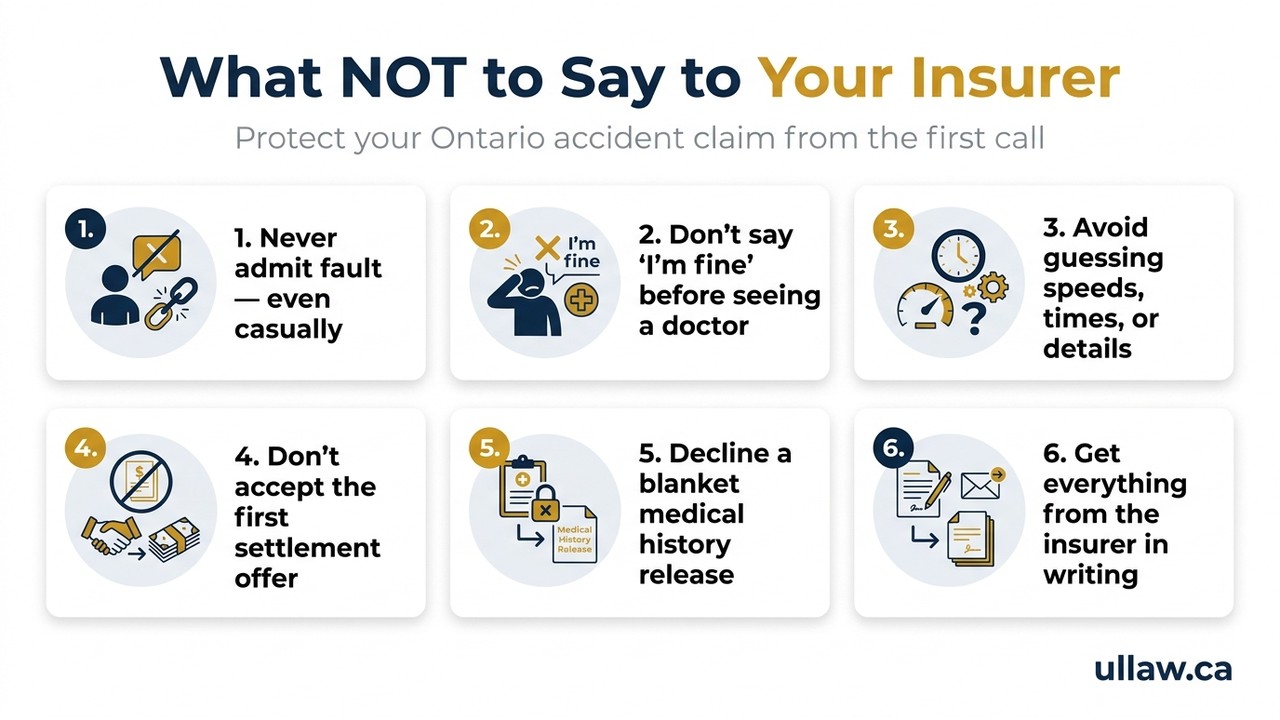
1. “I’m fine” or “I wasn’t hurt”
Symptoms from whiplash, soft-tissue injuries, concussion, and spinal trauma often don’t appear for 24 to 72 hours. Saying you feel fine at the scene or in an early phone call gives the insurer a recorded statement it can use to argue your injuries were minor — or caused by something else entirely. Never speculate about your physical condition before you’ve seen a doctor.
2. “It was partly my fault” or “I didn’t see them”
Ontario operates under a contributory negligence framework. Admitting even partial fault — even casually — can reduce your damages proportionally. Fault determination is a legal and factual question. Leave it to the investigation.
3. Detailed, off-the-cuff accounts of how the crash happened
Memory is imperfect, especially after trauma. If your early account differs slightly from what witnesses, cameras, or accident reconstructionists later show, the insurer will use that inconsistency against you. Keep your initial statements brief: the time, the location, the vehicles involved.
4. “I accept your settlement offer”
Accepting a quick settlement — especially before the full extent of your injuries is known — almost always releases the insurer from future liability. Once you sign, there is typically no going back, no matter how your condition worsens.
5. Information about your social media activity
Insurers routinely investigate claimants’ social media profiles. Don’t volunteer that you’ve been posting, travelling, or exercising. Better yet, limit your social media activity entirely while your claim is active.
6. Speculation or guesses
If you don’t know the answer to a question — your speed, the exact time, whether the light was red or yellow — say so. “I don’t know” is a complete, honest, and legally safe answer. Guessing invites contradiction.
7. Medical history beyond what’s directly relevant
Adjusters may ask broad questions about your general health, prior accidents, or pre-existing conditions. Ontario’s standard auto policy does require you to cooperate, but you are not obliged to narrate your entire medical past unprompted. Speak with a lawyer before disclosing pre-existing conditions — context matters enormously to how that information is used.
What Insurance Companies Don’t Want You to Know
Understanding the insurer’s playbook helps you protect yourself. Here are realities adjusters rarely volunteer:
-
You have the right to legal representation before giving a formal statement. Nothing in the Ontario Insurance Act requires you to give a recorded statement to the other driver’s insurer at all. Your own insurer has more latitude to require cooperation, but even then, a lawyer can help you prepare.
-
Early offers are almost always low. The first settlement offer typically arrives before your prognosis is clear, before specialist assessments are complete, and before income loss has fully crystallised. Insurers know claimants are stressed and may accept fast money.
-
Independent Medical Examinations (IMEs) are arranged by the insurer. The doctor conducting the IME is paid by the insurer. Their report may downplay your injuries. You have the right to bring your own medical evidence, and to have a lawyer review the IME report before you respond to it. Refusing to attend a properly noticed insurer examination can have severe consequences: in Can You Lose Accident Benefits for Missing an Insurer Exam in Ontario? (2026 CanLII 115048 (ON LAT)), the Tribunal dismissed a claimant’s application, and her refusal to attend properly noticed insurer examinations was one of two independent grounds for doing so.
-
Statutory accident benefits (SABs) have strict deadlines. Under the Statutory Accident Benefits Schedule (SABS) — part of Ontario’s auto insurance framework — benefits must be applied for within specific timeframes. Missing a deadline can forfeit entitlements. You can review the framework through Ontario’s e-Laws portal. For example, the Licence Appeal Tribunal dismissed a claim where the claimant waited over four months to notify their insurer and could not show a reasonable explanation for the delay — a stark reminder that these timelines are strictly enforced.
-
You can dispute denials at the Licence Appeal Tribunal (LAT). If the insurer denies or reduces your accident benefits, you have the right to dispute that decision at the Licence Appeal Tribunal. Most claimants don’t know this option exists, let alone how to use it effectively.
What to Say — and Not Say — to an Insurance Adjuster
Think of a conversation with an adjuster the way you’d think of a job interview: be polite, be honest, but be measured.
DO:
- Confirm the basic facts: date, time, location, vehicles involved.
- Say you are still being assessed by medical professionals when asked about injuries.
- Tell them you’ll have your lawyer or representative contact them if you’ve retained one.
- Ask for everything in writing — offers, decisions, requests for information.
- Keep your own notes of every conversation: date, time, name of adjuster, what was discussed.
DON’T:
- Agree to a recorded statement without speaking to a lawyer first.
- Speculate about fault, speed, or the other driver’s intentions.
- Downplay pain or discomfort (“it’s not that bad, really”).
- Discuss your finances or how urgently you need a settlement.
- Accept or reject any offer on the spot.
Adjusters may be pleasant and empathetic — that is part of effective claims management. Maintaining boundaries is not rude; it’s prudent. Use our personal injury settlement calculator to get a rough sense of what factors shape the value of a claim before any conversation about numbers.

What Are Red Flags in an Insurance Claim?
Both insurers and claimants can spot red flags — but for a claimant, the more important skill is recognising when the insurer’s conduct is signalling trouble for your claim.
Red flags that your claim may be in trouble:
- Unusually fast settlement offer — pressure to settle before you understand your injuries.
- Requests for a blanket medical release — giving the insurer access to your entire medical history, not just records related to the accident.
- Repeated delays in responding to benefit applications — particularly around the SABs timelines.
- An IME that dismisses your symptoms without adequately engaging with your treating physicians’ findings.
- Surveillance — if you notice anyone photographing or following you, it is worth telling your lawyer immediately.
- Benefit cutoffs at the 12-week or 2-year mark — Ontario’s SABs framework has specific transition points where benefit eligibility criteria change. A sudden denial at one of these thresholds is a known pressure tactic.
Red flags in your own conduct to avoid:
- Inconsistent statements across different conversations or forms.
- Social media posts that contradict your reported limitations.
- Missing medical appointments — gaps in treatment are used to suggest your injuries resolved.
- Failing to report all symptoms to your doctor — if it hurts, say so and have it documented.
Which Insurer Handles Your Claim — and Why It Matters
Ontario uses a no-fault accident benefits system, meaning you apply for statutory accident benefits through your own insurer regardless of who caused the crash. If the other driver was at fault, you may also have a tort claim — a lawsuit for pain and suffering, income loss beyond SABs limits, and other damages — against that driver (and, practically, their insurer).
This means you may be dealing with two separate insurers simultaneously, each with different interests and different staff. Keep the interactions completely separate. What you tell one may not automatically reach the other, but inconsistencies across the two files can and do surface during litigation.
The question of which insurer to “stay away from” is less about brand names and more about how any insurer responds to your specific claim. Signs of an insurer acting in bad faith — repeated unjustified delays, misrepresenting your policy, or coercing a quick settlement — may themselves have legal consequences for the insurer under Ontario law. Document everything.
For guidance specific to your situation, our motor vehicle accident team can help you understand your rights against both your own insurer and the at-fault driver’s insurer.

How a Lawyer Can Help You Navigate Insurer Conversations
Retaining a lawyer early — ideally before giving any formal statement — changes the dynamic significantly.
- Your lawyer speaks for you. Many insurers must direct formal communications through your representative once you’ve notified them of legal counsel.
- Recorded statements can be reviewed and prepared. If your own insurer legitimately requires a statement under the SABs cooperation clause, a lawyer can help you prepare accurate, complete, and strategically sound answers.
- Medical evidence is organised and presented properly. Lawyers experienced in motor vehicle accidents know which specialists, assessments, and reports carry weight — and how to counter an IME that minimises your injuries.
- Deadlines are tracked. The SABs framework under Ontario’s e-Laws is deadline-driven. Missing an application or appeal window can permanently foreclose benefits.
- Settlement value is assessed independently. You’ll know whether an offer is fair before you accept it, using a full picture of your past and future losses — not the insurer’s framing.
Most personal injury lawyers in Ontario work on a contingency fee basis, meaning you pay no upfront legal fees. The lawyer’s fee comes from the settlement or award. This makes experienced representation accessible regardless of your financial situation while you recover.
Talk to a UL Lawyers Team Member
If you’ve been in a motor vehicle accident in Ontario and an insurer has already called, you don’t have to navigate that conversation alone. Contact UL Lawyers for a free, no-obligation consultation — we’ll review what’s been said, what your rights are, and how to protect the full value of your claim from this point forward.