
The day after a serious car accident, deadlines are probably the last thing on your mind. You are dealing with injuries, missed work, and an insurance company that seems to call every other day. But in Ontario, the clock starts ticking almost immediately — and missing a deadline can mean losing your right to any compensation at all, regardless of how strong your case might be.
The short answer to whether you can still claim after three years depends entirely on what kind of claim you are making. Ontario’s accident claims system has two separate streams — no-fault accident benefits and tort (lawsuit) claims — and each comes with its own deadlines, its own regulator, and its own consequences for missing the cutoff. The rules are not always obvious, and the gaps between them have surprised many injured Ontarians.
This article walks you through every key deadline you need to know, the limited exceptions that may preserve a late claim, and the situations — such as claims involving children, incapacitated adults, or municipal defendants — where different rules apply. If you are worried you have already run out of time, read this first, then speak with a lawyer before assuming the door is shut.
Table of Contents
- Can You Still Claim for an Accident After 3 Years?
- What Is the Time Limit to Claim After a Motor Vehicle Accident in Ontario?
- Does the Statute of Limitations Apply Differently to Accident Benefits vs. Tort Claims?
- When Can a Late Claim Still Proceed? Exceptions to Know
- What Should You Do If You Think You May Have Missed the Deadline?
- How Long After an Accident Can You Make a Claim in Canada?
Can You Still Claim for an Accident After 3 Years?
In most Ontario motor vehicle accident cases, the answer is no — but the full picture is more nuanced than a flat cutoff.
For a tort claim (a civil lawsuit against an at-fault driver), Ontario’s Limitations Act, 2002 sets a basic limitation period of two years from the date you discovered — or ought to have discovered — that you had a claim. If that two-year window passed more than a year ago and no lawsuit has been issued, you are likely out of time for the tort side.
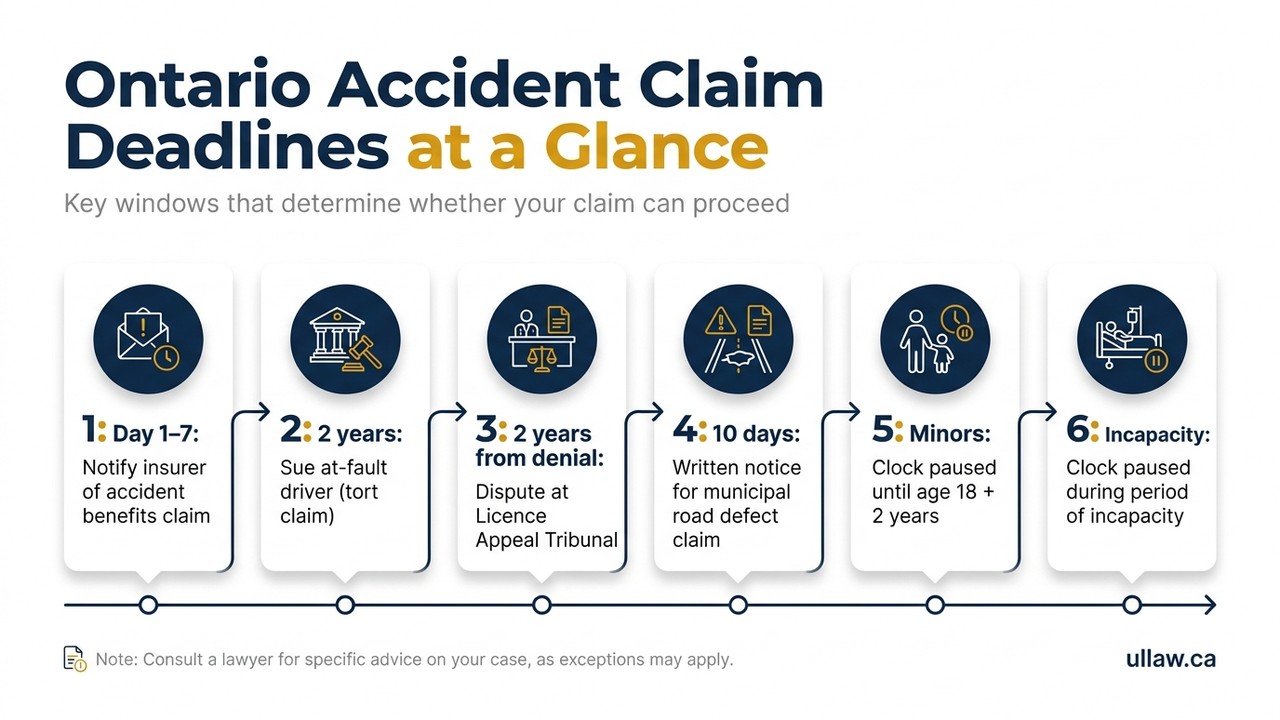
For no-fault accident benefits (the benefits paid by your own insurer regardless of fault), the deadlines are even tighter. The Statutory Accident Benefits Schedule (SABS) requires you to notify your own insurer within seven days of the accident, or as soon as practicable after that. Applications for specific benefits then carry their own deadlines — typically two years from the date an insurer denies a benefit or stops paying it, to bring a dispute to the Licence Appeal Tribunal (LAT).
So where does three years fit? By the three-year mark:
- Your tort limitation period will almost certainly have expired (barring a rare exception).
- Your accident benefits dispute window at the LAT will also have passed for most benefit categories.
- Any claim against a municipality for a road defect must have been preceded by written notice within 10 days of the accident — a deadline that is long gone.
There are limited exceptions — for minors, for people who lacked mental capacity, and in cases where injuries were genuinely latent and undiscoverable. But these are narrow. If you are approaching or past three years, you need a lawyer’s opinion immediately, not a general article.
What Is the Time Limit to Claim After a Motor Vehicle Accident in Ontario?
Ontario does not operate on a single universal deadline. The right question is which claim and which clock.
No-Fault Accident Benefits: The 7-Day Notice Rule
The SABS requires that you notify your own auto insurer no later than seven days after the accident that you intend to claim accident benefits — or as soon as reasonably practicable if you could not meet that window. This is not a soft guideline. Two recent LAT decisions illustrate the stakes:
- In Missed Accident Benefits Deadline: What Happens in Ontario? (2026 CanLII 112114 (ON LAT)), the Tribunal dismissed a claim where a pedestrian waited over two and a half years to notify her insurer, finding she had no reasonable explanation for the delay — and that her earlier WSIB filing showed she was aware of her injuries far sooner.
- In Can a Late Accident Benefits Claim Be Barred in Ontario? (2026 CanLII 89452 (ON LAT)), a claimant who notified his insurer nearly seven months after the accident was similarly barred. The Tribunal found no reasonable explanation, and held that the insurer’s prejudice from the delayed investigation outweighed the hardship to the claimant.
Neither decision means every late claim is automatically dead — but both confirm that the bar for excusing delay is high.
Tort Claims: Two Years From Discovery
If you want to sue the at-fault driver, the Limitations Act, 2002 gives you two years from the date you discovered (or ought reasonably to have discovered) that:
- you suffered an injury;
- the injury was caused by the other party’s negligence; and
- a lawsuit would be an appropriate remedy.
In most accidents, that discovery happens on the day of the collision itself. The two-year clock starts ticking immediately.
LAT Disputes: Two Years From Denial
If your insurer denies or stops paying a specific accident benefit, you have two years from the date of that denial to apply to the LAT to dispute it. Miss that window and you may be permanently barred from that particular benefit category.
Quick Reference
| Claim Type | Key Deadline |
|---|---|
| Accident benefits notice | 7 days (or as soon as practicable) |
| LAT dispute of a denied benefit | 2 years from denial |
| Tort lawsuit (civil claim) | 2 years from discovery |
| Notice of claim against municipality | 10 days from incident |
| Claims involving minors or incapacity | Clock paused — see below |
Does the Statute of Limitations Apply Differently to Accident Benefits vs. Tort Claims?
Yes — and understanding the difference could save your case.
Accident Benefits: Governed by the SABS, Not the Limitations Act
Accident benefits are a creature of statute, regulated under Ontario’s Insurance Act and the SABS. The limitation rules that govern when you can dispute a denial at the LAT come from the SABS itself, not from the general Limitations Act, 2002. This means:
- The seven-day notice obligation is specific to accident benefits and has no equivalent in the tort system.
- The two-year dispute window runs from the insurer’s denial — not from the accident date. If your insurer never formally denied a benefit, the window may not have opened yet (though you should not rely on this without legal advice).
- The LAT will assess late notices using a three-part balancing test: the prejudice to the insurer, the hardship to the claimant, and overall fairness. The claimant bears the burden of showing a reasonable explanation — both subjectively and objectively.
Tort Claims: The Limitations Act, 2002 Applies
A lawsuit against an at-fault driver is a civil claim governed by the Limitations Act, 2002. The key features are:
- The basic limitation period is two years from discovery.
- There is also an ultimate limitation period of 15 years from the act or omission — but this rarely matters in accident cases where the injury is immediately apparent.
- The Insurance Act (Ontario) also requires you to give written notice of a tort claim to any defendant insurer within a specific period. Missing this can complicate — though not automatically kill — your lawsuit.
The Practical Difference
You can lose your accident benefits claim very quickly (within days of the accident) if you fail to notify your insurer, while your tort claim can remain alive for two years from when you discovered the injury. These are parallel streams — losing one does not automatically affect the other. But many people assume their insurer will handle everything, and discover too late that the no-fault side has already been forfeited.
For a plain-language breakdown of what accident benefits cover, see our Accident Benefits in Ontario: Your 2026 Guide.

When Can a Late Claim Still Proceed? Exceptions to Know
The limitation rules are strict — but they are not absolute. Several important exceptions can preserve a claim that would otherwise be barred.
Minors (Persons Under 18)
Under the Limitations Act, 2002, the two-year tort limitation period does not begin to run while a claimant is a minor, unless they have a litigation guardian. This means a child injured in a car accident may have until their 20th birthday (two years after turning 18) to issue a lawsuit — even if the accident happened years earlier.
This is one of the most significant exceptions in Ontario personal injury law. If your child was injured and you assumed it was too late, speak with a lawyer before accepting that conclusion.
Mental Incapacity
The limitation period is also tolled (paused) under the Limitations Act, 2002 for any period during which a claimant is incapable of commencing a proceeding because of a physical, mental, or psychological condition — and does not have a litigation guardian. If a serious brain injury, psychiatric episode, or other incapacitating condition prevented you from acting, the clock may not have been running during that period.
The Discovery Rule
Some injuries are not immediately apparent. Soft tissue damage, traumatic brain injuries, and psychological conditions (such as PTSD following a collision) can take months or even years to manifest or be properly diagnosed. The Limitations Act, 2002 anchors the two-year period to the date of discovery — when you knew or ought reasonably to have known about the injury and its cause. Where injuries were genuinely latent and undiscoverable, the limitation period may start later than the accident date.
Accident Benefits: Reasonable Explanation for Delay
As the two LAT decisions discussed above confirm, a late accident benefits notice can be excused — but only where the claimant provides a credible, reasonable explanation that holds up both personally and against the standard of a reasonable person in similar circumstances. Medical evidence showing the injuries prevented earlier action carries the most weight.
Claims Against Municipalities
If your accident involved a road defect — a pothole, missing sign, icy surface left unaddressed — you may have a claim against a municipality under the Municipal Act, 2001 or the City of Toronto Act, 2006. These claims require written notice to the municipality within 10 days of the incident. This deadline is extremely short and rarely preserved after the fact. If a road hazard contributed to your accident, this notice must be a priority — not an afterthought.
What Should You Do If You Think You May Have Missed the Deadline?
Do not assume the door is permanently closed without getting legal advice. Here is what to do right now:
- Write down everything you remember about the accident, your injuries, and every step you have taken since — including any communications with your insurer or other parties.
- Gather your documents: the collision report, any insurer correspondence (especially denial letters), medical records, and anything you filed with WSIB or other programs.
- Do not contact the other driver’s insurer or make any statements before speaking with a lawyer. Anything you say can be used to assess when you “discovered” your claim — which matters for limitation purposes.
- Ask a lawyer to calculate your specific deadlines. The discovery rule, minors’ exception, and incapacity exception all require a fact-specific analysis. A general article cannot tell you whether your window is still open.
- Act immediately. Even if you think you are past the deadline, some exceptions are time-sensitive themselves — a court application to extend time must be brought promptly once you know you may need it.
You can also use our personal injury settlement calculator to get a preliminary sense of the value of your claim while you gather information — but do not let that process delay contacting a lawyer.
For more on how to navigate every step of an Ontario car accident claim, visit our motor vehicle accident practice page.

How Long After an Accident Can You Make a Claim in Canada?
Canada does not have a single national deadline for motor vehicle accident claims. Personal injury law — including limitation periods — is provincial jurisdiction, so the rules differ across the country. Here is a brief comparison:
- Ontario: 2-year tort limitation period from discovery (Limitations Act, 2002); 7-day notice for accident benefits under the SABS.
- British Columbia: Generally a 2-year limitation period under the Limitation Act (B.C.), but ICBC (the province’s public insurer) has its own specific notice and application requirements.
- Alberta: 2-year limitation period under Alberta’s Limitations Act, with specific notice rules under the province’s direct compensation scheme.
- Quebec: Civil law rules apply; different prescription periods govern depending on the type of claim and the SAAQ (public auto insurer).
If your accident happened outside Ontario but you live in Ontario — or vice versa — the choice of which province’s law applies can itself be a legal question. Cross-border accidents (including those involving Quebec, New York State, or other U.S. states) add further complexity around applicable insurance and jurisdiction.
The safest rule across every Canadian province: contact a lawyer as soon as possible after any accident, and do not assume you have more time than you do.
Talk to a UL Lawyers Team Member
If you are worried about a deadline — whether the accident was last week or last year — the most important step is to get a clear legal opinion before assuming it is too late. At UL Lawyers Professional Corporation, we offer a free consultation to help you understand exactly where you stand and what options may still be available. Contact our team today — the sooner you reach out, the more options we can protect.