
What is the 7-day notice rule for Ontario accident benefits?
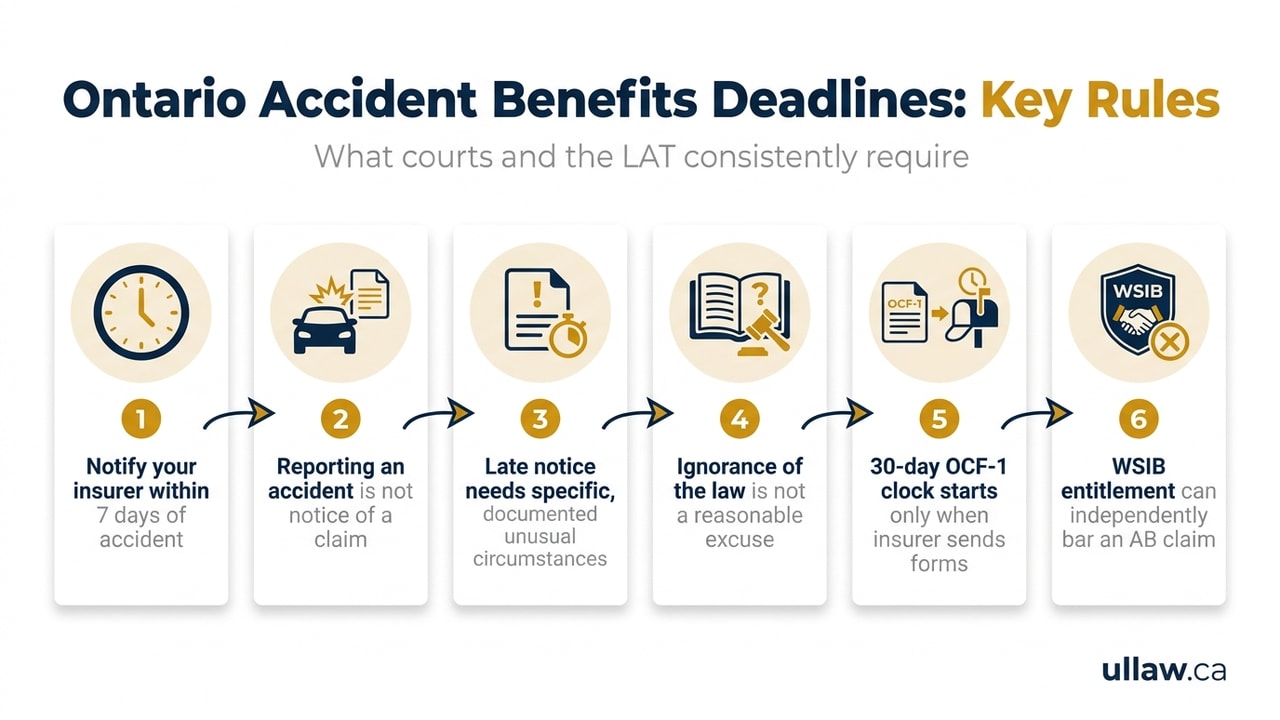
Anyone injured in a motor vehicle accident in Ontario must notify their own auto insurer of their intention to claim accident benefits within seven days of the accident, or as soon as practicable after that. This deadline is not a soft guideline — missing it without a credible, objectively reasonable explanation can permanently bar a claim at the Licence Appeal Tribunal.
Four of the six decisions discussed here turned on this exact rule. In Can Late Accident Benefit Notice Be Excused in Ontario?, 2026 ONCA 651, the Court of Appeal confirmed that simply reporting an accident to an insurer is not the same as giving notice of an intention to claim benefits — these are two legally distinct steps. The Court restored the LAT’s original decision denying relief, emphasising that the statutory text means what it says. In Can a Late Accident Benefits Claim Be Barred in Ontario?, 2026 CanLII 89452 (ON LAT), a claimant who waited nearly seven months received no relief, and the Tribunal explicitly noted that passengers in someone else’s vehicle may need to notify their own insurer — not just the driver’s insurer — of a potential claim.
When can a late notice be excused?
Late notice is not automatically fatal. Section 34 of the Statutory Accident Benefits Schedule preserves a claimant’s rights when there is a reasonable explanation for missing the deadline. Courts and the LAT apply a two-stage test: the explanation must be credible (believable on the facts) and objectively reasonable (consistent with what a reasonable person in similar circumstances would have done).
The clearest example of a successful excuse is Can You Claim Accident Benefits Late in Ontario?, 2026 CanLII 97255 (ON LAT), where a claimant who notified his insurer more than a year after the accident was still allowed to proceed. What distinguished this case was a combination of unusual facts: the accident involved an assault and criminal proceedings, there was no standard collision report, and the claimant had no prior experience with the accident benefits system. The LAT weighed those factors together and found the explanation reasonable. The insurer’s subsequent reconsideration request was dismissed, with the Vice-Chair reaffirming that reconsideration is not a second chance to re-argue a case simply because a party disagrees with the outcome.
By contrast, in When Is It Too Late to Claim Accident Benefits in Ontario? — a 2026 LAT decision where no CanLII citation is available — a claimant who waited over four months provided no corroborating medical evidence linking her symptoms to the accident, and the Tribunal found her explanation neither credible nor objectively reasonable.
Does ignorance of the law count as a reasonable excuse?
On its own, not knowing you had to report does not qualify as a reasonable explanation. Every decision in this group is consistent on this point. The LAT in Missed Accident Benefits Deadline: What Happens in Ontario?, 2026 CanLII 112114 (ON LAT) held that a pedestrian who waited over two and a half years could not rely on ignorance of the law, particularly because she had sought medical attention on the day of the accident and her employer had reported the accident to the WSIB the very next day — facts that weighed heavily against a later claim of not knowing the injuries were serious enough to report.
The 2026 LAT decision in Can a Late Accident Benefits Claim Be Barred in Ontario? reached the same conclusion: explanations based on language barriers, an assumption that a fellow passenger’s insurer would cover everything, and a belief that injuries were not serious enough were all rejected as falling short of the objective reasonableness standard.
What the successful claimant in Can You Claim Accident Benefits Late in Ontario? had that the unsuccessful claimants did not was a specific, unusual set of circumstances — not merely a general claim of not knowing the rules.
How does the LAT weigh hardship against prejudice to the insurer?
When a claimant does offer an explanation, the Tribunal balances three factors: the prejudice the insurer suffered from the delay (such as losing the opportunity to investigate while evidence was fresh), the hardship the claimant faces if benefits are denied, and whether it is fair in all the circumstances to excuse the late notice.
In Can a Late Accident Benefits Claim Be Barred in Ontario?, 2026 CanLII 89452 (ON LAT), the Tribunal found the insurer’s prejudice outweighed the claimant’s hardship and dismissed the application under section 55(1) of the Schedule. In When Is It Too Late to Claim Accident Benefits in Ontario?, the absence of any medical documentation linking injuries to the accident until well after the application was filed was a decisive factor against the claimant. Consumer protection principles — recognising that accident victims are often in a vulnerable position — do inform the analysis, as the LAT confirmed in Can You Claim Accident Benefits Late in Ontario?, 2026 CanLII 97255 (ON LAT), but those principles cannot substitute for a credible, evidence-supported explanation.

What is the 30-day OCF-1 rule, and when does it start?
Once an insurer is notified of an intention to claim, it must provide the accident benefits application package. The claimant then has 30 days from receiving those forms to submit a completed OCF-1 application. The critical point confirmed in Can an Insurer Deny Accident Benefits for a Late OCF-1 in Ontario?, 2026 CanLII 89428 (ON LAT) is that the 30-day countdown only begins once the insurer has actually provided the forms. If the insurer never sends the package, the deadline is never triggered.
The same decision affirms that insurers have a positive duty to assist accident victims — not just to ask once whether someone was hurt on the day of the accident. Because injuries can take days or weeks to become apparent, a single inquiry at the scene is not enough to discharge the insurer’s obligation to provide the application package and explain available benefits. The LAT ordered the claim to proceed to a hearing on the merits, though it noted that the claimant will still need to prove her injuries and losses at that hearing.
Can a WSIB entitlement bar an accident benefits claim entirely?
Yes, in some circumstances. In Missed Accident Benefits Deadline: What Happens in Ontario?, 2026 CanLII 112114 (ON LAT), the pedestrian claimant was barred on two independent grounds: the late notice without a reasonable explanation, and her entitlement to WSIB benefits, which precluded her from claiming accident benefits under the Schedule. The decision does not establish a general rule that pedestrians cannot access accident benefits — pedestrians are entitled to claim under Ontario’s auto insurance system — but it illustrates that entitlement to WSIB benefits can operate as a separate and complete bar, independent of any notice issue.

What these decisions have in common
Across all six decisions, a consistent pattern emerges. The seven-day notice obligation is strictly applied. Late claims succeed only when claimants can point to specific, unusual circumstances — supported by contemporaneous evidence — that explain why a reasonable person in their position could not have notified the insurer sooner. General explanations (not knowing the rules, assuming someone else would handle it, believing injuries were minor) have not succeeded. Insurers, for their part, cannot use procedural bars they helped create: where an insurer never sent the application package, the LAT refused to let the insurer rely on the resulting delay. The Court of Appeal has confirmed that the LAT’s factual findings on credibility are entitled to deference and cannot be overturned simply because a reviewing court might weigh the evidence differently.
If you were injured in a collision anywhere in Ontario — whether in Burlington, Hamilton, Mississauga, Brampton, Oakville, Milton, Toronto, Etobicoke, Kitchener, or elsewhere — these decisions underscore how quickly procedural deadlines can affect your rights under Ontario’s motor vehicle accident compensation system.
Questions and records to discuss with a lawyer
- When exactly did you notify your insurer? The date of first contact matters, and so does whether that contact was a general accident report or a specific notice of intention to claim benefits — the Court of Appeal has confirmed these are not the same thing.
- What medical records exist from the days and weeks immediately after the accident? Contemporaneous records linking symptoms to the collision have been a decisive factor in whether late-notice explanations succeed.
- Did your insurer send you an accident benefits application package? If not, the 30-day OCF-1 deadline may not have started running.
- Were you working at the time of the accident, and was a WSIB claim filed? WSIB entitlement can operate as an independent bar to accident benefits, separate from any notice issue.
- What were the specific circumstances that prevented earlier notification? The more unusual and documented those circumstances, the stronger the foundation for a reasonable-explanation argument.
This guide summarises published decisions and is general information, not legal advice. Every case turns on its own facts.