
Can you file a workplace injury lawsuit in Ontario? Usually not against your own employer if they have WSIB coverage. You generally can sue a negligent third party — another contractor, a manufacturer, or a property owner — for damages WSIB does not pay, including pain and suffering.
Quick answer: WSIB is no-fault and bars most employer lawsuits. A third-party claim is a separate track. Hire a WSIB lawyer, or a litigation lawyer if a negligent third party caused the injury. Call 905-744-8888 or email info@ullaw.ca. You can also book a free consultation.
If you’ve been injured on the job in Ontario, your mind probably jumps straight to the Workplace Safety and Insurance Board (WSIB). In some cases a workplace injury lawsuit against a negligent third party is the step that recovers damages WSIB does not pay.
Understanding Your Rights After a Workplace Injury

Getting hurt at work, whether in the Greater Toronto Area or anywhere else in Ontario, is overwhelming. You’re suddenly juggling medical bills, lost paycheques, and a whole lot of uncertainty. It’s so important to know that you might have more than one option for compensation. The two main paths—a WSIB claim and a third-party lawsuit—are fundamentally different, and knowing which one applies to you is key.
Think of the WSIB system as a type of no-fault insurance. Most employers in Ontario are legally required to contribute to it. In exchange, if you get hurt doing your job, you can receive benefits for lost wages and healthcare without needing to prove your employer was at fault. The trade-off is that you generally can’t sue your own employer or co-workers for the injury. If you want to dive deeper, you can explore our guide covering WSIB insurance in Ontario.
When a Lawsuit Becomes an Option
So, what if someone other than your employer or a co-worker caused your injury? This is exactly where a workplace injury lawsuit enters the picture. The law preserves your right to sue a negligent third party whose actions, or lack thereof, led to you getting hurt.
This opens up the possibility of claiming compensation for damages not covered by WSIB, most notably for your pain and suffering.
Let’s look at a few real-world examples that could pave the way for a lawsuit:
- A roofer is injured when a driver from a different supply company carelessly drops a load of materials from above.
- An office worker slips and falls on a dangerously icy walkway because the contracted snow removal company failed to salt it properly.
- A factory worker is badly hurt by a brand-new machine that had a critical manufacturing defect.
In each of these situations, the person or company at fault isn’t the employer—it’s a third party. This critical distinction unlocks your right to pursue a personal injury lawsuit to secure full and fair compensation for everything you’ve lost.
When Can You File a Workplace Injury Lawsuit?
Many injured workers in Ontario figure that filing a claim with the Workplace Safety and Insurance Board (WSIB) is their only option. And while the WSIB is the right path for most, it’s not the end of the story. There are specific, and often missed, situations where you can file a workplace injury lawsuit—a legal action that could lead to far more comprehensive compensation.
Figuring out if you have this option is the first step to getting the full support you actually deserve. It all boils down to one simple question: who was responsible for your injury? If the blame lies with someone other than your direct employer or a co-worker, the door to a lawsuit might just be open.
Suing a Negligent Third Party
The most common reason to launch a workplace injury lawsuit is when a “third party” is at fault. A third party is just any person or company—separate from your own employer—whose carelessness caused you to get hurt.
Think of it this way: your employer’s WSIB coverage is like a shield. It protects them and your colleagues from being sued directly by you. But that shield doesn’t cover anyone else. This is a critical detail that keeps your right to take legal action against other negligent people or companies intact.
Here are a few real-world examples to make it clearer:
- Defective Equipment: A piece of machinery you’re using malfunctions and injures you. You might have a solid case against the company that designed or manufactured that equipment.
- Another Company’s Employee: A delivery driver from a different company hits you in the loading bay. Or maybe a subcontractor on your construction site leaves a hazard that causes you to fall.
- Property Owner Negligence: You’re working at a client’s location and slip on an icy, unsalted walkway. The property owner or their snow removal contractor could be held responsible for not keeping it safe.
In situations like these, you can still have your WSIB claim. But you also have a separate, independent right to sue the third party who was actually at fault.
A third-party lawsuit allows you to seek compensation for things WSIB simply won’t cover, like damages for your pain and suffering. For many people, this is the only way to be made whole again after a serious injury turns their life upside down.
When Your Employer Isn’t Covered by WSIB
There’s another major exception, and it has to do with the industry you work in. While most businesses in Ontario must have WSIB coverage (we call these ‘Schedule 1’ employers), some are exempt. These are known as ‘Schedule 2’ employers.
These industries operate outside of the standard WSIB system. And because they aren’t forced to pay into it, their employees keep the right to sue them directly if an on-the-job injury is caused by the employer’s own negligence.
You’ll often find Schedule 2 employers in sectors like:
- Banks and financial services
- Airlines and other federally regulated transport companies
- Municipalities and local government boards
- Telecommunications companies
If you’re hurt on the job while working for a Schedule 2 employer, a personal injury lawsuit against your company might be your main path to compensation. Getting through these claims means knowing your rights and what’s available. For a deeper dive, you can read our breakdown of the different types of workers’ compensation benefits in Ontario.
Your Step-by-Step Guide to the Legal Process
The thought of filing a lawsuit can be intimidating, but it’s really just a structured process with a clear goal: getting you the fair compensation available under the law. Think of it as a roadmap. There are specific stages, and each one gets you a little closer to a resolution. Let’s walk through what the journey of a workplace injury lawsuit in Ontario actually looks like, step by step.
It all starts with a simple conversation. The right advice is the foundation for everything that follows, helping you understand your rights and what your claim could be worth.
The Initial Consultation: Your First Step
First things first: you need to talk to a personal injury lawyer. Reputable firms offer a free, no-obligation consultation, which is your chance to tell your story in a safe, confidential space. You’ll go over how the injury happened and, just as importantly, how it has turned your life upside down.
During this chat, the lawyer is listening for one key thing: was your injury caused by the negligence of a third party? That’s the crucial element that opens the door to a lawsuit outside of the WSIB system. They’ll also explain how their fees work, which is almost always on a contingency basis—meaning you pay no upfront legal fees.
Building Your Case with Evidence
If you and your lawyer decide to move ahead, the real work begins. This is the investigation phase, where your legal team starts gathering all the proof needed to build a rock-solid case.
This isn’t as complicated as it sounds. It usually involves:
- Getting official accident reports from your workplace or the police.
- Collecting all your medical files, from the initial emergency room visit to ongoing specialist appointments.
- Rounding up any photos or videos of the accident scene and your injuries.
- Speaking with anyone who witnessed the incident.
This collection of evidence becomes the backbone of your claim. It tells the story of what happened and proves the full impact of your injuries and financial losses.
A strong case is built piece by piece with solid evidence. Each document, photo, and statement helps to paint a clear picture of the other party’s negligence and the true impact the injury has had on your life.
Filing the Statement of Claim
Once enough initial evidence is gathered, your lawyer will draft and file a Statement of Claim. This is the formal legal document that officially kicks off your lawsuit. It’s filed with the Ontario Superior Court of Justice and then “served” to the person or company you’re suing (the defendant).
The Statement of Claim lays out the essential facts of your case, including:
- Who you are (the plaintiff) and who you are suing (the defendant).
- A clear description of how, when, and where you were injured.
- The specific actions (or inactions) that made the defendant negligent.
- A detailed account of your injuries and the compensation you’re seeking.
This document legally requires the defendant and their insurance company to respond, officially getting the ball rolling.
The Discovery Phase: Sharing Information
With the lawsuit underway, both sides enter a phase called Discovery. This is a critical part of the process where everyone has to put their cards on the table, sharing all relevant information and documents about the case.
Discovery usually involves written questions and an interview under oath called an Examination for Discovery. The defendant’s lawyer will ask you questions, and your lawyer will do the same to the defendant. The goal here is to get all the facts straight, understand the strengths and weaknesses on both sides, and avoid any surprises if the case ends up in a courtroom. To learn more about the fundamentals of personal injury cases, you can explore our detailed article on the law on personal injury.
Negotiation, Mediation, and Settlement
The vast majority of personal injury cases in Ontario—well over 95%—never actually see the inside of a courtroom. Once Discovery is complete, both sides have a much clearer picture of the case, which is when serious settlement talks usually begin.
A key part of this is mediation, a mandatory meeting where everyone gets together with a neutral third-party mediator. Your lawyer, the defendant’s lawyer, and an insurance adjuster will all be there. The mediator’s job isn’t to pick a side but to help guide the conversation toward a settlement that everyone can agree on.
As you navigate the legal process for your workplace injury, selecting the right legal representation is a critical step. Having a skilled negotiator in your corner can make all the difference in these discussions. An external resource on how to choose a personal injury attorney can provide some valuable insights here. If a fair agreement is reached in mediation, your case is over. If not, your lawyer will be ready to take the next step and fight for you at trial.
Building a Strong Foundation for Your Case
Think of your workplace injury case as a structure that needs to be built on solid ground. That ground is evidence. Every document, photograph, and witness statement you gather acts as a critical building block, reinforcing your claim and proving exactly how this injury has turned your life upside down.
You and your legal team are partners in this process. The more detailed and organized you are from day one, the stronger your position becomes. It’s this early, proactive work that often makes the biggest difference when it’s time to negotiate a fair settlement.
The path from injury to resolution generally follows a few key stages, from that first conversation with a lawyer to, hopefully, a final settlement.
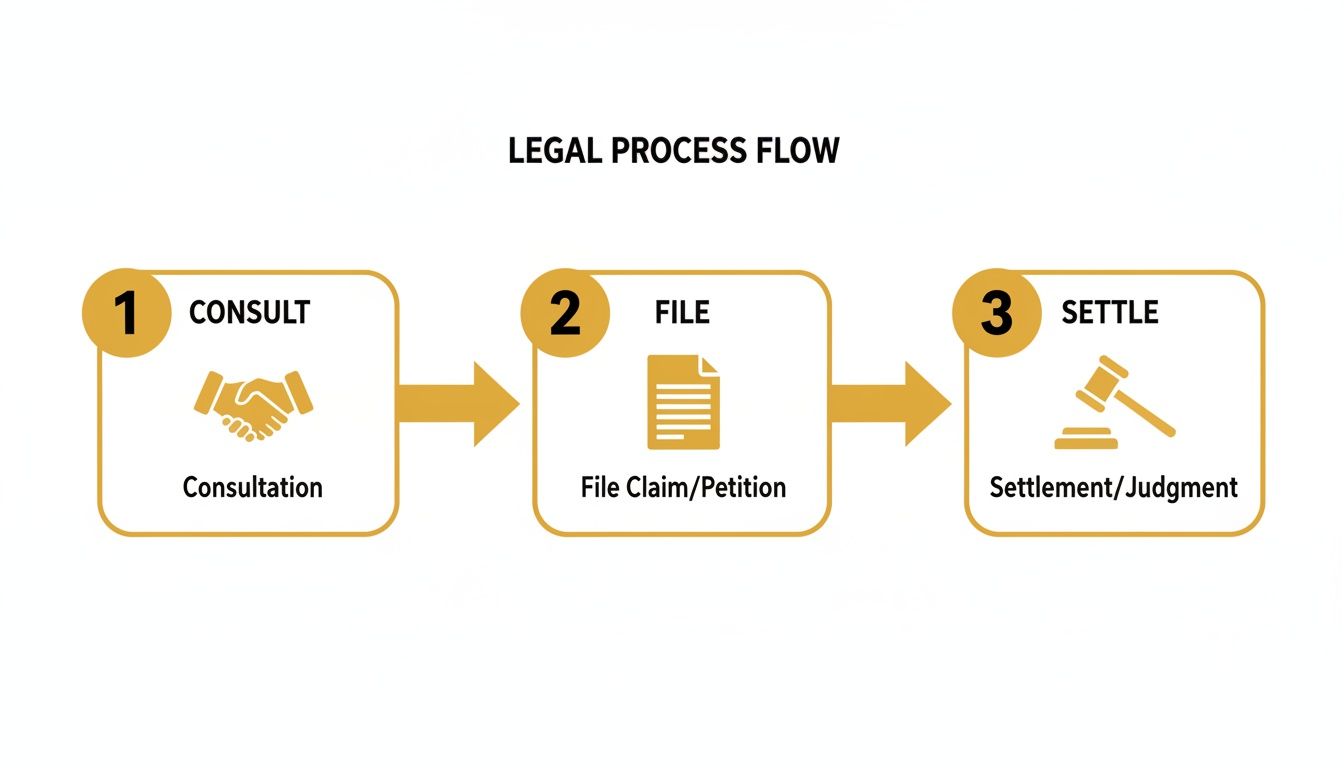
As you can see, the journey typically moves from consultation to filing a claim, with the majority of cases ultimately being resolved through a settlement.
Your Essential Evidence Checklist
To build a compelling case, your lawyer will need your help gathering some key pieces of information. Each item helps tell a part of your story, from the moment the accident happened to the ongoing impact on your health, family, and finances.
Here’s what you should focus on collecting:
- Official Incident Reports: This is the formal report you filed with your employer. If the police or the Ministry of Labour, Training and Skills Development were called to the scene, their reports are also absolutely essential.
- Photographs and Videos: Visuals are incredibly powerful. If you can, take clear pictures of the accident scene, whatever caused your injury (like a wet floor with no sign or a piece of faulty equipment), and your injuries as they heal.
- Witness Information: Get the names, phone numbers, and email addresses of anyone who saw what happened. An independent account of the events can be invaluable.
- Your Own Detailed Notes: As soon as you are able, write down everything you can remember. Note the date, time, location, and exactly what happened, step by step. Memories fade, so do this quickly.
Documenting Your Medical Journey
Your medical records are the backbone of your claim. They provide the objective, professional proof of your injuries and the treatment you’ve needed. It’s crucial to keep a complete file of every single medical interaction you have.
This file should include:
- The names and contact info for all doctors, specialists, physiotherapists, and any other healthcare providers you’ve seen.
- The dates of every appointment, test, and treatment you undergo.
- Copies of all medical reports, imaging results (like X-rays or MRIs), and prescribed treatment plans.
- Receipts for all out-of-pocket expenses, including prescriptions, therapy sessions, and medical devices like crutches or braces.
A meticulously organized medical file is non-negotiable. It creates an undeniable link between the accident and your injuries, justifying the compensation you’ll need for both your current and future care.
Tracking Your Financial Losses
A serious injury doesn’t just hurt your body; it hits your wallet, hard. To recover what you’ve lost, you need to track every single dollar you’re out because of the accident.
Start a simple log or spreadsheet to keep track of:
- Lost Wages: Hold onto your pay stubs from before and after the injury. They provide a clear picture of your income loss.
- Out-of-Pocket Expenses: This is everything from parking fees at the hospital to paying for help with yard work or cleaning because you’re no longer able to do it yourself.
- Travel Costs: Note the mileage and keep receipts for gas or transit fares for every trip you make to a medical appointment.
While every case is unique, many injuries fall into common categories. Repetitive strain injuries, for example, affect thousands of workers who perform tasks like typing or lifting day in and day out. You can learn more by checking out the latest workers’ compensation statistics and facts from RiversideWorkInjuryAttorney.com.
Critical Timelines and Legal Deadlines You Must Know

When it comes to legal matters, timing isn’t just important—it’s everything. Missing a key deadline isn’t a simple slip-up; it can permanently close the door on your right to seek compensation. If you’re considering a workplace injury lawsuit in Ontario, you absolutely must act quickly to protect your rights.
The most critical deadline comes from Ontario’s Limitations Act, 2002. This law sets the basic time limit for most personal injury claims. In simple terms, you have two years from the date your injury occurred to file a lawsuit. This two-year clock is incredibly strict. If you miss it, your case will almost certainly be dismissed before it even gets started.
But what happens when an injury isn’t obvious right away? The legal system has a way of dealing with that.
The Discoverability Principle Explained
That two-year clock doesn’t always start ticking on the exact day you got hurt. Instead, Ontario law applies what’s called the discoverability principle. This means the countdown begins the moment you knew—or reasonably should have known—that you had a potential legal claim on your hands.
Here’s a practical example: imagine you were exposed to a toxic chemical at a third-party worksite. You felt fine for years, but then you’re diagnosed with a related illness three years later. In this case, the two-year clock would likely start from the day of your diagnosis, not the day of the exposure. That’s the point you “discovered” the harm and its likely cause.
The discoverability rule is there to ensure fairness, especially for people with injuries that take time to appear. However, it can be legally complicated. Pinpointing the exact date of discovery is a crucial step where having an experienced personal injury lawyer is invaluable.
Special Rules for Suing Government Bodies
You also need to be aware of much shorter, stricter deadlines if your lawsuit involves a government body. For example, if your injury was caused by a municipal employee’s negligence or happened on city property (like a poorly maintained sidewalk), you could have as little as 10 days to give formal, written notice of your plan to sue.
If you miss that short notice period, you could be barred from suing, even if you’re still well within the main two-year limitation period. These tight timelines underscore just how vital it is to get legal advice immediately after an accident. To learn more about how these deadlines work, you can read our detailed overview of the statute of limitations in Canada. Moving quickly is always your best strategy to make sure no crucial deadline is missed.
Calculating the Full Value of Your Claim
When you’ve been seriously hurt at work, true compensation isn’t just about covering your immediate medical bills. To figure out the full value of a workplace injury lawsuit, you have to look at every single way the injury has impacted your life. Ontario law breaks these impacts—what we call “damages”—into two main buckets that together paint the complete picture of your losses.
The whole point is to secure a financial award that helps put you back in the position you would have been in if the accident had never occurred. This means we need to account for both the clear-cut, out-of-pocket expenses and the very real, but less tangible, human cost of your injury.
Pecuniary Damages: The Tangible Financial Losses
Pecuniary damages are the most concrete part of your claim. Simply put, they are the specific, calculable financial losses you’ve had to bear because of your injury. Think of them as the economic domino effect triggered by the accident.
Your legal team’s job is to meticulously track down and document every one of these costs. This builds a solid foundation for your claim, showing exactly what you need financially, not just for today but for years to come.
These damages almost always include:
- Past and Future Income Loss: This starts with the wages you’ve already lost from being off work. Then, we calculate the income you’re likely to lose in the future because your injuries prevent you from returning to your old job or working at the same capacity.
- Medical and Rehabilitation Costs: This covers any treatment not paid for by OHIP. We’re talking about things like physiotherapy, chiropractic care, prescription drugs, and crucial psychological counselling.
- Future Care Costs: We have to think long-term. This category anticipates your future needs, which could include more surgeries, assistive devices like wheelchairs or braces, modifications to your home to make it accessible, or even personal support worker services.
- Out-of-Pocket Expenses: This is a catch-all for all the other little costs that add up, like mileage and parking for medical appointments or hiring someone to help with housekeeping and yard work you can no longer do.
To get an objective measure of what the future looks like, we often rely on a Functional Capacity Evaluation (FCE). It’s a critical assessment that helps us quantify an injured person’s ability to work and what kind of care they will need down the road.
Non-Pecuniary Damages: The Human Cost
The second category, non-pecuniary damages, is designed to compensate you for the kinds of losses that don’t come with a price tag. This is the compensation for your physical pain, your emotional suffering, and the loss of your ability to enjoy life the way you used to.
Of course, no amount of money can truly undo what you’ve been through. But these damages are the legal system’s way of formally acknowledging the profound personal toll an injury takes.
In Ontario, there’s a limit on how much can be awarded for these “pain and suffering” damages. This cap is adjusted each year for inflation and was set by the Supreme Court of Canada. It means your award is calculated by comparing your situation to the most severe, catastrophic injury cases.
Figuring out this amount involves a deep look at how the injury has affected your:
- Day-to-day physical and emotional pain.
- Ability to enjoy hobbies, play sports, or even just socialize with friends.
- Relationships with your family and loved ones.
- Overall quality of life and independence.
This is a very complex area of personal injury law. For a deeper dive, I recommend reading our guide on claiming pain and suffering damages in Ontario. By putting together a strong case for both your financial (pecuniary) and human (non-pecuniary) losses, a good lawyer can fight for a settlement that truly reflects everything you’ve lost.
Common Questions About Workplace Injury Lawsuits
Getting hurt at work throws your life into chaos. Suddenly, you’re not just dealing with pain, but with a mountain of questions and uncertainty about your future. It’s completely normal to feel overwhelmed. Let’s walk through some of the most frequent questions we hear from injured workers across Ontario, from Toronto to Burlington, to give you some real-world answers.
Our aim here is to cut through the legal jargon and give you the straightforward information you need to see the path forward.
Can I Sue My Employer Directly in Ontario After a Work Injury?
For the most part, no. The system in Ontario is built around a trade-off. If your employer is covered by the Workplace Safety and Insurance Board (WSIB), you get access to no-fault benefits. In exchange, you can’t sue your employer or co-workers for your injury. This is the bedrock of the workers’ compensation system.
But there are crucial exceptions. A workplace injury lawsuit is a real possibility if your employer isn’t one of the industries required to have WSIB coverage (think banks or airlines, for example). More often, though, a lawsuit comes into play when your injury was caused by the negligence of a third party. This could be anyone from another contractor on a construction site to the company that manufactured a faulty piece of equipment you were using.
What if My WSIB Claim Was Denied? Can I Sue Instead?
This is a common and understandable point of confusion. A WSIB denial doesn’t automatically open the door to suing your employer. Your first and most important step is to appeal that denial within the WSIB system itself. It’s a formal process that can sometimes go all the way to the Workplace Safety and Insurance Appeals Tribunal (WSIAT).
A lawsuit is a totally separate track, one that hinges on proving negligence from an outside party. A skilled personal injury lawyer can work on two fronts simultaneously: fighting the WSIB denial through the appeals process while also investigating if you have a valid case against a negligent third party. This ensures you’re not leaving any potential compensation on the table.
Think of it this way: appealing a WSIB decision is about fighting for your benefits within the system. A lawsuit is about holding a negligent outside party accountable for their role in your injury. They are two different paths to justice.
How Much Does It Cost to Hire a Workplace Injury Lawyer?
We get it—the last thing you need when you’re off work is another bill. That’s why personal injury lawyers in Ontario almost always work on a contingency fee agreement.
What does that mean for you? It means you pay absolutely nothing upfront. No retainers, no hourly fees. Your lawyer’s payment is a set percentage of the money they recover for you at the end of the case.
Put simply: if your matter does not result in a recovery, you do not pay legal fees. This levels the playing field, making sure that everyone, regardless of their financial situation, can get focused legal help when they need it most.
Is It Likely That My Case Will Go to Trial?
Probably not. In fact, it’s highly unlikely. The vast majority of personal injury claims in Ontario, including those for workplace injuries, never see the inside of a courtroom. Well over 95% of cases are resolved through negotiation and settlement beforehand.
Our job is to get you the strong outcome efficiently. While we prepare every case as if it’s headed for trial—that’s what makes us strong negotiators—the goal is almost always to secure fair compensation for you without the time, cost, and stress of a formal trial.
Finding your way after a workplace injury is tough, but you don’t have to figure it out on your own. If you’re wondering whether you have a case, call 905-744-8888 or email info@ullaw.ca for a free consultation. You can also book online.
Related UL Lawyers resources
If a workplace injury has become a lawsuit, benefits dispute, or insurance issue, call UL Lawyers at 905-744-8888 or email info@ullaw.ca. These pages may help you choose the next step:
- Civil litigation services — hire page if a third-party workplace injury lawsuit is the track.
- Employment law services — hire page for WSIB denials, LOE cut-offs, and Intent to Object clocks.
- Long-term disability services — hire page if crash or workplace injuries opened a private LTD file.
- Personal injury settlement calculator — estimate, then call 905-744-8888.