A denied WSIB claim can feel like the system has already made up its mind. You reported the injury, saw doctors, filled out forms, and still received a letter saying the Workplace Safety and Insurance Board will not pay benefits, will cut off support, or will not accept part of your claim.
That letter is not always the end of the road.
In Ontario, many WSIB decisions can be challenged, but the appeal is deadline-driven and evidence-driven. The strongest appeals do not simply say the decision was unfair. They identify the exact reason WSIB denied the claim and answer that reason with medical records, workplace evidence, functional information, and a clear legal argument.
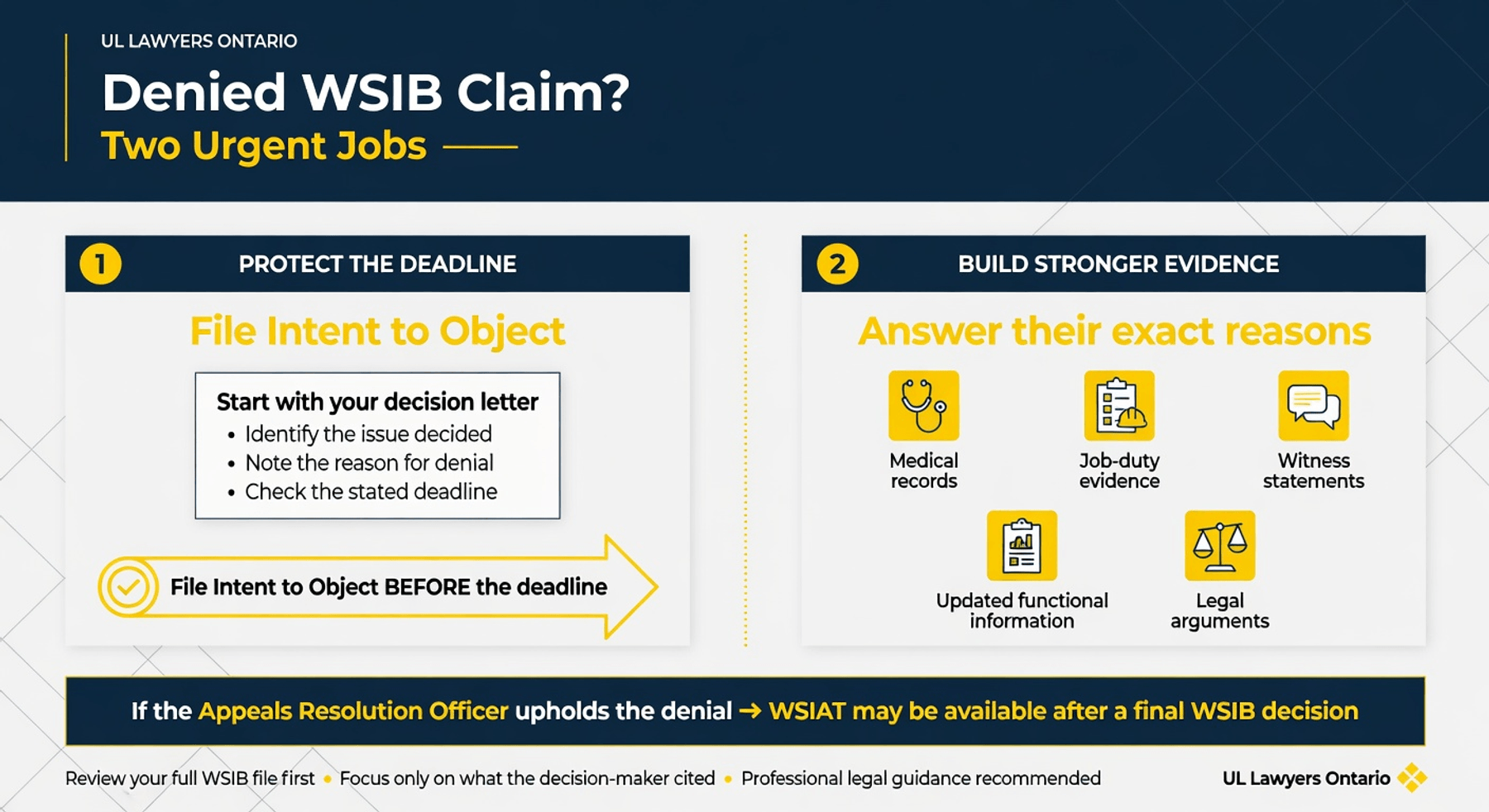
Ontario overview: A WSIB denial usually creates two urgent jobs: protect the appeal deadline and build better evidence. WSIB states that return-to-work decisions generally have a 30-day objection deadline, while many other decisions have a six-month deadline. WSIAT appeals from final WSIB decisions generally have a six-month timeline. File the Intent to Object on time. Hire a WSIB lawyer. Call 905-744-8888 or email info@ullaw.ca if the clock is running. You can also book a free consultation.
This guide explains what to do after a denied WSIB claim, how the internal appeal process works, when WSIAT becomes involved, and what evidence can make the difference.
Table of Contents
- Quick Answer: What Should You Do If WSIB Denies Your Claim?
- Why WSIB Claims Get Denied
- WSIB Appeal Deadlines in Ontario
- How the WSIB Appeal Process Works
- Evidence Checklist for a Stronger WSIB Appeal
- What Not to Do After a WSIB Denial
- Workplace Injury Lawsuit vs WSIB Appeal
- When Legal Help Can Change the Appeal Strategy
- Sources and Next Steps
Quick Answer: What Should You Do If WSIB Denies Your Claim?
If WSIB denies your claim, start with the decision letter. Find the date of the letter, the issue decided, the appeal deadline, and the reason WSIB gave. Then file the required objection form before the deadline, even if you are still collecting documents.
Your appeal should focus on the reason for the denial. If WSIB says your injury is not work-related, you need evidence connecting the injury to your job duties or incident. If WSIB says a pre-existing condition caused your symptoms, you need medical evidence explaining how the workplace accident caused, worsened, or materially contributed to your current disability. If WSIB says you can return to work, you need functional evidence showing what you can and cannot safely do.
A practical first-week plan looks like this:
- Save the decision letter and envelope or email.
- Calendar the deadline stated in the letter.
- Request or download the WSIB appeal form that applies.
- Ask your doctor for records that address the denial reason directly.
- Gather witness names, incident records, job-duty descriptions, and employer communications.
- Avoid long emotional submissions that do not answer the legal or medical issue.
- Speak with a lawyer if the denial involves causation, pre-existing conditions, return to work, mental stress, surveillance, or a serious loss of income.
For broader background on Ontario workplace injury benefits, see UL Lawyers’ resources on WSIB insurance in Ontario, workers compensation benefits, and workplace injury claims.
Why WSIB Claims Get Denied
A denial is frustrating, but it is also diagnostic. It tells you what WSIB thought was missing, inconsistent, late, unsupported, or outside the compensation system.
Some denials are procedural. A form may have been late, incomplete, or inconsistent with other records. Some are medical. WSIB may accept that you are injured but dispute whether the injury was caused by work. Others are functional. WSIB may accept the accident but decide you can return to modified duties or that your wage-loss benefits should end.
The denial reason matters more than the headline
Do not treat every denial the same way. A claim denied because the accident was reported late needs a different response than a claim denied because medical imaging does not show a new injury. A return-to-work dispute needs different evidence than a chronic pain or psychological injury dispute.
Read the letter with a highlighter. Look for phrases such as:
- “not compatible with the mechanism of injury”
- “insufficient medical information”
- “pre-existing condition”
- “not arising out of and in the course of employment”
- “suitable modified work was available”
- “no objective evidence of ongoing impairment”
- “late reporting”
- “labour market re-entry” or “work transition” decision
Those words point to the evidence you need.
Common denial patterns
WSIB denials often fall into these categories:
| Denial issue | What WSIB may be questioning | Evidence that may help |
|---|---|---|
| Work-relatedness | Did the injury arise from work duties or a workplace incident? | Incident reports, witness statements, job-duty descriptions, first medical notes |
| Medical causation | Did work cause or significantly contribute to the condition? | Treating doctor reports, specialist opinions, timelines, explanation of symptom onset |
| Pre-existing condition | Are symptoms mainly from an older injury or condition? | Medical comparison before/after the incident, aggravation analysis, functional change evidence |
| Late reporting | Was the injury reported too late to be reliable? | Explanation for delay, contemporaneous texts/emails, early medical records, coworker evidence |
| Return to work | Can the worker safely perform modified duties? | Functional abilities information, treatment restrictions, job-demand analysis |
| Ongoing entitlement | Should benefits continue? | Updated medical evidence, rehab records, pain/function logs, work attempts and setbacks |
The appeal should not be a general complaint. It should be a targeted answer to the denial reason.
WSIB Appeal Deadlines in Ontario
Deadlines are one of the most important parts of a WSIB appeal. If you miss the deadline, you may still be able to ask for an extension, but you should not rely on that. The safer move is to file on time and continue strengthening the file afterward.
WSIB explains its appeal process on its official pages for disagreeing with a WSIB decision about a claim and Appeals Practices and Procedures. The Office of the Worker Adviser also summarizes WSIB appeal time limits.
30-day objection deadlines
WSIB states that return-to-work decisions generally have a shorter objection deadline. The Office of the Worker Adviser notes that return-to-work, labour market re-entry, or work transition decisions can have a 30-day appeal timeline.
These cases often move quickly because they affect whether you are expected to return to modified work, cooperate with a return-to-work plan, or participate in work transition activities.
If your letter mentions return to work, re-employment, work transition, labour market re-entry, or modified duties, treat the deadline as urgent and verify it immediately.
Six-month objection deadlines
Many other WSIB operating-level decisions have a six-month objection deadline. These may include decisions about initial entitlement, loss of earnings, health care, permanent impairment, or whether the injury is work-related.
Do not assume you have six months. The decision letter controls the practical next step. Check the stated deadline and act from that date.
WSIAT appeal timing
If the internal WSIB appeal does not resolve the issue, the next level may be the Workplace Safety and Insurance Appeals Tribunal. WSIAT is independent from WSIB. Its Starting an Appeal page says you have six months from the date of the final WSIB decision to file your appeal with the Tribunal.
That does not mean you can skip the WSIB appeal stage. In most cases, WSIAT becomes available after a final WSIB decision on the issue.
How the WSIB Appeal Process Works
A denied WSIB claim usually moves through a staged process.
-
Decision letter
WSIB sends a written decision. This letter explains what was decided, why the decision was made, and the time limit to object. -
Intent to Object
The worker files an Intent to Object form. This preserves the right to challenge the decision and identifies the issue under appeal. -
File review and evidence gathering
Before the appeal is argued, the worker should review the WSIB file and gather evidence that addresses the decision-maker’s reasons. This may include medical records, job-duty evidence, witness statements, and updated functional information. -
Appeals Services / Appeals Resolution Officer
An Appeals Resolution Officer reviews the issue. The appeal may be decided in writing or through an oral process depending on the case. The ARO decision becomes the WSIB’s final decision on that issue. -
WSIAT
If the worker disagrees with the final WSIB decision, the worker may be able to appeal to WSIAT within the Tribunal’s deadline. WSIAT is more formal and requires careful preparation of evidence and legal arguments.
At each stage, the question is not simply whether the worker is hurt. The question is whether the evidence satisfies the rules for entitlement, ongoing benefits, health care, return-to-work obligations, or other disputed issues.
Evidence Checklist for a Stronger WSIB Appeal
A stronger appeal is built like a record, not like a complaint letter. The reviewer should be able to trace the injury from the workplace event or job duties to the medical diagnosis, functional restrictions, wage loss, and disputed benefit.

Use this checklist to organize the file:
Medical evidence
- first medical note after the injury
- family doctor records
- specialist reports
- physiotherapy, occupational therapy, or rehabilitation records
- diagnostic imaging or test results where available
- medication history
- functional abilities information
- medical explanation of how work caused, aggravated, or contributed to the condition
Workplace evidence
- incident report
- Form 6, Form 7, Form 8, and related correspondence
- witness names and statements
- photos of the work area, equipment, or hazard if relevant
- job description and actual job-duty evidence
- schedule, time records, or task logs
- emails or texts about the incident or symptoms
Functional evidence
- what tasks you could do before the injury
- what tasks you cannot safely do now
- modified-duty offers and why they were or were not medically suitable
- failed return-to-work attempts
- symptom journal entries showing consistency over time
Denial-specific evidence
- if WSIB cites a pre-existing condition, gather before-and-after medical records
- if WSIB questions work-relatedness, gather timeline and witness evidence
- if WSIB questions ongoing disability, gather updated restrictions and treatment notes
- if WSIB says suitable work was available, compare the job demands to medical restrictions
The goal is to make the appeal easy to follow. Label documents. Create a timeline. Explain why each document matters.
What Not to Do After a WSIB Denial
A denial creates pressure, and pressure leads to mistakes. Avoid these common problems.
Do not miss the deadline while waiting for perfect evidence.
File the objection on time. You can usually keep building the file afterward.
Do not send a long emotional letter with no evidence.
Frustration is understandable, but appeal decision-makers need documents that answer the denial reason.
Do not ignore medical treatment.
Gaps in care can be used to argue that the injury resolved or was not serious.
Do not assume your employer’s version is the only record.
Coworkers, text messages, incident photos, and early medical notes can correct an incomplete employer report.
Do not treat modified work as a simple yes-or-no issue.
The key question is whether the proposed work is medically suitable and consistent with restrictions.
Do not assume WSIAT is just another form.
A Tribunal appeal is more formal. By that stage, legal arguments, prior evidence, and procedural choices can matter a great deal.
Workplace Injury Lawsuit vs WSIB Appeal
Many injured workers ask whether they can sue instead of appealing WSIB. The answer depends on who employed the parties, what happened, and whether WSIB coverage applies.
Ontario’s Workplace Safety and Insurance Act, 1997 creates a workers’ compensation system that can replace the right to sue in many workplace injury situations. In practical terms, a worker covered by WSIB often must pursue benefits through WSIB rather than suing the employer for damages.
However, the analysis can become complicated where a third party caused the injury, where a motor vehicle accident happened during work, where Schedule 1 or Schedule 2 status matters, or where an election between WSIB benefits and a lawsuit may be available.
Do not make this decision casually. If your injury involved a motor vehicle accident, a contractor, another company, or a party outside your employer, get advice before assuming the lawsuit route is closed or open. UL Lawyers also has a resource on workplace injury lawsuits that explains the issue in more detail.
When Legal Help Can Change the Appeal Strategy
Not every WSIB appeal needs a lawyer. Some straightforward issues can be fixed with a missing form, a clearer doctor’s note, or a simple correction.
Legal help becomes more important when the denial turns on:
- medical causation
- pre-existing conditions
- chronic pain or psychological injury
- return-to-work or re-employment disputes
- labour market re-entry or work transition decisions
- surveillance or credibility concerns
- competing medical opinions
- serious wage loss
- a possible WSIAT appeal
- a motor vehicle accident or third-party claim
A lawyer can help identify the actual issue, gather targeted evidence, prepare submissions, and avoid steps that weaken the record.
If your WSIB claim has been denied, call UL Lawyers at 905-744-8888 or email info@ullaw.ca before the objection clock runs. We help injured workers across Ontario with Intent to Object filings, evidence gaps, ARO reviews, and WSIAT next steps.
You can also book a free consultation. Hire on employment law services.
Sources and Next Steps
For official information, review WSIB’s page on disagreeing with a WSIB decision, WSIB’s Appeals Practices and Procedures, the Office of the Worker Adviser’s appeals overview, and WSIAT’s page on starting an appeal.
For related UL Lawyers resources, see:
- Employment lawyers in Ontario — hire page if a workplace injury overlaps a termination or return-to-work fight. Call 905-744-8888.
- WSIB Lawyers in Ontario
- WSIB Insurance in Ontario
- Workers Compensation Benefits
- Workplace Injury Lawyer
- Workplace Injury Lawsuit