
Can you challenge a deportation order in Federal Court?
Yes. Recent Federal Court decisions confirm that a deportation or removal order is not necessarily final and can be reviewed by the Federal Court through judicial review.
In Can You Challenge a Deportation Order in Federal Court Ontario?, the Federal Court ruled on the validity of a deportation order that came out of the immigration inquiry process. That process is the formal mechanism through which removal orders are issued. The court treated the order as subject to its review and gave guidance on the procedural and substantive standards that apply. The decision reinforces that the inquiry process must comply with the rules of procedural fairness and with statutory requirements.
A second decision, Can a Deportation Order Be Challenged in Federal Court?, involved a removal order issued under the Immigration and Refugee Protection Act. The Federal Court reviewed the order and scrutinized the decision to exclude and remove the individual from Canada. That decision describes judicial review as one of the most important tools available to people facing deportation.
Taken together, these cases show that a person subject to a deportation order is not without recourse. Both also stress that this avenue has to be pursued promptly, because strict timelines apply. For a broader look at how removal and status issues fit together, see our overview of immigration law in Ontario.
What does the Federal Court look at when it reviews a deportation order?
The court asks whether the decision-maker followed proper procedures, applied the law correctly and reached a reasonable conclusion. It does not simply re-decide the case.
Both judicial review decisions describe the Federal Court’s role as supervisory. In the inquiry-process case, the court examined whether the decision-maker followed proper procedures and applied the law correctly. Where the process was flawed or the legal standard was misapplied, the court has the authority to send the matter back for a fresh determination.
The IRPA removal order decision adds detail about the standard the court uses. In most immigration cases, the Federal Court applies a reasonableness standard, which means it gives some deference to the original decision-maker. Simply disagreeing with the outcome is not enough. According to that decision, the person seeking review must show that the decision had a serious flaw in reasoning, ignored key evidence, or violated procedural fairness. If the court finds the decision was unreasonable or unfair, it can send the matter back to be decided again. That gives the affected person another chance to have their situation properly considered.
The same decision points out that getting leave to bring a judicial review and actually winning one are two different steps, each with its own requirements. The inquiry-process decision makes a similar point from the other direction. Unless there is a genuine legal error, a breach of procedural fairness, or an unreasonable conclusion, the court will generally uphold the original order. You can read more about how this process works on our judicial review page.
Does applying for judicial review stop a deportation?
No. According to these decisions, filing for judicial review does not by itself pause removal, and a stay of removal must be applied for separately.
Both judicial review decisions state plainly that they do not create a general or blanket right to remain in Canada while a judicial review is pending. A separate motion for a stay of removal must be brought, and stays are not granted automatically.
Can a Deportation Order Be Stayed Pending Appeal in Canada? deals directly with this question. The Federal Court considered whether a person subject to a deportation order was entitled to a stay of execution of that order while an appeal or judicial review was pending. It weighed the established three-part test and issued an order consistent with that analysis.
That decision also explains what a stay is and is not. A stay is not a permanent fix or a win on the underlying immigration matter. It is a temporary pause that keeps the removal order on hold only while the main legal challenge, such as a judicial review or appeal, works its way through the system. If that challenge ultimately fails, removal can still proceed. The decision also notes that timing matters a great deal, because a stay application must usually be brought urgently, before the scheduled removal date.
What do you have to prove to get a stay of removal in Canada?
The Federal Court applies a three-part test, and an applicant must satisfy all three parts to obtain a stay.
Can You Stop a Deportation Order in Canada? What Ontario Residents Should Know sets out the framework the court used to decide whether to halt a removal order pending further proceedings:
- Serious issue. There must be a serious issue to be decided, meaning the underlying case is not frivolous.
- Irreparable harm. The applicant must show they would suffer irreparable harm if removed before that case is heard.
- Balance of convenience. The harm to the applicant must outweigh any harm to the public interest in enforcing immigration law.
That decision describes the test as deliberately demanding. Courts do not pause removal orders simply because an applicant disagrees with a decision or has an appeal or judicial review pending. Each element must be established with clear evidence, and vague or speculative claims of hardship are generally not enough. Failing even one part of the test is enough for the stay to be refused.
Can You Stop a Deportation in Ontario With a Stay Motion? shows how this works in practice. The Federal Court dismissed the motion for a stay of removal because the applicant failed to establish irreparable harm on the evidence presented, even though serious issues had been raised. The decision notes that courts have repeatedly held that failing on even one branch, especially irreparable harm, is enough to dismiss the motion entirely.
It matters what that dismissal did not decide. The decision did not address the merits of the underlying judicial review. A denied stay means removal can proceed. It does not mean the judicial review has been dismissed or that the applicant’s legal arguments lack merit, because the two proceedings are separate.

What counts as irreparable harm in a stay of removal motion?
Irreparable harm generally means concrete, specific consequences that cannot be undone or adequately compensated after removal. A general fear of hardship is rarely enough on its own.
The stay-pending-appeal decision describes irreparable harm as typically the hardest hurdle. It gives examples of the kinds of consequences courts look for:
- separation from dependent children
- serious risk to personal safety in the destination country
- the permanent loss of an immigration status that cannot be recovered once removal occurs
The stay motion that was dismissed describes irreparable harm as harm that money cannot fix and that goes beyond the ordinary hardship of leaving Canada. General statements about hardship, family ties or fears are rarely sufficient. According to that decision, the evidence must be specific, credible, and directly tied to what will happen to this particular person if removed now rather than after the judicial review is decided.
Constitutional rights can also play a role. In Can You Stop a Deportation Order in Ontario? A 2026 Guide, the Federal Court considered a stay application based on Charter-protected rights to life, liberty and security of the person under section 7. It weighed the applicant’s constitutional and procedural arguments against the government’s position on enforcement. The decision explains that where a person can show removal would expose them to a serious risk of harm, whether physical, psychological or otherwise, courts may find that the Charter is engaged and that irreparable harm has been established. The strength of the underlying judicial review also feeds into whether the court treats the matter as raising a serious issue.
That decision is equally clear about the limits. Courts deny stays regularly where the applicant cannot point to concrete, individualized evidence of irreparable harm. A general fear of returning to one’s country of origin, without more, is rarely enough.
Can an immigration officer defer removal?
Yes. Immigration officers have limited but real discretion to defer a person’s removal when there are compelling reasons, and a refusal to defer can be reviewed by the Federal Court.
In Can an Immigration Officer Defer Removal in Ontario?, the question was whether a federal immigration officer was required to defer the applicant’s removal while outstanding circumstances were resolved, and whether the refusal to defer justified a stay. The Federal Court granted relief. It found that the officer’s refusal was subject to judicial scrutiny and warranted intervention.
The decision describes the kinds of compelling reasons that can support deferral: a pending application, a humanitarian concern, or a risk that has not yet been assessed. The officer’s discretion is not unlimited, but it is also not purely mechanical. An officer who refuses to defer must genuinely consider the circumstances put before them and cannot simply wave away serious concerns.
Where an officer refuses and removal is imminent, the affected person can bring an urgent stay motion in Federal Court. The same three-part test applies: a serious issue with the officer’s decision, irreparable harm if removed before the review is heard, and a balance of convenience favouring a pause.
The decision also sets out the limits. Officers are entitled to refuse deferral in many circumstances. That includes situations where no new or compelling information has been presented, or where the outstanding matter is speculative or remote. A pending application alone does not automatically entitle someone to a deferral.

What these decisions have in common
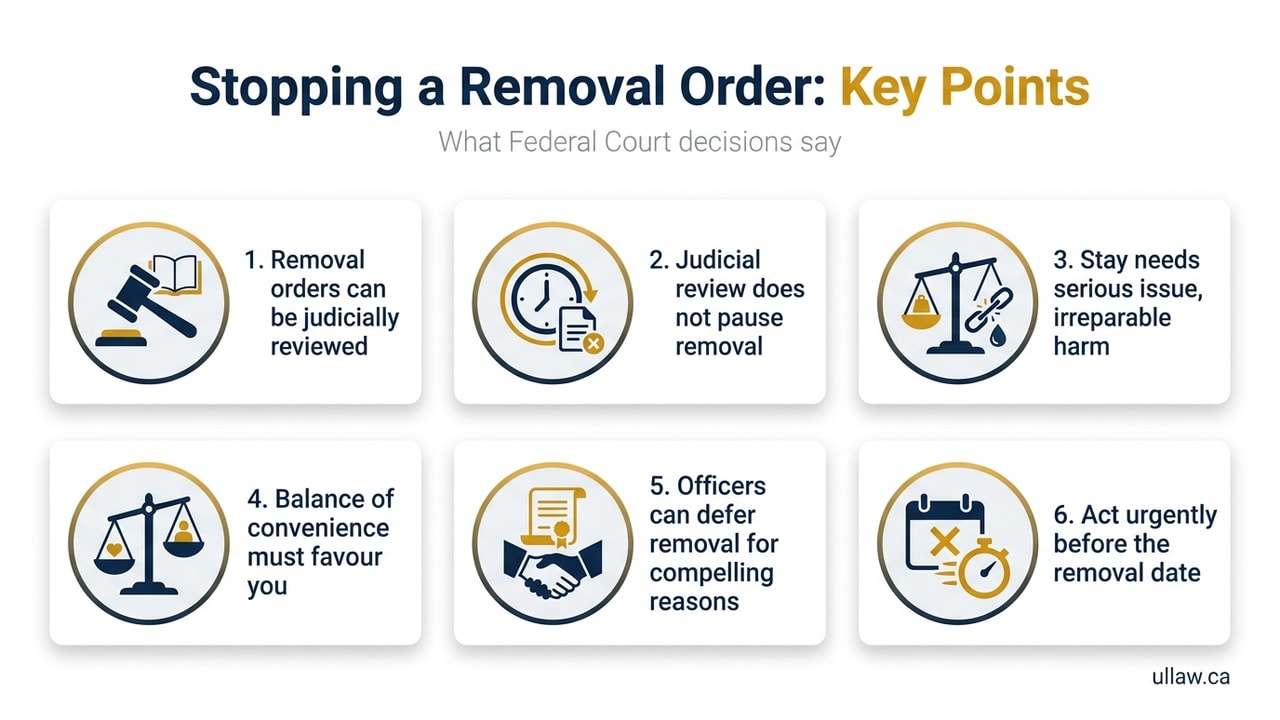
These seven Federal Court decisions point in a consistent direction. Deportation and removal orders, and officers’ decisions about whether to defer removal, are subject to Federal Court oversight. The court’s role is supervisory rather than a fresh hearing.
Several themes repeat across the cases:
- Judicial review and a stay are separate. Judicial review tests whether a decision was reasonable and procedurally fair. A stay is a temporary pause while that review proceeds. Filing one does not produce the other.
- The three-part test is applied consistently. Every stay decision applied the same framework: serious issue, irreparable harm and balance of convenience. Failing any one branch is fatal to the motion.
- Irreparable harm usually decides the outcome. The courts look for specific, individualized and credible evidence. General hardship, family ties or fear of return, without more, rarely meets the standard.
- Outcomes turn on the record. In the deferral case, the court granted relief. In the stay motion case, it dismissed the motion for lack of evidence of irreparable harm. The decisions emphasize that each case turns on its own facts and that one result does not predict another.
- Timing matters. Several decisions note that strict timelines apply and that stay motions usually need to be brought urgently, before the scheduled removal date.
Questions and records to discuss with a lawyer
Because these decisions turn so heavily on the evidence and on timing, people facing removal often find it useful to bring the following to a lawyer:
- The deportation or removal order itself, and any record of the inquiry or decision-making process that led to it, including any concerns about procedural fairness.
- Any decision by an immigration officer refusing to defer removal, along with the information and documents that were put before that officer.
- Details of any pending application, appeal or judicial review, and the scheduled removal date.
- Documents showing specific consequences of removal, such as information about dependent children, risks in the destination country, or an immigration status that could be lost.
- Questions about whether the circumstances could raise a serious issue on judicial review, and what evidence the court has looked at when assessing irreparable harm in similar cases.
If you or a family member is facing a deportation order, a refused deferral request or an upcoming removal date, you can request a consultation with UL Lawyers. The first 15 minutes are free for immigration matters, and every request is answered within 1 business day.
This guide summarises published decisions and is general information, not legal advice. Every case turns on its own facts.