What does Canadian law say about removing refugee claimants?
Refugee protection in Canada is real, but it is not absolute. Nine recent Federal Court decisions — all decided between June and August 2026 — make clear that certain categories of claimants can be excluded from protection entirely, that recognized refugees can lose their protected status on security or criminality grounds, and that courts reviewing those decisions apply a deferential standard. If you are navigating any of these issues, our immigration law practice can help you understand where you stand.
Can a refugee claimant be excluded from protection before their claim is decided?
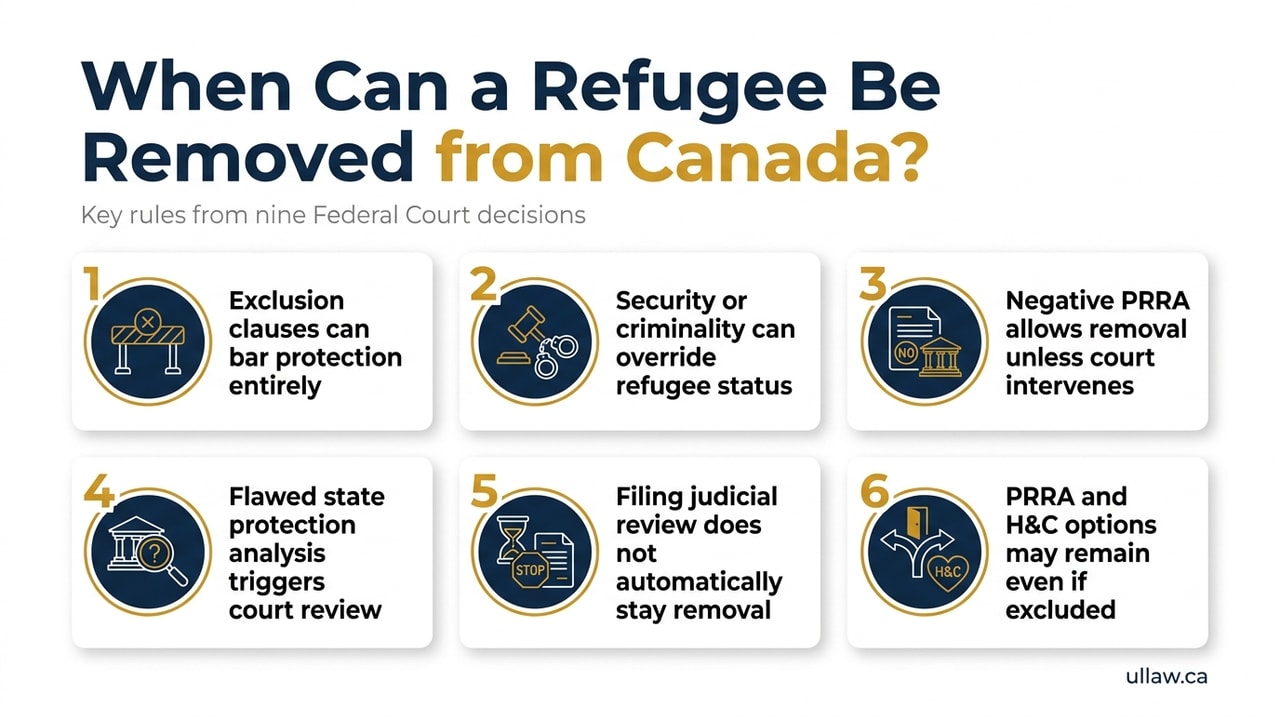
Yes — and the consequences are serious. Canadian refugee law incorporates exclusion clauses from international law that can bar a person from the refugee protection process altogether, even if they would otherwise face genuine risk in their home country. Two Federal Court decisions from 2026 confirm that these clauses are enforceable and that removal can follow.
In Can a Refugee Claimant Be Removed for Exclusion in Canada?, the Federal Court dismissed a judicial review application and upheld an exclusion and removal decision, confirming that when a tribunal’s reasoning is logical, supported by the evidence, and clearly explained, the court will generally not interfere. Similarly, in Can a Refugee Claimant Be Excluded from Protection in Canada?, the court upheld an exclusion where the decision-maker applied the correct legal test and considered the relevant evidence — including circumstances involving serious crimes or crimes against humanity.
Importantly, both decisions note that exclusion clauses are specific and fact-dependent. A standard claim denial is a different process from an exclusion finding, and the legal consequences differ significantly. Even where refugee protection is unavailable, other avenues — such as a Pre-Removal Risk Assessment (PRRA) or a Humanitarian and Compassionate (H&C) application — may remain open depending on the individual’s circumstances.
Can a recognized refugee be removed from Canada on security grounds?
Yes, in defined circumstances. Three Federal Court decisions decided within days of each other in June and August 2026 all reach the same conclusion: refugee or protected person status does not create an absolute bar to removal when serious security or criminality grounds are established.
In Can a Refugee Be Removed from Canada on Security Grounds? (2026 FC 859), the court upheld removal of a recognized refugee found inadmissible on serious security or criminal grounds, describing the exercise as a genuine balancing of Canada’s humanitarian obligations against its duty to protect public safety — not a rubber stamp, but a real weighing of evidence. Can a Refugee Be Removed from Canada for Security Reasons? reached the same result, confirming that public safety determinations can override the protections that normally shield a claimant from removal. Can a Refugee Be Removed from Canada Based on Security Concerns? added that the Immigration and Refugee Protection Act contains specific provisions — covering serious criminality and security threats — that can strip protection from an individual who has already been recognized as a Convention refugee.
All three decisions emphasize that the bar is high: vague concerns or minor issues are not enough, and decision-makers must follow a fair process, weigh the evidence, and provide reasons.
What happens when a refugee claimant loses a PRRA and faces removal?
A negative Pre-Removal Risk Assessment (PRRA) does not automatically end a person’s options, but it does allow removal to proceed unless a court intervenes. In Can a Refugee Claimant Be Removed from Canada After a PRRA Refusal?, the Federal Court dismissed a judicial review application after finding no reviewable error in the underlying risk assessment. The court applied a high standard: disagreeing with the outcome is not enough — the applicant must point to a specific flaw in how the decision was made, such as ignoring key evidence, applying the wrong legal test, or reaching a conclusion no reasonable decision-maker could reach.
The decision also makes clear that courts do overturn PRRA refusals when genuine legal or factual errors are present. If a claimant has new evidence of risk, or believes the officer overlooked important information, there may still be grounds to seek relief — including a stay of removal while a judicial review is pending.
Can a refugee claimant challenge the state protection analysis?
Yes — and in one 2026 case, that challenge succeeded. In When Can a Refugee Claimant Rebut State Protection in Canada?, the Federal Court intervened and sent the matter back for reconsideration because the state protection analysis was flawed. The court confirmed that there is a presumption in Canadian refugee law that a person’s home country can protect them, and that rebutting it requires clear and convincing evidence of systemic inadequacy — not merely an imperfect experience with authorities.
Critically, the court held that decision-makers cannot simply dismiss evidence of inadequate state protection without a proper analysis. Where a claimant presents credible, specific evidence that protection is unavailable or ineffective, the decision-maker must engage with it seriously and explain why it does or does not displace the presumption. This ruling stands as a counterpoint to the other decisions in this group: courts will intervene when the analysis itself is deficient, even if they generally defer to tribunals on questions of fact.
Can a refugee removal case be dismissed as moot before it is decided?
Sometimes — but a mootness finding does not automatically end the case. In Can a Refugee Removal Case Be Dismissed as Moot in Canada? (2026 FC 865), the Federal Court applied the two-step Canadian framework for mootness: first, has the dispute lost its live character so that the outcome would have no practical effect on the parties? Second, if yes, should the court exercise its discretion to hear the matter anyway?
The court noted that in immigration and refugee contexts — where circumstances can shift quickly through a new hearing, changed country condition reports, or a departure from Canada — mootness arises more often than in other areas of law. Factors favouring discretionary hearing include whether the issue is likely to recur and whether it raises important legal questions that would otherwise escape review. A decision to decline jurisdiction on mootness grounds says nothing about whether the original removal decision was right or wrong.
Can a refugee’s removal be stopped by the Federal Court?
The Federal Court has jurisdiction to examine whether immigration authorities properly considered all relevant factors before ordering or enforcing a removal. In Can a Refugee’s Removal Be Stopped in Canada?, the court ruled on the merits of a removal challenge, resulting in a determination that affected whether the removal could proceed. The decision confirms that refugees and refugee claimants have both procedural and substantive rights before removal can be enforced, and that courts can review whether decision-makers followed the correct legal process and whether the outcome was justified by the evidence.
However, simply filing for judicial review does not automatically pause a removal order. A separate stay of removal must be obtained, and courts apply a high bar when reviewing removal decisions.
What do these decisions have in common?
Across all nine decisions, several consistent themes emerge:
- Reasonableness is the standard. The Federal Court does not re-decide immigration cases from scratch. It asks whether the original decision was logical, supported by evidence, and within the range of acceptable outcomes. Decisions that meet that standard are upheld; those that do not — as in the state protection case — are sent back.
- Refugee protection is real but not absolute. Recognized refugees and claimants have meaningful rights, but those rights can be overridden by specific, high-threshold grounds: serious criminality, security concerns, or the application of exclusion clauses.
- Process matters. Even where removal is legally permitted, decision-makers must follow a fair process, engage with the evidence, and provide transparent reasons. Failures of process or analysis are grounds for judicial review.
- Other options may remain. Multiple decisions note that even where refugee protection is unavailable, avenues such as PRRA and H&C applications may still exist depending on the individual’s circumstances.
- Each case turns on its own facts. No single decision creates a blanket rule. The outcome in one judicial review does not determine the outcome in another.
These patterns are relevant whether you are in Burlington, Mississauga, Toronto, Hamilton, or anywhere else in Ontario.
Questions and records to discuss with a lawyer
If you or someone you know is facing removal, exclusion, or a negative PRRA decision, the following points are worth raising with an immigration lawyer:
- What specific ground is being relied on? Exclusion clauses, security inadmissibility, and PRRA refusals each follow different legal frameworks with different procedural rights.
- Has a stay of removal been considered? Filing for judicial review does not automatically stop a removal — a separate stay application may be necessary and time-sensitive.
- What evidence exists about conditions in the home country? The state protection analysis depends heavily on country condition evidence, and gaps or errors in that analysis can be grounds for review.
- Has every avenue been explored? Even where refugee protection is unavailable, PRRA and H&C applications may remain open depending on the facts.
- Is there a mootness risk? If circumstances are likely to change before a hearing — such as a new tribunal decision or a departure from Canada — the timing of any judicial review application may matter.
If you need help understanding a judicial review or a work permit refusal, our team serves clients across the region including Brampton, Oakville, Etobicoke, Kitchener, and Milton.
If you have questions about any of the issues discussed in this guide, you are welcome to request a consultation — we respond within one business day, and the first 15 minutes are free for immigration matters.
Newer decisions added to this guide
In Can a Removal Order Be Challenged in Federal Court Ontario?, (CanLII), the Federal Court granted judicial review and set aside a removal order issued under the Refugee Protection Act, directing the matter to be reconsidered. The Court confirmed that removal decisions are not automatically final — it will intervene where the original decision-maker applied the wrong legal standard or reached an unreasonable outcome on the facts. Importantly, the Court’s role is not to substitute its own view but to ensure the decision was both procedurally fair and substantively reasonable, a distinction that shapes how removal challenges are framed and argued.
In Can a Permanent Resident Be Removed from Canada for Security Reasons?, (CanLII), the Federal Court upheld a removal order against a permanent resident on public safety and national security grounds, confirming that permanent resident status, while strong, is not absolute. The Court found that where credible evidence supports a security concern and the proper procedural steps under the Immigration and Refugee Protection Act have been followed, a removal order will withstand judicial scrutiny. The decision underscores that the reviewing court asks only whether the outcome was reasonable and the process was fair — not whether it would have reached the same conclusion itself.
In Can a Refugee Claim Be Rejected for Credibility in Ontario?, (CanLII), the Federal Court dismissed an application for judicial review, upholding the tribunal’s credibility-based rejection of a refugee claim. The Court reaffirmed that decision-makers who hear testimony directly are better placed to assess believability, and that their findings attract significant deference — judicial review will only succeed if the credibility analysis lacked logical reasoning, ignored key evidence, or reached a conclusion that cannot be justified on the record. Showing that a court might have weighed the evidence differently is not enough to set the decision aside.
This guide summarises published decisions and is general information, not legal advice. Every case turns on its own facts.