
A human rights complaint in Ontario is an HRTO application, not a general grievance. Filing is free. You generally have one year from the incident (or the last incident in a series). The unfair treatment has to connect to a protected ground under the Human Rights Code in a social area such as employment, housing, or services.
Quick answer: File at the HRTO within one year. Reprisal for asserting your rights is illegal. Late filings are rarely accepted. If the deadline is close or your employer punished you for complaining, call 905-744-8888 or email info@ullaw.ca. You can also book a consultation.
Do You Have a Valid Human Rights Claim in Ontario?

Before you pour time and emotional energy into an application, you need to honestly assess if your experience fits the legal definition of discrimination. The Human Rights Code is a powerful tool, but it’s designed to fight specific kinds of unfairness—not just bad manners or a tough boss.
For your complaint to be considered valid, three things must be true:
- You have a personal characteristic that is protected under the Code (this is called a “protected ground”).
- You were treated poorly or put at a disadvantage.
- Your protected characteristic was a factor—even just one of the factors—in why you were treated that way.
That last point is key. The discrimination doesn’t have to be the only reason for the negative treatment, but it absolutely must be part of the reason.
Understanding Protected Grounds and Social Areas
Ontario’s human rights system rests on two foundational pillars: protected grounds (who you are) and social areas (where it happened). You need both for a complaint to succeed.
Let’s say you’re an employee in Mississauga caring for your aging parents. You ask your manager for a minor scheduling change to help with their medical appointments, but you’re flatly denied because it’s “inconvenient,” with no real discussion. This could very well be discrimination based on family status (a protected ground) within the social area of employment.
Or consider a tenant in Toronto who is told by their landlord that their emotional support animal isn’t allowed, even with a doctor’s note. That’s a potential human rights violation based on disability (the ground) in housing (the social area).
The whole point of the Code is to ensure you aren’t denied opportunities, harassed, or treated unfairly in key aspects of public life simply because of who you are. A strong claim always draws a clear line between a protected ground and the negative treatment you faced in a specific social area.
To help clarify this, the table below breaks down the key grounds and social areas covered by Ontario’s Human Rights Code.
Protected Grounds and Social Areas Under Ontario’s Human Rights Code
| Protected Grounds (Examples) | Social Areas (Where Protection Applies) |
|---|---|
| Race, Colour, Ethnic Origin | Employment (hiring, promotions, workplace environment) |
| Creed (Religion) | Housing (renting, buying, building rules) |
| Age (18 years and older) | Services, Goods, and Facilities (stores, restaurants, healthcare) |
| Sex, Gender Identity, Gender Expression | Contracts (business and personal agreements) |
| Sexual Orientation | Membership in Unions and Trade/Vocational Associations |
| Marital Status, Family Status | |
| Disability (physical, mental, learning, perceived) | |
| Receipt of Public Assistance (in housing only) |
This table provides a snapshot, but it’s crucial to remember that these protections are interpreted broadly by the Human Rights Tribunal.
Common Examples of Protected Grounds
While the Code lists many grounds, some come up more frequently than others in human rights complaints.
- Disability: This is a very broad category. It covers everything from physical and developmental conditions to mental health struggles and chronic illnesses.
- Race, Colour, and Ethnic Origin: It is illegal to be treated unfairly because of your racial identity, the colour of your skin, or your family’s country of origin.
- Creed (Religion): This protects your freedom to hold and practise your spiritual or religious beliefs without penalty.
- Age: The Code protects individuals 18 years and older from being discriminated against because of their age.
- Sex, Sexual Orientation, and Gender Identity: This is a wide-ranging ground that includes protection from sexual harassment, unfair treatment due to pregnancy, and discrimination based on your gender or who you love.
This isn’t a niche problem. Data from the Ontario Human Rights Commission (OHRC) reveals that 66% of Ontarians believe discrimination is a problem in the province. That number climbs even higher for vulnerable groups, with 17% of Toronto residents and people with disabilities calling it a major issue.
Understanding your rights also means understanding the obligations of others. For instance, provincial laws like the Accessibility for Ontarians with Disabilities Act (AODA) set clear standards. Learning about things like AODA compliance for websites can help you see where an organization may have failed in its duties, especially in disability-related cases.
The Clock is Ticking: The One-Year Deadline and Building Your Case
When you’re dealing with a human rights issue in Ontario, time is not on your side. The Human Rights Code gives you a strict one-year deadline to file an application with the Human Rights Tribunal of Ontario (HRTO), and this rule is a major hurdle for many people.
That one-year clock starts ticking from the date the discrimination happened. But what if it wasn’t a single event? Often, discrimination is a series of related incidents—think ongoing harassment from a supervisor or a pattern of being passed over for promotions. In those cases, the deadline is typically one year from the date of the last incident. This detail is crucial. If you faced discriminatory comments every week for a year, your deadline is based on the last comment, not the first.
Nailing Down the Deadline (And Why You Can’t Afford to Miss It)
Figuring out the exact date of that “last incident” can be a bit of a minefield. Was it the day your employment was terminated? The morning you got that awful email? Or the last time you had a hostile conversation in the hallway? This is why your first step must be to map out a clear timeline of events.
Missing the deadline can be fatal to your claim. While the HRTO has the power to accept a late application, the bar is incredibly high. You’d have to convince them you had a very good reason for the delay (acting in good faith) and that it won’t seriously harm the other party’s ability to respond. Honestly, it’s a long shot. It’s always safest to treat that one-year rule as absolute.
A common mistake I see is people waiting, hoping the situation will just get better on its own. The hard truth is that waiting almost always hurts your case. Memories fade, witnesses move on, and emails get deleted. The moment you believe you’re facing discrimination, you need to understand that the countdown to protect your rights has already begun.
Legal timelines are a serious business across all areas of law. For a bit more context on why these deadlines are so rigid, you can learn about the general principles behind the statute of limitations in Canada. It helps put the HRTO’s one-year rule into perspective.
Gathering Your Proof: How to Build a Rock-Solid Evidence File
A strong human rights application isn’t just about what you say happened; it’s about what you can prove. Your personal story is the heart of your case, but it becomes undeniable when you back it up with solid evidence. Your job now is to become a meticulous archivist of your own experience.
Start gathering everything. I mean everything. Don’t edit yourself or decide something isn’t important yet. That’s a job for your legal counsel later. For now, just collect it all.
Here’s what you should be looking for:
- Digital Conversations: Emails, text messages, and direct messages from platforms like Slack or Microsoft Teams are gold. Screenshot them, making sure the date, time, and sender are clearly visible.
- Company Paperwork: Pull together your employment contract, performance reviews (the good and the bad), pay stubs, your termination letter, and any written warnings. These documents often tell a story the other side isn’t expecting.
- Your Own Notes: This is so important. As soon as an incident occurs, write it down. Who was there? What was said, word for word? Where did it happen? How did it make you feel? Notes taken at the time of the event carry incredible weight.
- Potential Witnesses: Create a list of anyone who saw or heard what happened—colleagues, clients, even a delivery person. Jot down their names, contact info, and what you believe they witnessed.
- Health Records: If the stress and harm from the discrimination have affected your physical or mental health, records from your doctor, psychologist, or therapist can provide powerful proof of the impact it has had on your life.
The next step is to organize all of this chronologically. Use a binder with dividers or a clearly labelled set of digital folders. This timeline isn’t just for your application; it will be your guide through the entire process, from mediation all the way to a potential hearing.
Taking the First Formal Step: A Guide to the HRTO Application Form
Filing the Application (Form 1) with the Human Rights Tribunal of Ontario (HRTO) is the moment your complaint becomes a formal legal case. This document is your most critical opportunity to lay out your story clearly and persuasively. It’s not just paperwork; it’s the very foundation of your entire human rights complaint in Ontario.
The form itself can seem a bit daunting with its structured sections and legal terminology. But its core purpose is simple: it needs you to explain who was involved, exactly what happened, when and where it all went down, why you believe it was discrimination, and what you want the Tribunal to do to make things right. Nailing this from the get-go is absolutely critical.
Getting to Grips with Form 1
Every single part of the HRTO application form is there for a reason. Taking the time to provide clear, detailed, and accurate information in each section will save you from future headaches and make your case stronger right from the start. I’ve seen too many valid claims get bogged down by rushed or incomplete forms.
Here are the key parts that demand your full attention:
- The Parties: This sounds straightforward, but precision is key. You need the full, correct legal name and contact details for every single person and organization (the “Respondents”) you’re filing against. If it’s a company, use its registered business name, not just what’s on the sign out front.
- Grounds and Social Area: You must explicitly state which protected grounds from the Ontario Human Rights Code were violated (e.g., disability, race, family status). You also need to specify in which social area this happened (e.g., employment, housing, services).
- The Story (Details of the Discrimination): This is the heart and soul of your application. You’ll need to provide a chronological account of what happened. Get specific. Include dates, names, and exact quotes if you can remember them.
- The Remedies: This is where you tell the HRTO what you need to fix the situation. It could be financial compensation for things like lost wages or injury to your dignity, but don’t forget non-monetary solutions. These can be just as powerful, like demanding a written apology, reinstatement to your job, or changes to a company policy to prevent it from happening again.
Before you even start typing, it helps to map out your plan of attack for building your case file.
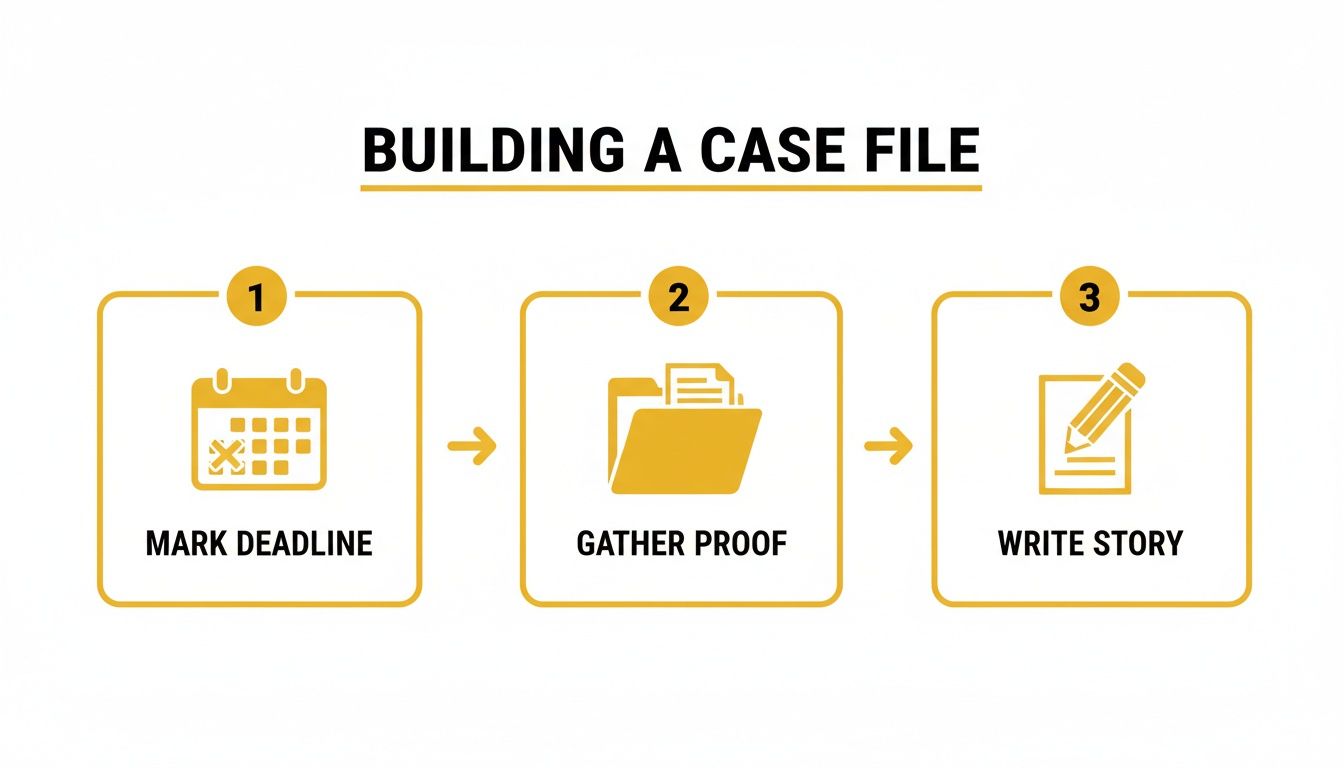
This simple flow—locking in your one-year deadline, gathering all your proof, and then writing your story—is your roadmap to a complete and convincing application.
How to Describe the Discrimination Effectively
When the form asks for the “particulars” of your claim, it’s asking for your narrative. This isn’t the time for general feelings like “my manager was unfair to me.” You need to connect the dots with concrete examples that link the poor treatment you received to a protected ground.
For instance, don’t just write, “I was harassed at work.”
Instead, be specific and factual:
“On May 10, 2024, my supervisor, John Smith, sent me three text messages containing sexualized jokes. A few days later, on May 15, after I told him his messages were inappropriate, he removed me from the weekly project lead meeting. I had been responsible for leading that meeting for the past year.”
See the difference? This version is powerful. It’s factual, it provides dates and names, and it clearly links a negative action (being removed from the meeting) to the applicant pushing back against harassment.
An Expert Tip: Write out your full story in a separate document first. This lets you organize your thoughts, check the timeline, and polish your wording without pressure. Once you’re happy with it, you can simply copy and paste it into the online form. It’s a great way to avoid the portal timing out and losing your work.
Submitting Your Completed Form
Once you’ve triple-checked your Form 1, you have a few ways to file your human rights complaint in Ontario. The HRTO strongly prefers online submissions because it’s the quickest and most reliable method.
- Online Portal: The HRTO’s online portal is the best way to go. It walks you through each section and gives you an immediate confirmation that your application was received.
- Mail or Courier: You can also mail the completed form to the HRTO office in Toronto. If you do this, make sure to use a service with tracking so you have proof it was delivered.
- In-Person: Dropping the form off by hand is another option, but always check the Tribunal’s current hours and any specific procedures before making the trip.
Whichever method you pick, always—always—make a complete copy of the submitted application for your own records.
So, You’ve Filed. What Happens Next?
Once the HRTO accepts your application, they’ll give you a file number. This number is now your case’s official identifier, so keep it handy and use it in all future communications.
Next, the HRTO will officially send a copy of your application to the Respondent(s) you named. They will be given a set amount of time to file their formal Response using Form 2. This is their chance to give their side of the story and address your allegations. Reading their response can be an emotionally charged experience, but remember, it’s a standard and necessary part of the process. It officially gets the ball rolling towards the next stages, which often include mediation.
What Happens After You File: Mediation vs. a Hearing

So, you’ve filed your application, and the other side has submitted their response. Now what? Your case is about to head down one of two very different roads: mediation or a formal hearing. The Human Rights Tribunal of Ontario (HRTO) will guide this process, but understanding your options is critical. The path you take will fundamentally shape the outcome of your complaint.
Most cases are first directed toward mediation. Think of it as a facilitated negotiation. It’s a completely voluntary and confidential process where a neutral HRTO mediator steps in to help you and the respondent find some common ground. The goal isn’t about winning or losing; it’s about trying to reach a settlement that everyone can live with.
The Mediation Process: Finding a Resolution
The whole point of mediation is to resolve your complaint without getting dragged into a formal, often stressful, hearing. The mediator isn’t a judge—they don’t make decisions or take sides. Their role is to keep the conversation productive, help clarify the real issues at stake, and brainstorm potential solutions you might not have considered.
The biggest benefit here is control. In mediation, you’re in the driver’s seat. You get to help craft a settlement that addresses your specific situation, which might include creative terms an adjudicator at a hearing can’t order. This usually leads to a much faster and more satisfying resolution for everyone involved.
Typically, the process looks something like this:
- It starts with an opening session where both parties are present.
- Then, you’ll break into private sessions, where the mediator talks to each side separately. This is a chance to speak candidly about what you want and where your bottom line is.
- The mediator then goes back and forth, helping to bridge the gap and find a workable compromise.
If you manage to reach an agreement, it’s written down in a legally binding settlement. Once signed, your HRTO file is closed, giving you certainty and closure, often months—or even years—sooner than if you’d waited for a hearing.
When Mediation Fails: Preparing for a Hearing
What if you can’t agree? Or what if one side simply refuses to mediate? In that case, your file moves toward a formal hearing. This is a much more rigid, court-like proceeding where an HRTO adjudicator—who acts like a judge—hears all the evidence and legal arguments before making a final, binding decision.
A hearing is your chance to present your full case from start to finish. This means you’ll be:
- Presenting evidence: This includes all the documents, emails, and notes you’ve gathered.
- Calling witnesses: People who can testify under oath about what happened.
- Facing cross-examination: The other side’s lawyer will get to question you and your witnesses.
- Making legal arguments: You’ll need to connect the dots and show the adjudicator exactly how your rights under the Human Rights Code were violated.
Unlike mediation, a hearing is public, and the final decision is completely out of your hands. It’s an intimidating process that demands meticulous preparation and a firm grasp of legal procedure. This is why having experienced legal representation is so important.
For newcomers to Canada, these complex legal systems can be especially daunting. If you’re navigating multiple legal streams, our guide on finding an immigration lawyer near you can offer broader context on getting the right specialized help.
What Can You Win? Potential Remedies from the Tribunal
If the adjudicator rules in your favour after a hearing, they have broad powers to order remedies. The purpose isn’t to punish the respondent but to compensate you for the harm you suffered and to ensure it doesn’t happen to anyone else. These remedies are tailored to the specific facts of your case.
Common Monetary and Non-Monetary Remedies
| Monetary Remedies | Non-Monetary Remedies |
|---|---|
| Lost Wages: Compensation for any income you lost because of the discrimination. | Reinstatement: An order for your employer to give you your job back. |
| Injury to Dignity, Feelings, and Self-Respect: Damages for the emotional pain and humiliation caused. | A Written Apology: A formal letter of apology from the person or organization. |
| Special Damages: Reimbursement for costs you incurred, like therapy or job-hunting expenses. | Policy Changes: Requiring the organization to create or update its human rights policies. |
| Mandatory Training: Forcing the respondent to provide human rights training to staff and managers. |
The scope of human rights issues is staggering. A recent annual report from the University of Toronto, for example, logged 250 complaints in a single year. These complaints covered everything from inappropriate comments and social media posts to discriminatory academic and HR decisions.
This data highlights just how varied discrimination can be and why a wide range of remedies is necessary. While the amount awarded for injury to dignity can vary, in serious cases of harassment or reprisal, the financial compensation can be quite significant.
Why Expert Legal Help Can Make a Difference
Deciding to file a human rights complaint in Ontario is a huge step, and frankly, a brave one. But the path ahead isn’t always straightforward. While you absolutely have the right to represent yourself at the Human Rights Tribunal of Ontario (HRTO), the system is loaded with procedural tripwires and unwritten rules that can derail even the most well-prepared person.
You’re already carrying the emotional weight of your experience. The last thing you need is the added stress of becoming a legal expert overnight.
This is where having a professional in your corner can change everything. The difference between a compelling, successful claim and one that gets dismissed often boils down to legal strategy—something an experienced lawyer has honed over years of practice.
Navigating the Tricky HRTO System
The HRTO process isn’t just about telling your story. It’s about fitting that story into the specific legal framework of the Ontario Human Rights Code. A human rights lawyer does so much more than fill out forms. They know how to pinpoint the strongest legal arguments, gather evidence that actually makes an impact, and predict what the other side will do next.
I’ve seen too many strong cases fall apart due to common, avoidable mistakes:
- Missing a critical deadline for filing a document or a response.
- Submitting evidence that’s weak or irrelevant, failing to draw a clear line between the mistreatment and a protected ground.
- Failing to frame the argument legally, which can get a case dismissed on a technicality before it even gets off the ground.
- Being unprepared for cross-examination at a hearing, which can unfortunately damage your credibility.
An experienced lawyer helps you sidestep these pitfalls, making sure your claim is presented powerfully right from the start.
The Strategic Advantage in Mediation and Hearings
Whether your case ends up in mediation or goes all the way to a formal hearing, having an advocate is a massive advantage. In mediation, your lawyer is your negotiator, fighting for a resolution that’s genuinely fair and compensates you for the harm you’ve faced. They know what a reasonable settlement looks like and will protect you from accepting a lowball offer out of sheer exhaustion or pressure.
If your complaint does go to a hearing, your lawyer becomes your voice. They will present your case, question witnesses, and make persuasive legal arguments to the adjudicator. This frees you up to focus on your most important job: being a witness and telling your truth, without the burden of managing the entire legal proceeding alone.
The system is under immense pressure. In a recent fiscal year, the Ombudsman’s office in Ontario fielded a staggering 30,675 complaints and inquiries—a 30-year high. This surge has strained tribunals like the HRTO, which has seen a significant jump in complaints, underscoring the challenges people are facing.
This backlog means there’s no room for error. Every step has to be handled with precision to avoid delays that can drag on for months or even years.
Making Expert Legal Help Accessible
At UL Lawyers, we understand that worrying about legal fees is the last thing you need. We are committed to making sure that expert legal guidance is within reach. Our team, based in Burlington and serving clients across the GTA and all of Ontario, knows the personal and emotional toll a human rights battle takes.
That’s why we offer no-upfront-fee consultations. This gives you a chance to explore your legal options without any financial pressure. Our 24/7 support ensures you’re never left waiting for an answer. You don’t have to go through this alone. To get a better feel for how our team handles workplace conflicts, you can read our insights on labour lawyers in Ontario.
For anyone seeking help with a human rights complaint, it can be useful to see how modern law firms operate to serve their clients better. Many are adopting new tools, like AI virtual receptionists for law boutiques, to ensure client communication is seamless and efficient. By pairing compassionate support with sharp, effective advocacy, we make sure your case gets the full attention it deserves.
Common Questions About the Ontario Human Rights Process
Going up against the legal system can feel overwhelming, and it’s completely normal to have a lot of questions when you’re thinking about a human rights complaint in Ontario. Let’s clear up some of the most common uncertainties we see from clients every day.
How Much Does It Cost to File a Human Rights Complaint?
Filing an application with the Human Rights Tribunal of Ontario (HRTO) is completely free. There is no fee to start the process. This is a core part of the system—it’s designed to make sure that money isn’t a barrier to justice.
Where costs can come in is if you decide to hire a lawyer for representation. At UL Lawyers, we offer initial consultations with no upfront fees, which lets you get a clear picture of your options and the strength of your case without any financial stress.
What Happens If I Miss the One-Year Deadline to File?
This is a big one. The one-year deadline for filing a complaint is taken very seriously by the Tribunal and is often the first major hurdle. If you file late, the HRTO will only even consider your application if you have a rock-solid reason for the delay.
You’ll need to show that you acted in good faith and that the delay won’t cause any real prejudice to the other side (the respondent). Honestly, this is a very high bar to clear and late applications are rarely accepted. My best advice is to act fast and get legal advice if you’re even close to that deadline.
A common mistake is waiting and hoping a situation will just fix itself. Time slips away fast. The Tribunal doesn’t bend its rules on deadlines, and filing late could mean you lose the chance to have your case heard at all.
Can My Employer Fire Me for Filing a Complaint?
No, they absolutely cannot. The Ontario Human Rights Code has a very strong “reprisal” clause. It makes it illegal for your employer, landlord, or any service provider to punish you for filing a complaint or even just for standing up for your rights.
This protection isn’t just for you; it also covers anyone who might be a witness for you. If you get fired, demoted, harassed, or face any other negative consequence for asserting your rights, you can file a separate—and very serious—complaint for reprisal.
How Long Does the Entire HRTO Process Take?
The timeline really depends on the specifics of your case and the Tribunal’s workload. It’s a wide range, from several months to potentially a couple of years.
- Mediation: This is usually the quickest path. If everyone agrees to mediate and you reach a settlement, your case could be resolved within a year.
- Hearing: If you can’t settle and your case goes to a full hearing, it could easily take 18 months to two years or even longer to get a final decision.
Patience is a must, but it helps to know what to expect. For more in-depth answers to other legal questions, feel free to explore our FAQ page.
If you need to file a human rights complaint in Ontario, or the one-year clock is running, call UL Lawyers at 905-744-8888 or email info@ullaw.ca. You can also book a free consultation.
Related UL Lawyers resources
- Employment law services — discrimination, accommodation, and reprisal at work.
- Leave from work for stress — job-protected leave when disability or mental health is part of the file.