
Sponsoring your spouse for permanent residence in Canada is a major life step, but it’s also a serious legal commitment. Before you even think about the paperwork, it’s crucial to understand what you’re signing up for and make sure you and your partner tick all the boxes required by Canadian immigration law.
Your Obligations as a Sponsor
Bringing your partner to Canada is an exciting prospect, but it’s more than just a personal promise—it’s a formal, legally binding contract with the Government of Canada. This is something we see clients overlook all the time, and it’s a critical piece of the puzzle.
This contract is called a sponsorship undertaking. In simple terms, it means you are financially on the hook for your partner for three full years, starting from the day they officially become a permanent resident. This responsibility doesn’t just disappear if your relationship status changes; it remains in place no matter what.
Can You Be a Sponsor?
So, who can actually sponsor their spouse? The basic requirements are pretty straightforward. You need to be at least 18 years old and either a Canadian citizen or a permanent resident residing in Canada.
What if you’re a Canadian citizen living abroad? You can still sponsor your partner, but there’s an extra step: you have to prove that you plan to move back to Canada as soon as their application gets the green light.
You also have to show that you can support your spouse financially. The good news is that for spousal sponsorship, there isn’t a strict low-income cut-off (LICO) like there is for sponsoring parents or grandparents. However, you must prove to Immigration, Refugees and Citizenship Canada (IRCC) that you aren’t receiving social assistance for any reason other than a disability. Proving your financial stability is absolutely key to building a strong case.
For a complete checklist of what’s needed, you can review the detailed spousal sponsorship Canada requirements to make sure you have everything covered from the start.
Proving Your Relationship to IRCC
Canadian immigration law is very specific about the types of relationships it recognizes for sponsorship. You need to identify and apply under the correct category that truly represents your partnership.
-
Spouse: This is the most common one. You and your partner are legally married, and that marriage is recognized both in the country where you tied the knot and under Canadian law.
-
Common-law Partner: You aren’t legally married, but you’ve been living together in a committed, marriage-like relationship for at least 12 consecutive months. You’ll need to back this up with solid proof, like joint bank accounts, shared rental agreements, or bills in both your names.
-
Conjugal Partner: This is a less common and often misunderstood category. It applies to couples (opposite-sex or same-sex) who have been in a committed relationship for at least a year but couldn’t live together or get married because of major, unavoidable obstacles. Think immigration barriers, religious persecution, or laws in their home country criminalizing their relationship.
Here’s a tip from experience: Don’t assume that being engaged automatically qualifies you as conjugal partners. The conjugal category is for truly exceptional situations where living together or marrying is impossible, not just inconvenient.
Getting these fundamentals right is your first—and arguably most important—step. It sets the foundation for your entire application, from the documents you gather to how you prove your relationship is genuine. By starting with a clear understanding of the rules, you’re putting yourself in the best position for a successful outcome.
Inland vs. Outland Sponsorship: Which Path Is Right for You?
One of the first, and most important, decisions you’ll make in the sponsorship process is choosing your application stream. Will you file an “inland” or an “outland” application? This isn’t just a box to tick on a form; it’s a strategic choice that affects everything from processing times to your partner’s ability to work and travel while you wait.
Think of it this way: an inland application is for couples who are already living together in Canada. A key requirement is that the sponsored spouse or partner must stay in Canada with the sponsor and hold valid temporary status (like a visitor, student, or worker) for the entire duration of the process.
An outland application, on the other hand, is processed through a Canadian visa office abroad. Now, here’s a crucial point that many people miss: despite the name, your partner can still be physically inside Canada when you submit an outland application, as long as they have valid status. This flexibility is a game-changer for many couples we work with across the Greater Toronto Area.
The Big Draw of an Inland Application: The Open Work Permit
The single greatest advantage of filing an inland spousal sponsorship application is the Spousal Open Work Permit (SOWP). If your partner is in Canada with you on valid temporary status, you can apply for this work permit at the same time you submit the sponsorship package.
This permit allows your spouse to work for almost any employer in Ontario while the permanent residence application is being processed. For a couple building a life together in Burlington, Mississauga, or Toronto, this is huge. It means your partner can start earning, contributing to household expenses, and gaining valuable Canadian work experience right away.
But there’s a significant trade-off. The sponsored person is expected to stay in Canada while an inland application is processing. Leaving the country, even for a short trip, could put the entire application at risk. IRCC might see it as a sign that you’re no longer cohabiting in Canada, which is a core requirement of the inland stream.
Why Outland Sponsorship Is Often the Smarter Play
While the SOWP is tempting, the outland route often offers strategic benefits that make it the better choice for many families. The most important advantages are processing speed and flexibility.
While timelines always fluctuate, outland applications often have more predictable, and sometimes faster, processing times. We’ve seen some outland files processed in 10-15 months or even less, whereas inland applications can sometimes stretch on for longer.
Here’s where outland really shines:
- Freedom to Travel: Your partner isn’t “stuck” in Canada. They can travel between their home country and Canada (as long as they have a valid visitor visa or eTA). This is perfect for managing family matters or work commitments abroad.
- Faster Processing Potential: Depending on the visa office handling your partner’s country of citizenship, the outland path can be significantly quicker.
- Full Appeal Rights: This is a critical difference. If an outland application is refused, you have the right to a full appeal at the Immigration Appeal Division (IAD). An inland refusal, however, doesn’t grant you that right. Your only option is a more complex and limited judicial review at the Federal Court of Canada.
Before you can choose a path, you need to be sure of your relationship status in the eyes of Canadian immigration. This is the foundation of your entire application.
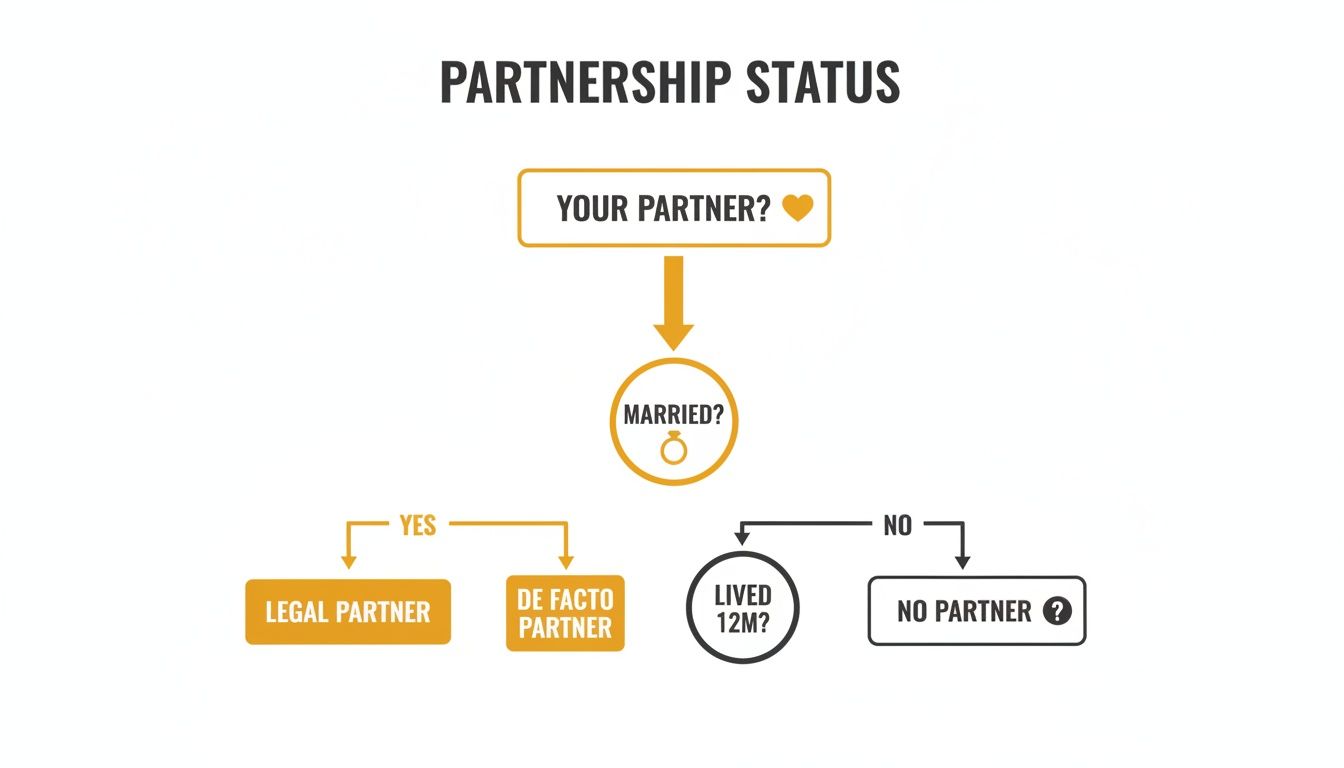
Understanding whether you’re considered married, common-law, or conjugal partners is the first step. It determines which forms you’ll need and what evidence to provide, regardless of whether you choose inland or outland.
A Note From Our Experience: One of the biggest myths we have to bust is that if your spouse is already in Canada, you must file an inland application. This is simply not true. You can absolutely file an outland application even while your partner is visiting you in Canada. IRCC recognizes this “dual intent” to visit temporarily while also seeking to immigrate permanently.
Making the Best Choice for Your Family
Deciding which route to take comes down to your personal circumstances. To help you weigh the pros and cons, here’s a direct comparison of the two streams.
Inland vs Outland Sponsorship: A Head-to-Head Comparison
This table breaks down the key features of each sponsorship path, helping you see clearly which one aligns best with your family’s needs and priorities.
| Feature | Inland Sponsorship | Outland Sponsorship |
|---|---|---|
| Applicant Location | Must be living together in Canada. | Can be inside or outside Canada. |
| Work Permit | Eligible for a Spousal Open Work Permit (SOWP). | Not eligible for a SOWP with the application. |
| Travel | Sponsored person should NOT travel outside Canada. | Sponsored person is free to travel. |
| Appeal Rights | No right of appeal to the IAD. | Full right of appeal to the IAD. |
| Processing Time | Can be less predictable and sometimes longer. | Often more predictable and potentially faster. |
So, how does this play out in the real world?
Imagine a couple living together in Brampton. The sponsored spouse’s visitor visa expires in four months. The SOWP from an inland application seems like the obvious choice. But what if there are delays and their status expires before a decision is made? They could fall out of status, creating major headaches. This is where knowing about things like Bridging Open Work Permit eligibility becomes absolutely essential.
Now, picture another couple. One partner is in Toronto, the other in India. They want to be together as soon as possible, but the sponsored partner needs to return home frequently for family reasons. For them, an outland application is the clear winner. It gives them the flexibility they need without putting their application in jeopardy.
Ultimately, the choice comes down to your priorities. Is the immediate ability for your partner to work in Canada the most important thing? Or do you value the freedom to travel, the security of appeal rights, and potentially faster processing more? Weighing these factors honestly will point you toward the right path for your journey.
Gathering Proof of Your Genuine Relationship
Once you’ve decided whether to apply from inside or outside Canada, you’ve reached the heart of your application: proving to Immigration, Refugees and Citizenship Canada (IRCC) that your relationship is the real deal.
This is, without a doubt, the most scrutinized part of the entire process. Simply having a marriage certificate isn’t enough. An immigration officer’s job is to screen for marriage fraud, and it’s your job to build a case so strong and so convincing that it leaves no room for doubt.
Think of it as telling the story of your life together, but using documents, photos, and financial records as your evidence.
Financial Interdependence Is a Huge Green Flag
From an officer’s perspective, one of the most compelling ways to show you’re a genuine couple is to prove you’ve merged your financial lives. It’s tangible proof that you operate as a team, share responsibilities, and are building a future together.
This is where you show, not just tell. Gather documents that highlight your shared financial commitments. Things like:
- Joint Bank Accounts: Statements from chequing or savings accounts in both of your names are gold. Make sure they show regular activity over several months.
- Shared Credit Cards: Do you have a credit card where one of you is the primary cardholder and the other has a supplementary card? Include copies of those statements.
- A Shared Roof: A lease agreement or property deed with both names on it is incredibly powerful evidence.
- Utility Bills: Compile hydro, gas, internet, or phone bills that are addressed to both of you at the same address.
- Insurance Policies: Showing that you’ve named each other as beneficiaries on a life insurance policy or that you share a car or home insurance policy speaks volumes.
It’s not about having a flawless financial history. It’s about showing your lives are connected in a way that’s normal for a committed couple in Canada.
A crucial takeaway for our clients in Ontario is that consistency is key. A single joint bill is good, but a year’s worth of joint bank statements, a shared lease, and a joint car insurance policy paints a much more robust picture of your shared life.
Documenting Your Relationship’s Story and Social Life
Beyond the numbers, you need to bring your relationship’s history to life. How did you meet? When did things get serious? Do your friends and family see you as a unit?
I often advise clients to start by creating a simple timeline of their key milestones—from the first date to moving in together. Then, you back that timeline up with solid proof.
Evidence That Tells Your Story:
- Photographs: Don’t just throw in a few selfies. Curate a collection of 10-20 photos that show your relationship over time. Make sure to include pictures with friends and family from both sides, at different events like holidays or vacations, and in various settings. For every photo, add a small caption explaining the date, location, and who else is in the picture. This adds crucial context.
- Communication Records: This is absolutely vital, especially for couples who have spent time apart. Include screenshots from WhatsApp or iMessage, emails, and video call logs. You don’t need to include everything, but select samples from different periods to show you’ve been in constant contact.
- Travel Documents: If you’ve travelled to see each other or gone on trips together, include flight itineraries, hotel bookings, and even passport stamps. This is hard evidence that directly supports your relationship timeline.
Getting Friends and Family to Vouch for You
Letters from friends and family can add a deeply personal layer to your application. Think of them as testimonials from people who have seen your relationship grow and can speak to its authenticity.
Ask a few close friends or relatives to write a detailed, personal letter. A generic “they are a great couple” won’t cut it. The best letters explain:
- How they know you and your partner.
- How long they’ve known you as a couple.
- Why they believe your relationship is genuine, maybe mentioning a specific memory or event they witnessed.
- Their full name, address, and phone number.
Getting letters from people in both Canada and your partner’s home country is a great strategy. It demonstrates that your relationship is known and accepted in both of your social circles.
Putting all of this together can feel overwhelming, but it is truly the foundation of a successful application. To make sure nothing slips through the cracks, our comprehensive spousal sponsorship checklist offers a clear, structured guide. Remember, the goal here is to paint a complete and honest portrait of your life together.
Submitting Your Spousal Sponsorship Application and What Happens Next
You’ve done the heavy lifting—gathering all those documents and painstakingly proving your relationship. Now it’s time to take that complete package and officially submit it. This is the final stretch, but getting the details right here is absolutely critical.
Let’s walk through what to expect after you hit “submit.”
Your entire application gets uploaded online through the official Immigration, Refugees and Citizenship Canada (IRCC) portal. At this stage, you’ll also pay all the government fees. It’s not just a single charge; you’re looking at a combination of the sponsorship fee, the principal applicant processing fee, and the right of permanent residence fee.
The Waiting Game: What to Watch For
Once your application is in, the real waiting begins. This can be nerve-wracking, but knowing the milestones helps manage the anxiety. The very first thing you’ll get is the Acknowledgement of Receipt (AOR).
The AOR is an automated email confirming IRCC has your application and has created a file for you. Think of it as your official entry ticket into the system. From here on, you can use the application number they provide to link your file to your online account and start tracking its progress.
It’s worth noting that the landscape for spousal sponsorship is shifting. The Canadian government is adjusting its immigration targets, with plans to welcome 82,000 spouses, partners, and children in 2024, rising to 84,000 in 2025 and 2026. While the numbers are high, it highlights the importance of submitting a flawless application from the get-go to avoid delays.
Next Up: Biometrics and Medicals
After the AOR lands in your inbox, a couple of procedural (but non-negotiable) steps follow. Your spouse will receive a Biometric Instruction Letter (BIL). This is a formal request for them to provide fingerprints and a photo at an official Service Canada location (if they’re in Canada) or a Visa Application Centre (VAC) if they’re abroad. This isn’t something to put off—it needs to be done within 30 days.
Sometime after that, IRCC will ask for a medical exam. This has to be done by an IRCC-approved “panel physician,” and you can’t just go to your family doctor. The panel physician’s office will send the results directly to IRCC, so you don’t have to worry about that part.
A question we get all the time is, “Should we do the medical exam before they ask for it?” While you can do an upfront medical, we usually advise against it. The exam is only valid for 12 months. If your application takes longer to process, you’ll be out of pocket for a second exam. It’s safer to just wait for the official request.
Stay vigilant with your email (check your junk folder, too!) during this time. IRCC might send requests for additional information, like police certificates from countries where your spouse has lived for six months or more since turning 18. Quick responses are key to keeping your file moving. For a deeper dive, it’s helpful to understand the average family sponsorship processing times in Canada and what can cause delays.
Will You Need a Sponsorship Interview?
Most applications are approved without an interview, but IRCC can request one if an officer has doubts about the genuineness of your relationship. An interview can involve just the sponsored spouse or, sometimes, both of you together.
If you get that interview notice, don’t panic—prepare. The officer will dig into the specifics of your life together, trying to see if your story holds up.
They’ll likely ask about:
- Your Story: How you met, key dates like your first date or engagement, and how your relationship developed.
- Your Life Together: Things like who does which chores, what a typical day looks like, and how you spend your free time.
- Family Details: They’ll want to see if you know the basics, like each other’s parents’ and siblings’ names and what they do for a living.
- Shared Finances: How you handle money, whether you have joint bank accounts, or who is responsible for paying certain bills.
The whole point is to confirm you’re a real couple building a life together. The best strategy is to be honest, consistent, and confident in your shared story. It’s often the final hurdle before getting that long-awaited approval.
Avoiding Common Application Pitfalls and Refusals
Getting your spousal sponsorship application submitted feels like a massive weight off your shoulders, but the journey isn’t quite over. A refusal can be devastating, especially when you realize it was likely preventable. From our experience, understanding where others have gone wrong is one of the best ways to fortify your own application.
Day in and day out, we see the same avoidable mistakes trip up otherwise solid cases. These aren’t usually complex legal blunders; more often, they are simple oversights that create just enough doubt for an immigration officer to hit pause.
Inconsistency Is the Biggest Red Flag
If there’s one thing that makes an immigration officer suspicious, it’s inconsistent information. Every single form, letter, and piece of evidence you submit needs to tell the exact same, cohesive story.
Think about it from their perspective. An officer will absolutely notice if you claim you met in June 2022 on one form, but a support letter from a friend says you met that autumn. They’ll question why your relationship narrative says you moved in together in May, but your joint lease agreement is dated for August. Even small discrepancies like these can plant a seed of doubt about the genuineness of your relationship.
-
Weak Application Example: A couple throws in a few undated photos from a single vacation. Their lease agreement starts six months after they claim they began living together. The story just doesn’t line up.
-
Strong Application Example: A couple provides a detailed relationship timeline and backs it up with a chronologically organized photo album, complete with captions, dates, and names. Their joint bank statements and lease agreement align perfectly with the dates mentioned in their story.
Before you hit submit, do one final, critical review of every single document. Put yourself in the immigration officer’s shoes. Does every date match? Is every name spelled correctly? Does the story make perfect sense from start to finish? This last check can truly make all the difference.
The Problem of Insufficient or Vague Evidence
Simply saying you’re in a real relationship isn’t enough—you have to prove it with overwhelming evidence. A common pitfall we see is providing proof that’s either superficial or completely lacks context.
A few one-off money transfers just don’t have the same impact as months of joint bank account statements showing shared bills and household expenses. Ten selfies won’t be as convincing as photos taken with each other’s families at holidays, weddings, and other milestone events. Your goal is to paint a picture of a life that is deeply and genuinely intertwined.
This is especially critical because spousal sponsorship is a cornerstone of Canada’s commitment to family reunification. In fact, more than 106,000 spouses, partners, and children were welcomed to Canada in 2023 through this very stream. As the largest part of the family class, officers are incredibly meticulous. You can find more on this in the latest Annual Report to Parliament on Immigration.
Critical Errors and Inadmissibility
Some mistakes are more serious than just weak evidence; they can lead to an automatic refusal or even a ban from entering Canada. When it comes to your application, complete honesty isn’t just the best policy—it’s the only one.
- Undeclared Family Members: You are required to declare all of your dependants (like children from a previous relationship), even if they aren’t coming to Canada with your spouse. Failing to do this can mean they are permanently barred from being sponsored in the future.
- Previous Marriages: Forgetting to disclose a previous marriage or not providing a final divorce certificate is a major error. You must provide official proof that all prior legal unions have been formally and legally dissolved.
- Criminal Inadmissibility: An undeclared criminal record, no matter how minor it might seem, can make your spouse inadmissible to Canada. It is absolutely crucial to be upfront and provide all the necessary police certificates from every country required.
Trying to navigate these issues on your own can feel overwhelming. If your situation involves a past refusal, a criminal record, or any other complication, getting professional guidance is a smart move. Finding a trusted immigration lawyer near you can help you tackle these problems proactively and put your strongest possible case forward. By learning from these common missteps, you can build a file that is clear, consistent, and compelling.
Answering Your Spousal Sponsorship Questions
Going through the sponsorship process naturally brings up a lot of questions. We get it. You want to make sure you’re doing everything right. Based on our experience helping families across Ontario, we’ve put together some straightforward answers to the questions that come up most often.
Can I Sponsor My Spouse If I’m Not Working?
Yes, you can. One of the most common misconceptions is that you need a specific income to sponsor your spouse. Unlike sponsoring a parent or grandparent, there’s no set minimum income requirement, or Low Income Cut-Off (LICO), for spousal sponsorship.
That said, your financial situation still matters. You have to convince Immigration, Refugees and Citizenship Canada (IRCC) that you can support your spouse’s basic needs without turning to social assistance. If you’re not employed, you can demonstrate this stability in other ways, like:
- Showing significant savings or other assets.
- Presenting a clear financial plan for how you’ll manage your expenses together.
- Having documented financial support from another family member.
The only hard-and-fast rule here is that you can’t be receiving social assistance yourself, unless it’s for a disability.
How Long Am I Financially Responsible for My Spouse?
This is a big one, and it’s something every sponsor needs to understand completely. When you sponsor your spouse, you sign a legal contract with the Government of Canada called an undertaking.
This isn’t just a formality. The undertaking is a serious, legally-binding commitment to financially support your spouse for three years. This three-year clock starts the moment they become a permanent resident.
What does this mean in practical terms? If your relationship ends or you divorce during that period, the obligation doesn’t go away. If your sponsored spouse receives social assistance within those three years, you are legally on the hook to repay that money to the government.
Can My Spouse Come to Canada While the Application is in Process?
Absolutely. Many couples don’t want to be apart for the entire processing time, and IRCC understands this. Your spouse can apply for a visitor visa (or an eTA, if they’re from a visa-exempt country) to visit you in Canada while the sponsorship application is being reviewed.
This is possible because of a concept called “dual intent.” It means that a person can intend to come to Canada for a temporary reason (like a visit) while also intending to immigrate permanently. The key to a successful visitor application in this scenario is proving your spouse has strong ties to their home country—things like a job, property, or family—which show they’ll leave Canada when their visit is over if their permanent residence isn’t finalized yet.
What About My Spouse’s Children from a Previous Relationship?
You can include your spouse’s children in the same sponsorship application, as long as they qualify as a dependent child. According to Canadian immigration law, this means the child is:
- Under 22 years of age, and
- Does not have a spouse or common-law partner.
Each child will need their own set of forms and documents, and they’ll also have to complete medical exams and, depending on their age, background checks. It is incredibly important to declare every dependent child on the application, even if they aren’t planning to come to Canada with your spouse.
Spousal sponsorship is filled with these kinds of details, and getting them right is crucial. If you’re feeling overwhelmed or just want to make sure your application is as strong as it can be, UL Lawyers is ready to help. We work with families across the GTA and Ontario, bringing an expert and compassionate perspective to your case. Reach out for a free, no-obligation consultation to talk about your specific situation. You can find out more at https://ullaw.ca.