In Canada, what many people call a “prenuptial agreement” is legally known as a marriage contract. Forget the dramatic movie portrayals; this isn’t about planning for a breakup. It’s a powerful financial planning tool for couples, designed to create a clear blueprint for your life together and foster transparency right from the start.
Rethinking Prenups in Modern Canadian Relationships

The entire conversation around prenups in Canada is changing, and for the better. The old stigma—that they signal a lack of trust—is fading fast. Today, these agreements are increasingly seen as a sign of a mature, practical partnership.
Think of it less as preparing for the end and more as designing a strong foundation for your future. It’s no different than business partners signing a shareholder agreement before launching a company. A marriage contract lets you and your partner set clear, mutual expectations upfront. It opens the door for a truly honest conversation about money, assets, and debts—a dialogue that can only strengthen your relationship.
Why Are More Canadian Couples Choosing Prenups?
It’s no surprise that prenups are becoming more common, especially for couples in Ontario and across the Greater Toronto Area (GTA). Lifestyles and relationships today look a lot different than they did even a generation ago.
Just consider a few common scenarios:
- Later Marriages: People are often getting married later, which means they’re bringing significant personal assets, established careers, or investments into the partnership.
- Individual Asset Accumulation: One or both partners might have a down payment saved, a growing business, or a future inheritance they want to protect.
- Blended Families: For partners with children from a previous relationship, a prenup is a crucial tool to ensure certain assets are earmarked for their kids’ futures.
- Clarity on Debt: An agreement can clearly define who is responsible for pre-existing debts, protecting one partner from taking on the other’s financial baggage.
A prenuptial agreement is fundamentally a tool for communication. It forces a couple to have a frank discussion about their financial goals, expectations, and values, which is one of the healthiest things you can do before marriage.
Taking this proactive step gives both of you genuine peace of mind. By working through the details together, you build a shared financial vision, letting you step into your marriage with confidence and a unified plan.
The very structure of Canadian families is evolving. According to Statistics Canada, the number of married couples increased by 6% between 2016 and 2021, but the most dramatic shift has been the explosion in common-law relationships, which grew by 447% between 1981 and 2021. This highlights how Canadians are forming partnerships differently and underscores the growing need for clear domestic contracts. You can explore these marriage statistics in Canada to see the full picture.
Crafting an Ironclad Prenup in Ontario

For a prenup to actually work when you need it, it has to be more than a template you download and sign over dinner. In Ontario, these agreements—officially called marriage contracts—are held to some pretty strict legal standards. A court simply won’t enforce a contract that isn’t fair, transparent, and built on a solid legal foundation.
Think of it like building a house. You wouldn’t dream of skipping the foundation and hoping the walls stay up. A prenup is no different. If you miss the fundamental legal pillars, a judge could set the whole thing aside, leaving you right back in the middle of the uncertainty you were trying to avoid.
These rules aren’t just about ticking boxes. They’re in place to make sure the agreement is resilient and protects both people, preventing one partner from being strong-armed into a deal they don’t fully grasp.
The Non-Negotiable Legal Checklist
To make sure your marriage contract will hold up in Ontario, it has to meet a few key criteria. These aren’t just good ideas; they’re mandatory.
- It Must Be in Writing: A handshake deal or a verbal promise about who gets what won’t fly. The entire agreement needs to be a formal, written document.
- It Must Be Signed by Both Parties: Pretty straightforward, but crucial. Both of you have to willingly sign the final document to show you agree to its terms.
- It Must Be Witnessed: Your signatures need to be witnessed by someone else, who then also signs the document.
Getting these basic formalities wrong can make the entire agreement invalid from the get-go. They’re the first line of defence in creating a document that an Ontario court will actually recognize.
The Cornerstones of a Valid Prenup
Beyond the signatures and paperwork, two elements are absolutely critical to creating a truly “ironclad” prenup: full financial disclosure and independent legal advice. This is where many DIY or poorly drafted agreements fall apart.
Full and Honest Financial Disclosure
This is non-negotiable. Before anyone signs anything, both partners must lay all their financial cards on the table. We’re talking about a complete and truthful list of every asset, every debt, and all sources of income. Trying to hide a secret investment account or downplaying the value of your business is a surefire way to get a prenup thrown out later on.
The whole point of disclosure is to make sure you’re both making informed decisions. You can’t intelligently agree to waive your right to a share of an asset if you don’t even know it exists.
In the eyes of the court, fairness begins with transparency. A prenuptial agreement built on incomplete or misleading financial information is built on a foundation of sand. It simply will not stand up to legal scrutiny.
Independent Legal Advice (ILA)
This is arguably the single most important step for making your prenup enforceable. Independent Legal Advice (ILA) means each of you hires your own separate family lawyer to go over the agreement. Your lawyer’s job is to explain what the fine print really means, how it impacts your rights, and to make sure your interests are being protected.
Having ILA creates a powerful shield against any future claims that someone was pressured, coerced, or simply didn’t understand what they were signing. When both partners have had a lawyer review the document, it becomes incredibly difficult for one person to successfully argue they didn’t know what they were getting into.
As you plan your financial future together, it’s also smart to think about estate planning. You can get a head start by understanding potential costs with tools like an Ontario probate fees calculator.
This kind of financial foresight is becoming more common. Family lawyers across Canada are seeing a big jump in millennials asking for prenups. This is often driven by people marrying later in life and wanting to protect the assets they’ve already built. The more complex your financial picture, the more important this planning becomes.
An experienced family lawyer from a firm like UL Lawyers will ensure every single one of these legal boxes is properly ticked, resulting in a resilient agreement that offers genuine peace of mind and stands the test of time.
Defining the Boundaries of Your Agreement
Knowing what you can and cannot put into a Canadian prenup is the difference between an agreement that works and one that’s just a piece of paper. Think of it as drawing a clear map for your financial future together; you need to know where the legal roads are and where the dead ends lie. A well-drafted marriage contract gives you and your partner control, but only within the limits the law allows.
Trying to include clauses that are legally out of bounds doesn’t just get those specific parts thrown out—it can jeopardize the entire agreement. By understanding what’s permissible versus what’s prohibited right from the start, you and your partner can build a plan based on realistic, legally sound expectations. This clarity is your best defence against future disputes.
What You Can Include in Your Prenup
A prenup in Canada, particularly in Ontario, gives you a surprising amount of power to customize your financial life as a couple. It’s your chance to opt out of the default rules set by provincial family law and create a plan that actually fits your specific situation.
Here are the key areas you have control over:
- Property Division: You get to decide exactly how assets—whether acquired before or during the marriage—will be divided if you separate. This covers everything from bank accounts and investments to real estate and vehicles.
- The Matrimonial Home: The family home gets special treatment under Ontario law. A prenup lets you specify exactly how this crucial asset will be handled, which can be a significant departure from the default 50/50 split.
- Protection of Specific Assets: Do you own a business? Expecting a family inheritance? Have a cottage that’s been in the family for generations? A prenup can designate these assets as separate property, shielding them from division upon separation.
- Debt Responsibility: You can clearly state who is on the hook for debts brought into the marriage and any new debts accumulated during it. This is a huge benefit, as it protects you from being held liable for your partner’s financial missteps.
- Spousal Support: While there are some important limits, you can set out the terms for spousal support. This includes whether it will be paid at all, for how long, and in what amount. It brings a lot of predictability to an otherwise uncertain area.
A marriage contract is your opportunity to write your own financial rulebook. It allows you to replace the government’s ‘one-size-fits-all’ approach with a personalized plan that reflects your shared values and circumstances.
Setting these terms clearly doesn’t just protect your assets; it also connects to your broader financial picture. For example, the decisions you make in a prenup can directly influence how you structure your estate plan. You can learn more by exploring our guide on wills and estate law to see how these critical legal documents work together.
What You Cannot Include in Your Prenup
While Canadian prenups are flexible, they have some very firm, non-negotiable limitations. The law is crystal clear that certain rights, especially anything involving children, simply cannot be signed away in a domestic contract. The court system will always prioritize the well-being of children above any agreement between parents.
These topics are strictly off-limits:
- Child Custody (Decision-Making Responsibility): You cannot pre-determine who will make major decisions for your children. A court will always decide this based on the child’s best interests at the time of separation.
- Parenting Time (Access): In the same way, you can’t use a prenup to lock in a future parenting schedule. This is also determined by what’s best for the child when the time comes.
- Child Support: This is a big one. The right to child support belongs to the child, not the parents. You cannot waive it or set a fixed amount in your prenup. The amount must follow the federal Child Support Guidelines.
- Possession of the Matrimonial Home: A prenup can’t be used to waive a spouse’s right to live in the matrimonial home after separation. This is a specific right protected by law to prevent one partner from being left homeless.
- Unconscionable or Unfair Terms: Any clause that is grossly unfair or would leave one spouse in a state of severe financial hardship can be challenged and thrown out by a judge. The agreement has to be fundamentally fair.
To make it even clearer, here’s a simple breakdown of what’s on and off the table when you’re drafting your agreement in Ontario.
What You Can vs. Cannot Include in an Ontario Prenup
| Permissible Clauses | Prohibited Clauses |
|---|---|
| How to divide property owned before marriage. | Pre-determining child custody or parenting time. |
| Rules for dividing property acquired during marriage. | Waiving or setting a fixed amount for child support. |
| How the matrimonial home will be dealt with. | Clauses that are illegal or against public policy. |
| Protecting specific assets (e.g., business, inheritance). | Waiving the right to possess the matrimonial home. |
| Assigning responsibility for debts. | Grossly unfair terms that would cause severe hardship. |
| Setting terms for spousal support (waiver or amount). | Any clause that undermines a child’s best interests. |
| How finances will be managed during the marriage. | Provisions that encourage divorce or infidelity. |
Knowing these boundaries from the outset is the first, most critical step toward crafting a prenup that will actually stand up in court and protect both of you down the road.
Your Step-By-Step Guide to Creating a Prenup
The idea of creating a prenup can feel overwhelming, but it’s best to think of it as a clear, structured project. When you break it down into manageable steps, the whole process becomes much less intimidating. Let’s walk through the entire journey, from that first crucial conversation with your partner to signing the final document.
The real goal here is to turn a complex legal task into a collaborative effort that actually strengthens your relationship. Understanding how it all works demystifies the process, making sure you and your partner feel in control every step of the way.
Step 1: Initiate the Conversation Early
The most important step happens long before any lawyers get involved. You need to talk about it. Start discussing a prenup with your partner well before the wedding—ideally, at least six to twelve months before your wedding day. Starting early takes the pressure off. A court will look very skeptically at an agreement signed the week before the wedding, as it raises red flags about pressure and duress.
Frame this conversation around planning your future together, not a lack of trust. It’s a practical tool for building a transparent financial foundation. Think of it as a chance to get on the same page about everything from how you’ll handle joint bank accounts to protecting a family business or inheritance.
Step 2: Each Partner Hires Their Own Lawyer
Once you’ve both agreed to move forward, this next step is non-negotiable for making your prenup stick. Each of you must hire your own, separate family lawyer. This is what the legal world calls Independent Legal Advice (ILA), and it’s absolutely essential for creating an enforceable agreement.
Why is this so critical? Having your own lawyer ensures that:
- Both of you genuinely understand your legal rights and what you might be agreeing to give up.
- Neither person can later say they were forced into it or didn’t get what the terms meant.
- Your specific, individual interests are properly represented during the negotiations.
A prenup is only as strong as the process used to create it. Having two separate, dedicated lawyers is the single best way to ensure the agreement is fair, balanced, and will be upheld by a court.
Step 3: Complete Full Financial Disclosure
With your lawyers on board, the next phase is all about transparency: full and honest financial disclosure. This means you both need to lay all your financial cards on the table by creating a complete inventory of your assets, debts, and income.
You’ll need to gather documents like:
- Bank and investment account statements.
- Appraisals for any property you own, along with mortgage details.
- Valuations for any businesses and your most recent tax returns.
- A clear list of any major debts, like student loans or credit lines.
This isn’t optional. Trying to hide an asset or misrepresenting your financial situation is a surefire way to have a court throw out the entire agreement later on. It’s all about making sure you’re both negotiating with a clear and complete picture of the financial reality.
This flowchart maps out the key elements of a prenup, showing what goes in and what stays out.
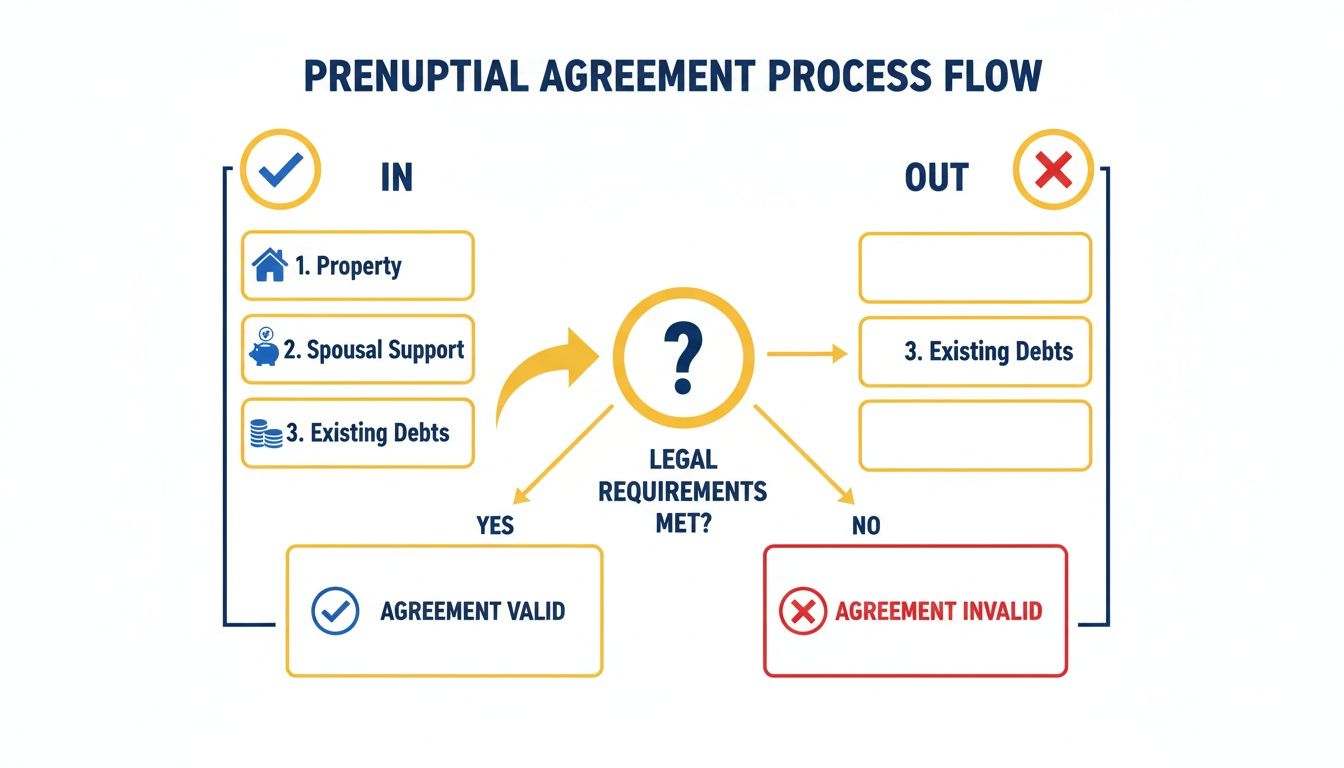
As you can see, things like property division and spousal support are fair game, but you can’t pre-determine issues related to children.
Step 4: Negotiate, Draft, and Finalize the Agreement
Now your lawyers get to work. Based on your goals and financial disclosures, one lawyer will draft the first version of the agreement. The other lawyer then reviews that draft with their client, suggesting changes and negotiating terms. This is a very collaborative stage, with some back-and-forth until a final version is reached that everyone is happy with.
While you’re thinking about which assets to protect, it’s also a good time to consider other legal documents that secure your financial well-being. For example, you can learn more about what is a power of attorney for property and see how it fits into your overall life plan.
Once the final text is agreed upon, you’ll have one last meeting with your respective lawyers to go over it in detail. After you confirm you understand and accept all the terms, you’ll sign the document with a witness present. Just like that, your prenup becomes a legally binding contract.
Common Mistakes That Can Invalidate Your Prenup
A well-drafted prenup can be one of the smartest decisions a couple makes, but it’s not bulletproof. Even with the best of intentions, a few critical mistakes during the drafting process can make the entire agreement worthless in the eyes of a Canadian court. Knowing what these pitfalls are is the best way to avoid them and ensure your agreement actually protects you.
Think of your prenup as a legal structure. Its strength depends entirely on the integrity of its foundation. A single crack—like a hidden asset or a signature given under pressure—can bring the whole thing tumbling down when it’s put to the test. When a marriage contract is challenged, judges will look very closely at both the process and the final terms for any hint of unfairness.
Hiding Assets or Debts
This is, without a doubt, the number one reason prenups in Canada get tossed out. The entire process hinges on absolute, honest-to-goodness transparency. If one partner conveniently “forgets” to disclose a major asset, downplays the value of their business, or hides a mountain of debt, the other person can’t possibly give their informed consent.
It’s really quite simple: you can’t agree to give up your rights to something if you don’t even know it exists. A court will almost always set aside an agreement if it finds out one person was negotiating with a stacked deck. This isn’t a minor clerical error; it’s a fundamental breach of the good faith needed to create a binding contract.
Pressure, Coercion, or Duress
A prenup has to be signed freely and voluntarily. A classic example of what not to do is springing the agreement on your partner a week before the wedding with a “sign this or it’s all off” ultimatum. That kind of last-minute pressure is a massive red flag for any judge.
An agreement signed under duress isn’t a real agreement. Canadian courts are committed to protecting the more vulnerable person in these scenarios and won’t hesitate to invalidate a prenup that was born out of coercion or undue influence.
The best way to steer clear of this is to start the conversation months—not weeks—before the wedding. This gives you both plenty of time to think things over, get proper legal advice, and negotiate without the immense emotional pressure of the big day looming over your heads.
Skipping Independent Legal Advice (ILA)
As we’ve stressed before, each partner having their own lawyer isn’t just a good idea; it’s a critical piece of the puzzle for an enforceable prenup in Ontario. When one lawyer tries to advise both parties, or if one partner decides to go it alone, it creates a huge vulnerability. The unrepresented partner can later argue they had no idea what they were signing or the legal rights they were giving up.
Having Independent Legal Advice (ILA) proves to the court that both of you had a professional in your corner, explaining your rights and the contract’s implications. This single step is your best defence against a future claim of misunderstanding or unfairness. While this process is about what happens in a separation, it shares a theme with estate planning, where unclear intentions can spark legal fights. For example, understanding how to contest a will often involves looking at whether someone was pressured or unduly influenced—the very thing ILA helps prevent in a prenup.
Unconscionable or Grossly Unfair Terms
While you can customize the rules away from standard family law, a prenup can’t be completely outrageous. An agreement that leaves one spouse destitute while the other walks away with everything is what the law calls “unconscionable.” Canadian courts reserve the right to intervene and throw out an agreement that is just too lopsided to be upheld.
This doesn’t mean everything has to be split 50/50. But the outcome must land within a reasonable zone of fairness, ensuring neither person faces severe financial hardship because of the terms they signed.
Partnering with a Lawyer to Protect Your Future

Throughout this guide, we’ve tried to shift the perspective on prenups in Canada. A marriage contract isn’t about planning for failure; it’s a smart financial planning tool for any modern couple. Think of it as an act of total transparency that actually strengthens the foundation of your relationship.
But its success isn’t a given. As we’ve covered, whether a prenup holds up in court depends entirely on meeting strict legal requirements. This is why getting professional legal guidance isn’t just a good idea—it’s absolutely essential if you want an agreement that offers real protection.
Why Choose UL Lawyers for Your Prenup
At UL Lawyers, we’ve helped countless couples across the Greater Toronto Area (GTA) and Ontario create marriage contracts that are fair, clear, and legally solid. We get that this process involves more than just knowing the law; it requires a great deal of sensitivity and open communication.
Our approach is always human-first. We start by taking the time to really listen and understand your specific situation, your financial picture, and what you both hope to achieve. We truly see our clients as part of our extended family, and our main goal is to make this process feel empowering, not intimidating.
A great family lawyer does more than just draft a document; they help facilitate an important conversation. Our role is to translate your shared intentions into a resilient legal agreement that gives you both genuine peace of mind.
With our deep expertise in Ontario’s Family Law Act, we make sure every detail is handled correctly. From managing the full financial disclosure process to providing strong independent legal advice, we guide you meticulously through each step. We’re here to answer every single question, making sure you feel confident and fully informed from start to finish.
It’s also worth noting that even with a solid prenup, understanding the full landscape of legal support, like paralegal services for divorce, can be helpful for long-term planning.
Take the Next Step with Confidence
Putting a marriage contract in place is one of the most significant steps you can take to safeguard your assets and build a secure future together. You don’t have to figure this out on your own.
The team at UL Lawyers is here to give you the expert support you need. We invite you to contact UL Lawyers for a consultation to talk about how we can help you craft a fair agreement that protects what matters most and brings you lasting security.
Frequently Asked Questions About Prenups in Canada
Even with a good understanding of the basics, it’s natural to have more specific questions about how a prenup works in the real world. Let’s tackle some of the most common questions we hear from couples in Ontario to give you the clarity you need.
How Much Does a Prenup Cost in Ontario?
There’s no single price tag for a prenup in Ontario. The cost really depends on how complex your financial picture is and how much back-and-forth is needed to reach an agreement.
For a couple with relatively simple assets, you might be looking at a few thousand dollars in total legal fees. But if you have business interests, several properties, or sophisticated investments, the price will naturally go up. This reflects the extra time your lawyers will need to draft and review everything carefully.
Keep in mind, that total cost is split. Each partner must have their own independent legal counsel, and you each pay for your own lawyer. While it feels like a big expense upfront, it’s almost always a fraction of the financial and emotional toll of a messy separation down the road.
Can We Get a Prenup After We Are Married?
Yes, absolutely. If you sign this kind of agreement after you’re already married, it’s simply called a marriage contract (or sometimes a postnuptial agreement).
It serves the exact same purpose as a prenup and has to follow the same strict legal rules—including full and honest financial disclosure and independent legal advice for both of you. Many couples go this route when their financial situation changes dramatically, like when one person starts a business, gets a significant inheritance, or decides to sell a major asset.
What Happens Without a Prenup in Ontario?
If you don’t have a valid marriage contract, Ontario’s Family Law Act sets the rules for how your property is divided if you separate. The standard procedure is called an equalization of net family property.
Essentially, this process involves adding up the value of most assets each of you acquired during the marriage, and then splitting the total value down the middle. The spouse who accumulated more has to write a cheque to the other spouse for half of the difference. A prenup lets you bypass these default rules and create your own plan.
A prenup is all about creating certainty. It lets you replace the government’s one-size-fits-all formula with a personalized roadmap that you and your partner build together—one that truly reflects your financial reality and goals.
Are Prenups Only for the Wealthy?
This is probably the biggest misconception out there. While prenups are definitely smart for protecting significant assets, they offer practical benefits for couples from all walks of life. A prenup is a powerful financial planning tool that can:
- Protect a future inheritance, regardless of its size.
- Keep a small, growing business from being split up in a divorce.
- Define how debts, like student loans, will be treated.
- Ensure financial stability for a partner who steps back from their career to raise children.
At its core, a prenup is just a financial plan for your partnership. For anyone curious about the real-world consequences, especially regarding what happens if you sign a prenup and get divorced, it’s worth exploring the specifics. It’s about being proactive and establishing clear expectations, no matter your net worth.
Crafting a prenuptial agreement that is both fair and legally sound is one of the smartest steps you can take for your future together. The experienced team at UL Lawyers is here to guide you through every step with compassion and expertise. Contact us today to learn how we can help you protect your tomorrow. https://ullaw.ca
Additional Considerations From Related Guides
The following points consolidate useful material from closely related UL Lawyers resources that covered overlapping search intent. They are included here so readers can find the strongest version of the guidance in one place.
From: Prenuptial Agreement Canada: Essential Guide to Asset Protection
What a Canadian Prenuptial Agreement is Really About
It’s time we changed how we think about prenuptial agreements. Forget the old cliché that they’re a plan for divorce. A prenup in Canada is much better thought of as a financial roadmap for your life together. It’s a sign of maturity and open communication, letting you and your partner make big decisions with cool heads and mutual respect.
This document is governed by provincial laws, like Ontario’s Family Law Act. It gives you the power to create your own rules for things like property division and spousal support, rather than having the default provincial laws automatically applied if you separate.
Moving Past the Stigma
The old stigma around prenups is definitely fading. More and more Canadian couples see them as a smart, practical step. This is especially true if one or both partners are coming into the marriage with their own assets, a business, or even significant debt like student loans.
A well-crafted agreement encourages transparency right from the start. Laying all your financial cards on the table builds a solid foundation of trust. It ensures you’re both on the same page about your financial future—both as a couple and, in the unlikely event you go your separate ways, as individuals.
A prenuptial agreement isn’t about planning to fail; it’s about building a partnership with a shared understanding of financial responsibilities and expectations. It transforms abstract worries into a concrete, mutually agreed-upon plan.
What Does a Marriage Contract Actually Do?
At its core, a marriage contract is a tool for certainty and control. It helps you take charge of your financial life, which is a huge benefit for couples from all walks of life.
Here’s what a prenuptial agreement typically aims to do:
- Protect Pre-Marital Assets: It can shield property, investments, or a business that one partner owned before the wedding.
- Define Matrimonial Property: You can clearly spell out how any assets or wealth you build during the marriage will be divided.
- Clarify Debt Responsibility: The agreement can ensure you aren’t on the hook for your partner’s pre-existing or future personal debts.
- Outline Spousal Support: You can set the terms for spousal support—the amount, how long it’s paid—or even agree to waive it completely.
It’s worth noting that a similar agreement exists for unmarried couples living together. If you’re curious about that, you can find out more by reading our guide on what is common law marriage in Canada. By tackling these financial conversations head-on, you’re taking a responsible step to secure your future.
Why Modern Canadian Couples Are Choosing Prenups
Let’s get one thing straight: getting a prenuptial agreement in Canada isn’t about planning for failure. It’s about building a marriage on a foundation of transparency and mutual respect. Today’s couples, especially across Ontario and the GTA, are practical. They recognize that modern relationships often start with complex financial histories, and they’d rather talk about it upfront.
Think about it. One partner might be a business owner in Burlington, while the other is building a career in Toronto. One could be sitting on a family inheritance, while the other is managing student loan debt. A marriage contract takes these real-world scenarios and creates a clear, agreed-upon plan. It’s not a sign of weak commitment; it’s a testament to a strong one, where both people enter the marriage with their eyes wide open.
Protecting Individual Assets and Businesses
A major reason couples opt for a prenup is to protect assets they’ve acquired before the wedding bells ring. Let’s say you’ve spent the last decade pouring your heart and soul into building a business in Burlington. Without a prenup, the increase in your company’s value during the marriage is typically considered family property, meaning it could be split if you separate.
A marriage contract can draw a clear line in the sand, defining your business as a separate asset. This ensures your hard work and risk-taking remain yours. The same logic applies to other important assets:
- Family Inheritance: A prenup can safeguard any inheritance you expect to receive, ensuring it stays within your family line or is reserved for your children.
- Real Estate: If you owned a house or condo before getting married, the agreement can specify exactly how that property will be treated.
- Investments and Savings: It can protect the RRSPs, TFSAs, or investment portfolios you diligently built up before you even met your partner.
Shielding a Partner from Debt
A prenup is a two-way street. Just as it protects assets, it can also shield you from your partner’s pre-existing debts. If your fiancé has significant student loans or business liabilities, a marriage contract can state that you won’t be on the hook for those debts if the marriage ends.
This creates a financial firewall. It gives both of you peace of mind and allows for genuine financial independence within the partnership, preventing one person’s past from derailing the other’s future.
Addressing Second Marriages and Blended Families
From: Prenuptial agreement in canada: A Modern Guide to Protection and Clarity
The Modern Prenup: Beyond Hollywood Stereotypes
Forget those dramatic movie scenes where a prenup is slapped on the table as a last-minute ultimatum. Here in Canada, the reality is far more practical and collaborative. Today, a marriage contract isn’t about distrust; it’s about smart, transparent financial planning for modern couples building a life together.
It’s best to see it as a financial roadmap for your marriage. By sitting down to discuss and define how assets, debts, and even future income will be managed, you kick off your partnership with total transparency. This process forces you to align your financial goals right from the start, building a strong foundation on mutual understanding, not assumptions.
Why Are Prenups Gaining So Much Traction in Ontario?
We’re seeing a definite shift in attitude, especially among younger generations in the GTA and across Ontario. It’s increasingly common for people to enter a marriage with established careers, personal businesses, significant student debt, or even children from a previous relationship. A modern prenup acts as a sensible financial tool, helping couples set clear boundaries and protect their assets, particularly when navigating the financial complexities of divorce.
This trend is really being driven by a generational pivot toward financial foresight. A landmark TD survey showed that 52% of Gen Z Canadians (aged 18 and over) want a prenup before getting married—a number that’s way above the national average. This surge is especially noticeable here in Ontario, where young adults see these agreements as essential for protecting everything from a future inheritance to their hard-earned startup equity.
A well-crafted marriage contract isn’t a plan for failure; it’s a blueprint for a strong, financially transparent partnership. It ensures both you and your partner are on the same page, protecting your individual futures and your shared life.
Key Elements of an Ontario Prenuptial Agreement
This table breaks down the core components of a marriage contract, giving you a quick overview of what it protects and why it matters.
| Component | What It Achieves for You | | --- | --- | | Separate Property Protection | Designates specific assets (like a family cottage, inheritance, or business) as your own, keeping them separate from shared marital property. | | Debt Responsibility | Clearly states who is responsible for debts brought into the marriage and any incurred during it, so you aren’t liable for a partner’s financial past. | | Spousal Support Terms | Allows you to pre-determine the terms of spousal support—or even waive it entirely—creating financial predictability if you separate. | | Division of Marital Assets | Outlines a fair process for dividing assets acquired during the marriage, from real estate to investments, avoiding potential court battles later on. | | **Estate Planning…
The Cornerstones of an Enforceable Ontario Prenup
While the idea of a prenuptial agreement—or marriage contract, as it’s known in Ontario—is thankfully becoming less taboo, a lot of people underestimate what it takes to make one stick. A casual chat over coffee and a handshake simply won’t cut it in a courtroom.
For a prenuptial agreement in Canada to be legally binding, it has to be built on a rock-solid legal foundation. Ontario’s Family Law Act lays out some very specific rules, and these aren’t just friendly suggestions. They’re mandatory. If you miss even one, a judge could toss the whole agreement out, leaving you right back at square one.
The Non-Negotiable Formalities
Let’s start with the absolute basics. To even have a chance at being valid, your marriage contract must meet three formal requirements. Think of these as the ticket you need just to get in the door.
- It Must Be in Writing: Verbal promises are worth about as much as the paper they’re written on—which is to say, nothing. The entire agreement must be a tangible document.
- It Must Be Signed by Both Parties: You and your partner must both sign the final version, showing you’ve read and accepted the terms inside.
- The Signatures Must Be Witnessed: This isn’t a private affair. Each of you needs to sign in front of a witness, who then signs the document themselves to verify they saw it happen.
These steps create a clear, official record that you both willingly and formally committed to the agreement.
Full and Frank Financial Disclosure
Beyond the signatures and witnesses, we get to what is arguably the most critical pillar of a strong prenup: full and frank financial disclosure. This is the part where you both lay all your financial cards on the table. No holding back.
This means everything—your assets, like bank accounts, investments, real estate, and business interests, but also all of your debts, from mortgages and student loans to that pesky credit card balance. If you try to hide an asset or conveniently forget to mention a significant debt, you could poison the entire agreement. A court can, and often will, invalidate a contract if it discovers one person wasn’t honest, because the other person couldn’t have given genuine consent without knowing the full picture.
Transparency isn’t just a nice-to-have; it’s a legal necessity. A prenuptial agreement is only as strong as the honesty it’s built on. Hiding one key detail can cause the whole thing to come crashing down.
The Critical Role of Independent Legal Advice
From: A Practical Guide to Prenuptial Agreements in Canada
Will Your Prenup Hold Up in a Canadian Court?
Having a signed prenuptial agreement (or a “marriage contract” as it’s called in Ontario) can give you a real sense of security. But for that security to mean anything, the document has to be ironclad. A Canadian court won’t just rubber-stamp an agreement because you signed it; it has to meet some pretty strict legal tests to be considered valid and binding.
Think of it like building a house. You wouldn’t skip the foundation, right? In the world of Canadian prenups, that foundation is built on three critical pillars. If even one of them is weak, the whole agreement could come tumbling down if it’s ever challenged in court. These pillars are all about ensuring the agreement is fair and that both of you entered into it honestly.
For your prenup to be enforceable, it must first include the essential elements of an enforceable contract—things like an offer, acceptance, and so on. But family law, especially in provinces like Ontario, adds specific, crucial layers of protection on top of that.
Pillar 1: Full and Honest Financial Disclosure
The first pillar is total transparency. You and your partner must provide full and honest financial disclosure. This means every single financial card goes on the table. No holding back.
This isn’t just a quick chat over dinner about your finances. It’s a formal process of exchanging detailed financial statements and supporting documents.
- Assets: List everything you own. This means bank accounts, investments, real estate, business interests, vehicles, and even valuable personal items.
- Debts: You also have to disclose every penny you owe, from mortgages and lines of credit to student loans and credit card balances.
- Income: A clear, documented picture of your earnings from every source is mandatory.
Trying to hide an asset or conveniently forgetting a significant debt is a surefire way to have a court throw out the entire agreement later. The logic is simple: you can’t make a fair deal if you don’t have all the facts.
Pillar 2: Independent Legal Advice (ILA)
This second pillar is arguably the most critical safeguard: Independent Legal Advice (ILA). Each of you needs to have your own separate lawyer review the agreement. This isn’t just a friendly suggestion—it’s a cornerstone of enforceability in Canada.
Your lawyer’s job is to make sure you truly understand what you’re signing. They’ll walk you through the terms, explain what rights you’re giving up, and spell out the potential consequences down the road. It proves you’re signing with your eyes wide open.
What Goes Into an Ontario Marriage Contract? The Key Clauses
Once you’ve handled the crucial steps of financial disclosure and getting independent legal advice, it’s time to actually build the agreement. Think of a marriage contract as a blueprint for your financial life together, constructed from specific clauses. Each clause is a building block that creates a clear, strong, and legally sound structure.
These aren’t just stuffy legal formalities. They are the practical, real-world instructions that will guide you through specific “what if” scenarios. Whether it’s shielding a family business from a potential split or deciding how spousal support might work, the details in these clauses are what give the agreement its teeth.
Let’s break down the essential pieces that form the foundation of most marriage contracts in Ontario.
Property Division and the Matrimonial Home
One of the main reasons people get a prenup is to create their own rules for dividing property. In Ontario, the Family Law Act has a default setting: most assets built up during the marriage get split 50/50 through a process called equalization. A marriage contract lets you switch off that default and design a system that works for you.
For instance, you could agree that the business you’ve poured your heart into will always remain yours, and any increase in its value won’t be shared if you separate. This is a go-to strategy for entrepreneurs across Burlington and the GTA looking to protect their livelihood.
But there’s one major exception everyone needs to know about: the matrimonial home. In Ontario, the law gives this property special status. No matter what your contract says, both spouses have an equal right to possess the home, and its value is almost always divided equally upon separation. This is one rule you can’t contract out of.
Protecting Specific Assets
Many of us enter a marriage with assets we’ve worked hard for or inherited, and we want to keep them separate. A marriage contract is the perfect vehicle for this. You can literally list specific items and state that they are off-limits when it comes to dividing family property.
Some of the most commonly protected assets include:
- Inheritances and Gifts: You can make it crystal clear that any future inheritance or a significant gift from your family belongs only to you.
- Business Interests: A clause can stipulate that your shares in a company are not subject to equalization, which protects not just you, but your business partners and employees too.
- Pre-Marriage Investments and Savings: You can specify that certain investment portfolios or savings accounts you had before the wedding day remain entirely yours.