Personal Injury
Toronto Car Accident Lawyer: Your Guide to Winning a Claim
The moments right after a car accident are often a blur of shock and confusion. While your first instinct might be to find a top Toronto car accident lawyer, what you actually do at the scene is what truly sets the stage for your entire claim. Those first few actions protect both your health and your legal rights from the very start.
The First Moves That Protect Your Car Accident Claim
The screech of tires, the jarring impact—it doesn’t matter if it happens on the Gardiner Expressway or a quiet side street in Burlington, a crash can leave you completely shaken. It’s chaotic, for sure, but the steps you take in those first few minutes can have a massive impact on your insurance claim and any legal action that follows. Your smartphone is your most important tool here.
First things first: safety. Check on yourself and anyone else in your car. If anyone is hurt or if the vehicles are blocking traffic, call 911 immediately. Getting paramedics, fire, and police on the scene is critical for medical emergencies and making the area safe.
And remember, adrenaline is a powerful painkiller. You might feel fine at first, but some injuries only show up hours or even days later. It’s always a good idea to get checked out by a doctor.
Documenting the Scene Like a Pro
Once you know everyone is safe, it’s time to switch gears and start gathering evidence. Think of yourself as an investigator trying to capture every detail of what just happened. This information is gold for your lawyer and the insurance companies.
Your smartphone is perfect for this:
- Take pictures of everything. Start with wide shots of the whole scene to show where the cars ended up, nearby traffic signs, and what the road conditions were like. Then, get close-ups of the damage on all vehicles from different angles. Don’t forget to photograph skid marks, debris on the road, and anything else that tells the story.
- Get driver and witness info. Snap a clear photo of the other driver’s licence, the vehicle ownership, and their insurance slip (that little pink card). If there are any witnesses, politely ask for their names and phone numbers. An independent account of what happened can be incredibly powerful.
- Jot down the details. Make a quick note in your phone of the exact location, the time of day, and which direction you were heading. Every small detail helps paint a clear picture.
One of the most common mistakes people make is saying too much. Avoid talking about who was at fault. Simple, polite phrases like “I’m so sorry” can be twisted later into an admission of guilt. Just stick to exchanging the necessary facts and information.
Reporting the Accident Correctly in Ontario
You don’t always have to call the police to the scene of an accident in Ontario. What you’re required to do depends entirely on how serious the crash was.
You must report the collision to the police right away if:
- Anyone has been injured.
- The total damage to all vehicles looks like it’s more than $2,000.
- You think another driver might be impaired by drugs or alcohol.
If nobody’s hurt and the combined damage seems to be under $2,000, a police report isn’t legally required. However, if the damage is over that $2,000 threshold but there are no serious injuries, you have 24 hours to report the accident at a designated Collision Reporting Centre. You’ll need this official report to move forward with your insurance claim.
For a more detailed breakdown of these rules, our complete guide explains exactly what to do after a car accident in Ontario.
Finally, don’t forget about your mental well-being. A car accident is a traumatic event. While this resource refers to another province’s system, this guide to ICBC counselling after an accident highlights the importance of psychological support, a step that’s just as crucial for anyone in Ontario. By taking these deliberate steps right away, you build a solid foundation for both your physical recovery and any legal action that may follow.
Decoding Ontario’s Two-Part Car Accident System
Many people we talk to are surprised to learn that Ontario has a “no-fault” insurance system. It’s an incredibly misleading term. It doesn’t mean no one is to blame for a crash; it just means your first call for immediate support is to your own insurance company, no matter who was at fault.
Understanding this is the key to getting fair compensation because it involves two completely separate paths. Think of it as having two different toolkits for your recovery. One gives you immediate help for urgent needs, while the other is all about holding the at-fault driver accountable for the long-term impact on your life.
Your First Line of Support: Statutory Accident Benefits
The first path is your claim for Statutory Accident Benefits, often called SABS. These are the benefits every Ontario driver is entitled to from their own auto insurer, as set out by provincial law. SABS are the foundation of your recovery, a crucial safety net for essential expenses right after a collision.
The whole point of SABS is to cover immediate needs that OHIP or your work benefits plan won’t touch. These benefits often include:
- Income Replacement Benefits to help cover a portion of your lost wages if the accident puts you out of work.
- Medical and Rehabilitation Benefits for treatments like physiotherapy, chiropractic care, massage, and psychological counselling.
- Attendant Care Benefits if your injuries are severe and you need help with personal care at home.
- Other Expenses like housekeeping help, caregiver benefits, and even certain funeral expenses in tragic cases.
You have to act fast. You have only 30 days from the time you get the application forms to submit them. Missing this deadline can put your access to this critical support at risk. For a closer look at what’s available, you can learn more about the specifics of accident benefits in Ontario in our detailed guide.
The Second Path: The Tort Claim Against the At-Fault Driver
While SABS provide that crucial first layer of support, they rarely cover everything. They absolutely will not compensate you for your pain and suffering, your future lost income, or other major long-term losses. This is where the second path—a tort claim—comes in.
A tort claim is simply a lawsuit you file against the at-fault driver and, by extension, their insurance company. In this arena, “fault” is everything. To be successful, you and your lawyer must prove that the other driver’s carelessness directly caused your injuries and losses.
A tort claim is meant to make you “whole” again, at least from a financial standpoint. The goal is to get compensation that covers the full scope of your losses, aiming to put you back in the position you would have been in if the accident had never happened.
This is the only way to get compensation for things like:
- Pain and Suffering: For the physical pain, emotional trauma, and loss of enjoyment of your life.
- Future Income Loss: For the diminished earning capacity that extends far beyond what SABS will cover.
- Future Care Costs: For medical treatment and support you’ll need for years or even the rest of your life.
- Family Member Claims: For the losses and hardship your loved ones have suffered because of your injuries.
The infographic below shows the very first things you must do—Assess, Document, and Report. These actions build the foundation for both your SABS application and any future tort claim.
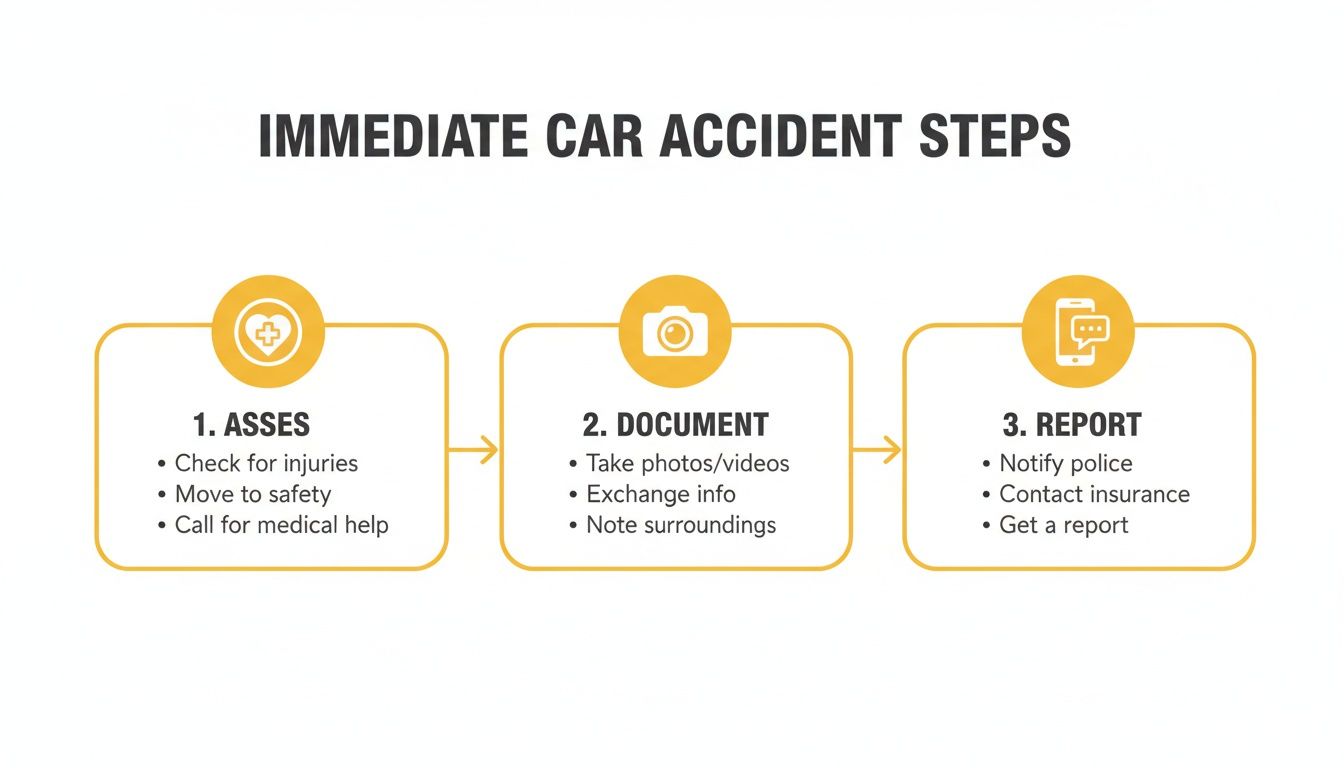
These initial steps are so important because they preserve the evidence you’ll need later on to prove who was at fault and show the true extent of your injuries.
Let’s put this all together to see how these two systems work side-by-side.
| Feature | Statutory Accident Benefits (SABS) | Tort Claim (Lawsuit) |
|---|---|---|
| Purpose | Provides immediate access to medical, rehab, and income replacement benefits. | Compensates for pain, suffering, and long-term financial losses not covered by SABS. |
| Who Pays? | Your own insurance company, regardless of fault. | The at-fault driver’s insurance company. |
| What’s Covered? | Specific benefits like medical care, income replacement (up to a limit), attendant care, and other defined expenses. | Pain and suffering, future income loss, future care costs, and family member claims. |
| Key Deadline | You must notify your insurer within 7 days and submit your application within 30 days of receiving it. | You generally have 2 years from the date of the accident to file a lawsuit. |
As you can see, SABS is your immediate safety net, while the tort claim is the path to holding the negligent driver accountable for the full, long-term impact of their actions. An experienced lawyer ensures you navigate both processes correctly to maximize your total recovery.
How to Find the Right Car Accident Lawyer in Toronto

Choosing a lawyer after a car accident is one of the most critical decisions you’ll make. It’s not just about hiring a legal representative; it’s about finding a dedicated advocate who can navigate the complexities of Ontario’s insurance laws. The right lawyer can genuinely mean the difference between a settlement that secures your future and an outcome that leaves you shouldering the financial burden of someone else’s mistake.
Not all lawyers are created equal. You need a specialist. A lawyer who splits their time between real estate closings and family law simply won’t have the same deep understanding of Ontario’s Insurance Act or the battle-tested experience required to stand up to a large insurance company. Your search should centre on finding a firm whose primary focus is personal injury law.
Preparing for Your Free Consultation
Any reputable personal injury firm in the Toronto area will offer a free, no-obligation consultation. Think of this as a two-way interview. While they’re assessing the merits of your case, you should be assessing them. To get the most out of this meeting, you need to show up prepared.
Bring everything you have so far—the police report, photos of the scene, and any witness information. But more importantly, come armed with a list of questions. This simple step helps you compare different lawyers and make a decision based on real substance, not just a flashy advertisement.
A good lawyer’s first job is to educate you. They should make you feel comfortable, never rushed, and explain your rights and the legal road ahead in plain English. Your confidence in them starts here.
The answers—and the way they’re delivered—will tell you everything you need to know about their experience, their communication style, and their commitment to clients.
Critical Questions to Ask a Potential Lawyer
Don’t be shy about digging into a lawyer’s background and their firm’s process. A confident, experienced professional will respect your diligence and answer your questions directly.
Here are a few essential questions to get you started:
- What percentage of your practice is actually dedicated to car accident claims? You want someone who lives and breathes this specific area of law, not a generalist.
- Have you handled cases involving injuries like mine? Their experience with the specifics—whether it’s a serious spinal cord injury, a concussion, or psychological trauma—is incredibly valuable.
- Who will be my day-to-day contact? Are you meeting the senior lawyer who will actually handle your file, or will it be passed down to a junior associate or paralegal?
- How do you approach settlement versus going to trial? The best lawyers prepare every case as if it’s going to trial, which gives them maximum leverage during negotiations. This is key, as over 95% of claims are resolved before ever seeing a courtroom.
Getting clear answers helps you gauge their expertise and see if their firm is the right cultural fit for you and your family. For more insight on this, check out our guide on what to look for when you need a personal injuries lawyer near me.
Understanding Contingency Fee Agreements
The thought of legal bills is a huge source of stress for most accident victims. Thankfully, the system in Ontario is built to help. The vast majority of personal injury lawyers work on a contingency fee basis.
This is often called a “no win, no fee” arrangement. It means you pay zero legal fees upfront. Your lawyer’s payment is a pre-agreed-upon percentage of the final settlement or court award they win for you. If they don’t secure any compensation for you, you don’t owe them a fee. Simple as that.
This model gives everyone access to justice, no matter their financial situation. Before you sign anything, however, make sure you read the retainer agreement carefully. A transparent lawyer will walk you through it, explaining the fee percentage and how disbursements (the costs of running your case, like expert reports or court filing fees) are handled. There should be no surprises.
What to Expect on Your Claim Journey

A common misconception is that a personal injury claim wraps up in a few weeks. In reality, a car accident claim here in Ontario is a marathon, not a sprint. Knowing what the journey looks like can help you set realistic expectations, so you can focus on the most important thing: your recovery.
Your claim really gets started the moment you hire a lawyer. From that point on, your legal team handles all the back-and-forth with the insurance companies. This is a huge relief, as it immediately shields you from the constant pressure of adjusters who, frankly, are trained to minimize what they pay out.
While your lawyer navigates the legal maze, your main job is simple: go to your medical appointments and keep your team in the loop about your progress.
Building the Foundation: Evidence and Medical Assessments
The first leg of the journey is all about building a solid case. Your lawyer will be busy collecting all the crucial pieces of the puzzle—the police report, statements from anyone who saw what happened, and, of course, your medical records. This pile of paperwork becomes the backbone of your claim, proving exactly how the accident happened and the true extent of your injuries.
During this time, you’ll also be asked to attend Independent Medical Examinations (IMEs). It’s a bit of a misleading name, as these are appointments with doctors who are chosen and paid for by the insurance company. It’s vital to understand they aren’t there to treat you; their purpose is to give the insurer an opinion on your condition.
Be completely honest and consistent during these assessments. Any major differences between what you tell the insurer’s doctor and what your own medical team has documented can be used against you down the road to question how serious your injuries are.
Don’t worry, your lawyer will walk you through exactly what to expect. At the same time, the reports from your own doctors create the other side of the story, detailing your actual treatment and long-term prognosis from a perspective of genuine care.
The Litigation Phase: Discovery and Mediation
If the insurance company isn’t willing to offer a fair settlement early on, the next step is to file a lawsuit. This moves your case into the formal litigation phase. One of the most critical steps here is the Examination for Discovery. This isn’t as scary as it sounds; it’s a formal meeting where you give your side of the story under oath, answering questions from the other driver’s lawyer.
Your lawyer will spend a lot of time preparing you for this. The key is to tell your story clearly and consistently. For instance, if a T-bone collision on the Don Valley Parkway left you with a back injury, you’ll need to describe the force of the impact, what you felt immediately after, and how that injury now affects everything from your job to your daily life.
After discovery, the next big milestone is Mandatory Mediation. In Ontario, you can’t go to trial without trying mediation first. Everyone sits down with a neutral third-party mediator who helps guide the settlement talks between your team and the insurance company’s lawyers. It’s incredibly effective—over 95% of car accident claims in Ontario are settled out of court, and this is often where it happens.
Your lawyer’s expertise in managing all the documents and legal agreements is critical; having an understanding of effective contract management highlights just how meticulously your interests are protected.
Reaching a Resolution: Settlement or Trial
The entire process, from that first call to a potential settlement, can take several months or, for more severe injuries, even a few years. An experienced Toronto car accident lawyer guides you through every step, patiently building the strongest case possible. This timeline is actually a good thing—it ensures everyone understands the full, long-term impact of your injuries before any final decisions are made.
The main goal is always to secure a fair settlement without ever seeing the inside of a courtroom. But if an insurer simply won’t make a reasonable offer, your lawyer needs to be ready and willing to take your fight to trial.
To get a better sense of what you might be entitled to, you can learn more about the different types of motor vehicle accident compensation in our detailed guide.
Common Mistakes That Can Hurt Your Claim
When you’re dealing with the aftermath of a car accident in Toronto, it’s easy to make a small misstep that has huge consequences down the road. The path to fair compensation is a minefield of potential errors that can seriously reduce the value of your claim—or even give an insurance company a reason to deny it completely.
Knowing what not to do is just as critical as knowing what to do. While your lawyer handles the legal heavy lifting, avoiding these common pitfalls is one of the most powerful things you can do to protect your case.
Giving a Recorded Statement Without Legal Advice
Sooner or later, you’ll get a call from the other driver’s insurance adjuster. They often sound friendly, concerned, and just want to “get your side of the story” in a recorded statement.
Don’t fall for it. Be incredibly cautious here.
The adjuster’s job isn’t to help you; it’s to protect their company’s bottom line. They are highly trained to ask leading questions, and they’re listening for anything—any tiny detail or turn of phrase—that could be twisted to suggest you were partially at fault or that your injuries aren’t as bad as you say.
Expert Tip: Never give a recorded statement to the at-fault driver’s insurance company without talking to your lawyer first. Let your lawyer prepare you for the conversation or, even better, have them handle all communication on your behalf. This simple step prevents you from accidentally saying something that could damage your own case.
Underestimating the Impact of Social Media
What you post online can and absolutely will be used against you. It’s a guarantee that the insurance company will have investigators scouring your social media profiles, looking for anything that contradicts your claim.
Think about this real-world scenario: you’ve claimed a severe back injury has left you unable to work or enjoy your usual activities. A week later, a well-meaning cousin tags you in a photo from a family get-together where you’re seen lifting a small child for a quick hug. Even if you were in agony for days after, the insurer’s lawyer will wave that photo in front of a judge or jury as “proof” that you’re faking it.
Protect yourself by taking these simple steps immediately:
- Make all of your social media accounts private. This is your first line of defence. Do it now.
- Don’t post anything about the accident, your injuries, or your recovery. No status updates, no photos, no vague comments.
- Ask your friends and family not to post photos of you or tag you in anything. Just explain that it’s a necessary precaution for your legal case.
Missing Critical Deadlines
Ontario’s legal system runs on a strict clock. Missing a deadline isn’t a minor issue—it can be catastrophic for your claim. While most people know you generally have two years from the date of the crash to file a lawsuit, there are other, much shorter deadlines that are just as important.
For instance, you have to notify your own insurance company within seven days to kickstart your Accident Benefits claim. After you get the application forms, you must complete and return them within 30 days. If you miss these early deadlines, you risk having essential medical, rehab, and income benefits delayed or even denied. This is exactly why getting a lawyer involved right away is so critical.
Accepting the First Settlement Offer
Insurance companies are businesses, plain and simple. Their primary goal is to settle claims for as little money as possible. A classic tactic is to make a quick, lowball offer early on, often before you and your doctors even know the full extent of your injuries.
That initial offer can look tempting, especially when bills are piling up and you’re not working. But accepting it means you sign away your right to any future compensation related to this accident, forever. If your condition gets worse or you find out you need surgery a year from now, it’s too late. You can’t go back for more.
Always have a Toronto car accident lawyer thoroughly review any settlement offer before you even think about saying yes.
Not Following Your Doctor’s Advice
This one is huge. Failing to follow your doctor’s prescribed treatment plan can be incredibly damaging to your case. If your doctor tells you to go to physiotherapy twice a week and you skip appointments, the insurance company’s lawyer will have a field day.
They’ll argue one of two things: either you weren’t as hurt as you claimed, or you made your own condition worse by not taking your recovery seriously. Either way, it hurts your credibility and the value of your claim.
Make it a priority to attend every appointment, see the specialists you’re referred to, and take your medications as prescribed. Your dedication to getting better not only helps you heal, but it also builds an undeniable medical record that proves the seriousness of your injuries. This documentation becomes especially vital if you’re ever faced with an Ontario accident benefits denial, because a strong treatment history is your best weapon in an appeal.
Your Top Car Accident Claim Questions Answered
After a car crash, your mind is probably racing with questions. The whole process, from dealing with insurance adjusters to understanding your legal rights, can feel overwhelming. We get it. Below, we’ve answered some of the most common and pressing questions we hear from clients every single day here in the GTA.
How Long Do I Really Have to File a Claim in Ontario?
This is easily one of the most critical questions, and the answer isn’t as simple as you might think. There are multiple deadlines you absolutely cannot miss.
The big one you hear about is the two-year limitation period. That’s your window to formally file a lawsuit (a tort claim) against the at-fault driver. But long before that, other crucial deadlines pop up.
Right after the accident, you have only seven days to report the incident to your own insurance company to get your Accident Benefits claim started. Once they send you the application forms, you have just 30 days to complete and return them.
On top of that, if you plan to sue the other driver, you must give them formal written notice within 120 days of the crash. Missing any of these deadlines can be catastrophic for your case, which is why it’s so important to speak with a lawyer right away.
What if the Accident Was Partly My Fault?
Many people hesitate to call a lawyer because they think being even 1% at fault means they can’t get any compensation. Thankfully, that’s a myth.
Ontario’s legal system uses a concept called contributory negligence. It’s a way of looking at the evidence and assigning a percentage of fault to everyone involved. Your final compensation from the lawsuit is simply reduced by your percentage of fault.
Here’s a real-world example: Say a court finds your total damages are $200,000, but determines you were 25% responsible for the collision. Your final award would be reduced by that amount, meaning you would receive $150,000.
The key takeaway is that even if you were partially at fault, you are still entitled to pursue compensation. Plus, it usually won’t stop you from accessing your own no-fault Accident Benefits for things like medical treatment and income support.
How Much Is It Going to Cost to Hire a Lawyer?
The thought of legal bills is enough to stop many people from getting the help they deserve. This is precisely why almost every experienced personal injury lawyer works on a contingency fee basis.
You might have heard this called a “no win, no fee” agreement. It means exactly that.
- You pay zero legal fees upfront.
- Your lawyer covers the costs of building your case.
- Their fee is a pre-agreed-upon percentage of the final settlement or award they win for you.
If for some reason your case is unsuccessful, you don’t owe any legal fees. It’s a system designed to give everyone access to justice, not just those who can afford to pay a lawyer by the hour. We’ll always review the percentage and the agreement with you in plain language before you sign anything.
Do I Have to Go to Court?
Most people picture a dramatic courtroom battle when they think of a lawsuit, but that’s rarely how it plays out. The truth is, the vast majority of car accident cases in Ontario—well over 95%—are settled before ever reaching a trial.
Our system is actually built to encourage resolution through negotiation, settlement meetings, and a process known as mandatory mediation. A good lawyer prepares every file as if it’s going to trial, because that strength and preparation is what forces insurance companies to the negotiating table with a fair offer.
The ultimate goal is to secure the best possible settlement for you without the stress and uncertainty of a trial. Going to court is always the last resort, reserved for when an insurer simply refuses to be reasonable.
Navigating the legal system after a car accident shouldn’t add to your stress. The dedicated team at UL Lawyers is here to provide the clear guidance and strong advocacy you need. We serve clients across the entire Greater Toronto Area and Ontario, offering free consultations to help you understand your rights. Contact us today to start your journey toward justice and recovery. Learn more at https://ullaw.ca.
Relevant next step
Talk to a motor vehicle accident lawyer
If your article involves a crash, injury, or claim dispute, get advice on compensation and claim value.
View accident injury servicesGET STARTED WITH A FREE CONSULTATION
Why Us
Why Choose UL Lawyers
- Decades of combined experience
- Millions recovered for our clients
- No fee unless we win your case
- 24/7 client support
- Personalized legal strategies
Keep Reading