Related service
AD&D claim review
When an insurer disputes whether a loss qualifies under an accidental death policy, we review the policy wording and evidence to clarify your rights.
Review an AD&D decisionWills & Estates

Maybe you found a few handwritten pages in a parent’s desk drawer after the funeral. Maybe a relative wrote out their wishes on a notepad in the hospital. Or maybe you’re thinking about writing your own will by hand tonight. Whatever brought you here, the question is the same: does a handwritten will actually count in Ontario?
The short answer is that it can. Ontario law recognizes a holograph will, which is a will written entirely in the will-maker’s own handwriting and signed by them, with no witnesses needed. The rules are strict, though. A typed paragraph, a fill-in-the-blank form, a note added after signing, or a signature in the wrong place can turn a sincere document into a legal problem. Proving a holograph will at probate also works differently than proving a witnessed will.
This guide covers holograph wills only: what the Succession Law Reform Act requires, the traps that can invalidate one, how to prove one in court, when a judge can step in to save a flawed document, and how these wills get challenged. If you want a general guide to preparing a formal will, see our article on how to make a will in Ontario.
Yes. Ontario is one of the Canadian provinces that accepts holograph wills. Under the Succession Law Reform Act (SLRA), you can make a valid will entirely in your own handwriting and signature, without any other formalities and without witnesses. You can read the current version of the Act on Ontario e-Laws.
If a holograph will is valid, it carries the same legal weight as a will prepared by a lawyer. It can name an estate trustee (executor), leave gifts, set up simple trusts, and revoke earlier wills.
People often use the two words as if they mean the same thing, but they don’t:
A holograph will can be valid and still be fragile. Compared with a lawyer-prepared will, there is usually:
None of this makes a holograph will invalid. It does mean the people relying on it should expect to provide more evidence, and that family members who are unhappy with it may have more room to question it.
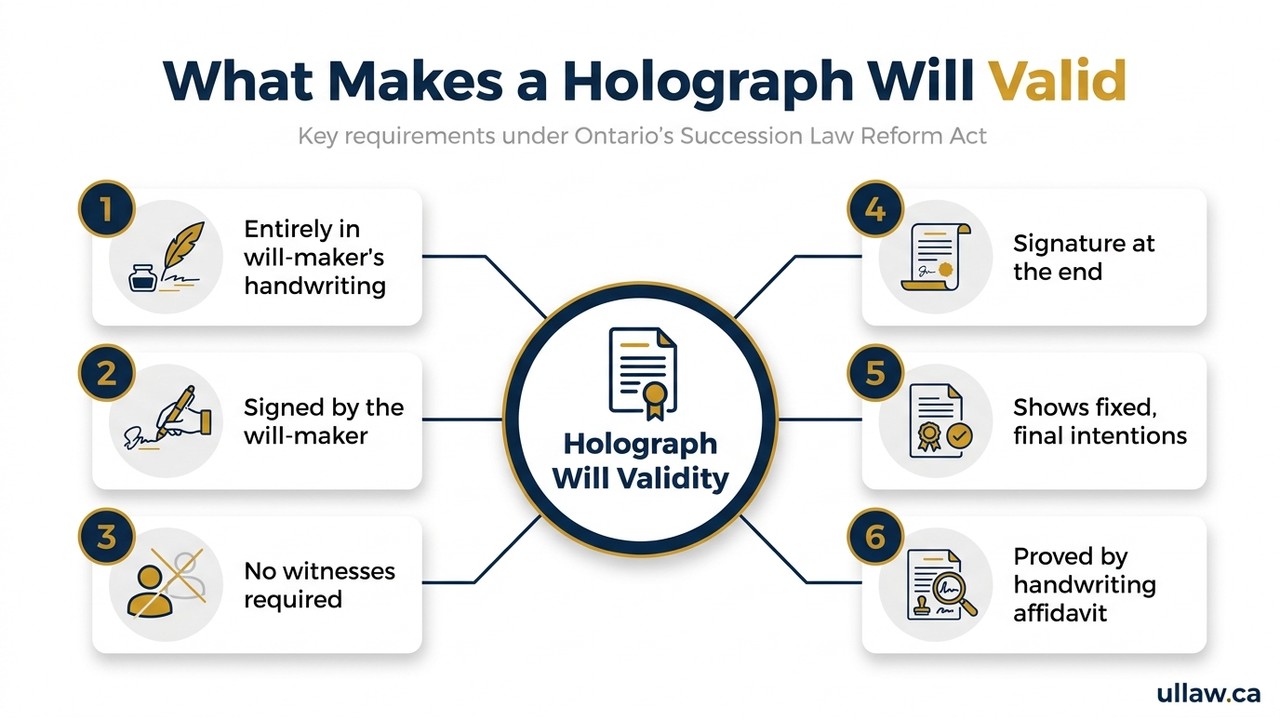
A holograph will has to meet the SLRA’s form rules and the basic requirements that apply to every will. In practical terms, a court will usually look for the following.
Every word that does legal work, such as the gifts, the names, and the appointment of an executor, must be in the will-maker’s hand. Typed text, printed form wording, or another person’s writing can’t form part of the holograph will.
The will-maker must sign it. The signature has to be placed so that it’s clear they meant it to give effect to the whole document. More on placement below.
The document must show a deliberate, fixed and final intention about what should happen to the person’s property on death. A shopping-list style note, a letter saying “I’m thinking of leaving the cottage to Sam,” or a rough draft may not qualify, even if it’s signed.
As with any will, the will-maker must have had testamentary capacity when they wrote it and must have known and approved of its contents, free from undue influence.
Generally the will-maker must be at least 18, subject to limited exceptions set out in the SLRA.
No. A true holograph will does not need any witnesses in Ontario. Witnessing is the main feature that sets it apart from a formal will.
A formal (non-holograph) will, such as a typed will or a will someone else wrote out for you, follows different rules. Generally, the will-maker must sign it (or acknowledge their signature) in front of two witnesses who are present at the same time, and both witnesses must then sign in the will-maker’s presence. Our guide on how to make a will in Ontario covers those formalities.
You can, and it won’t usually make a valid holograph will invalid. Still, it can cause confusion:
Witnesses aren’t needed for validity, but evidence helps a great deal later on. Things that can make probate easier include:
These steps help whoever eventually has to prove that the will is really yours.
This is one of the most common traps. The SLRA requires a holograph will to be written wholly in the will-maker’s handwriting. Typed or pre-printed words don’t meet that requirement.
A will kit usually has printed wording such as “I give, devise and bequeath…” with blanks for names and amounts. If the will-maker fills in the blanks by hand and signs without proper witnesses, the document is not a holograph will as a whole.
Courts have sometimes looked at whether the handwritten words alone, read without the printed text, still make sense as a complete will. If they do, and the will-maker signed it, those handwritten parts may stand as a holograph will. If the handwriting only makes sense alongside the printed words (for example, a blank that just says “my daughter”), that route often fails.
A will typed on a computer, printed and signed, but not properly witnessed, is not a holograph will. It’s a formal will that was executed incorrectly.
Depending on the circumstances, the options may include:
Each of these depends heavily on the facts. If an estate relies on a kit or a partly typed document, get advice before you file anything with the court.

The SLRA is fairly flexible about signature placement, but the flexibility has limits.
A will’s signature is generally acceptable if it is placed at, after, following, under, beside or opposite the end of the will, so that it is obvious from the face of the document that the will-maker meant the signature to give effect to what they wrote. A blank space between the last line and the signature usually won’t, by itself, invalidate the will.
The Act does not give effect to:
So if someone signs at the bottom of page two and then adds “P.S. my car goes to Alex” underneath, that gift is at real risk of being disregarded, unless it is separately signed or a court validates it.
A full signature is best. Initials or another mark may be enough if the evidence shows the will-maker used it as their signature, but that is one more fact someone may have to prove later.
Practical tip: sign once at the very end, below the last line of text, and initial each page.
Probating a holograph will follows the same court process as any will. The estate trustee applies to the Superior Court of Justice for a Certificate of Appointment of Estate Trustee With a Will. The key difference is how you prove the will itself.
For a formal will, one of the witnesses usually swears an affidavit of execution confirming they saw it signed. A holograph will has no witnesses, so the application instead includes an affidavit attesting to the handwriting and signature of a holograph will (under the probate rules in Ontario’s Rules of Civil Procedure, this is Form 74.9).
The affidavit should come from someone who knows the deceased’s handwriting well and can explain how they know it. Examples include:
It can strengthen the application if the affiant doesn’t benefit under the will, or if you file more than one affidavit.
Court staff may come back with questions or requests for further evidence, which is more common with handwritten documents. For the general forms and tax process, see our guide on how to probate a will in Ontario.
Sometimes, yes. Since January 1, 2022, section 21.1 of the SLRA has given the Superior Court of Justice the power to order that a document is fully effective as a will even though it wasn’t properly executed. The court can do this if it is satisfied that the document sets out the deceased’s testamentary intentions, or their intention to revoke, alter or revive a will.
The court is mainly asking: Is this document genuine, and does it reflect a deliberate, fixed and final expression of what this person wanted to happen on death? Evidence often includes:
Section 21.1 is a safety net and not a substitute for doing it properly. Published decisions applying it can be searched on CanLII.
Often, not on their own. This is one of the most frequent problems we see in estate files.
Under the SLRA, a change made to a will after it was signed generally has no effect unless the change itself is executed with the same formalities as a will. For a typed, witnessed will, that usually means the will-maker and the witnesses signing or initialling near the change.
A quick scribble in the margin, a crossed-out name with a new one written above, or an unsigned sticky note will usually not change a typed will. If the evidence doesn’t show otherwise, alterations may be presumed to have been made after the will was signed.
For illustration only: A father signs a lawyer-prepared will leaving his estate equally to three children. Years later, he crosses out one child’s name and writes “except Mark – see letter” in the margin, without signing it. A court would probably not treat that note as a valid change on its own. Whether it could be validated would depend on evidence of when he wrote it, why, and whether it was a final decision.
If you want to change a will, sign a new will or a properly executed codicil. Margin notes aren’t enough.
Because there are no witnesses and often no lawyer, holograph wills come up regularly in estate litigation. The main grounds for a challenge are set out below.
The question is whether the deceased really wrote and signed it. Evidence can include:
The will-maker must have understood what a will does, had a general sense of their property, known who would naturally expect to benefit, and appreciated the effect of their choices. Medical records, care-home notes and evidence from people who saw the will-maker around that time are often central.
Challengers may argue that someone pressured the will-maker, sat beside them while they wrote, or told them what to write. Suspicious circumstances, such as a caregiver suddenly becoming the main beneficiary, can shift the evidentiary burden.
The document may be a draft, a wish list or a letter rather than a will. Even if it is valid, vague wording can lead to a separate court application to interpret it.
Generally, the person relying on the will must prove it was properly made and that the will-maker had capacity and knew and approved of its contents. A person alleging undue influence usually bears the burden of proving it.
Challenges often start with a notice of objection to probate and a motion for directions. Limitation periods apply, often two years from death, but the rules can be complex. Family members may also have separate dependant’s support rights under the SLRA. See our guide on how to contest a will.
If you have just found a document that might be a holograph will, the first few days matter. Mistakes made early can make the will harder to prove later.
Avoid distributing property, emptying accounts or promising gifts until the will’s validity is clear. If another family member disputes it, early actions can create personal liability for whoever took them.
Whether the document is a valid holograph will, needs s.21.1 validation, or is likely to be challenged depends on the specific facts. Speaking with an Ontario wills and estates lawyer early can help you choose the right path before anything is filed. If you’re unsure whether something like a separation or marriage affects the will, see what voids a will in Ontario.
A handwritten will can carry real legal force in Ontario, but proving it, or defending it, depends on details that are easy to miss. You might be an estate trustee trying to probate a holograph will, a family member questioning one, or someone wondering whether a flawed document can be saved under section 21.1. In any of these situations, getting clear advice early can save time and conflict. Our wills and estates team at UL Lawyers offers a free, no-obligation consultation to review your situation and explain your options. Every estate is different, and we’ll give you a candid view of where you stand.
Frequently Asked Questions
Common questions about wills & estates in Ontario.
Generally, no. A holograph will must be written by hand and signed, and Ontario does not currently recognize electronic wills. Typing your wishes into a phone, an email or a word processor doesn't create a holograph will, because nothing is in your handwriting. The court's validation power under section 21.1 of the Succession Law Reform Act is also generally understood not to extend to purely electronic documents. If you want your wishes to be legally effective, write them out by hand and sign them, or better yet, sign a properly witnessed formal will. A digital note may still be useful as background evidence of your wishes, but you shouldn't rely on it as your will.
No. Ontario law doesn't require a holograph will to be notarized, and a date isn't strictly required for validity either. That said, a date is strongly recommended. If several handwritten documents turn up after a death, a date can be the clearest way to tell which one came last and is meant to be the final will. An undated document can lead to arguments, extra evidence and sometimes a court application to sort out the order. Notarizing doesn't make a holograph will more valid, but a dated, signed, clearly worded document can make probate much smoother for your estate trustee.
This can be a serious problem. If a will was last known to be in the will-maker's possession and can't be found after death, the law may presume they destroyed it intending to revoke it. That presumption can sometimes be rebutted with evidence, for example that the will-maker spoke about the will shortly before death, or that the original was accidentally lost. Proving a lost will usually requires a court application with evidence of the will's contents, such as a photocopy, and evidence that it wasn't revoked. With a holograph will, you would also need evidence about the handwriting. Outcomes depend heavily on the facts, so get advice early.
If another person writes any part of the will, it is no longer wholly in your handwriting and generally won't qualify as a holograph will. Physical help, such as guiding your hand, can also invite allegations of undue influence or questions about whether you really wrote it. If illness, injury or disability makes it hard for you to write, a formal witnessed will prepared with a lawyer is usually much safer. Ontario law allows for someone to sign on a will-maker's behalf in certain circumstances, but that falls under the formal will rules, not the holograph rules, and witnesses are required.
Timing depends on the type of claim. Many will challenges are subject to a limitation period that is often two years from the date of death, but how and when that period applies can be complicated, and some steps, such as filing a notice of objection, should be taken as soon as possible, ideally before a certificate of appointment is issued. Claims for dependant's support under the Succession Law Reform Act have their own timing rules. If you have concerns about a handwritten will, such as possible forgery, lack of capacity or pressure from someone, speak with an estates lawyer promptly so that deadlines don't pass while you're still deciding what to do.
Relevant next step
If this guide affects probate, wills, or estate planning, get advice before you act on it.
Call 905-744-8888 or email info@ullaw.ca. Consultations are free for injury and disability matters. On other matters, the first 15 minutes are free.
Related services
Related service
When an insurer disputes whether a loss qualifies under an accidental death policy, we review the policy wording and evidence to clarify your rights.
Review an AD&D decisionRelated service
A denied or delayed critical illness benefit can place unexpected financial strain on a family. We help clients understand their coverage and options.
Review a critical illness claimRelated service
When long-term disability benefits are denied or terminated, we examine the policy wording and medical evidence to identify a practical next step.
Review an LTD decisionWhy Us
Recent case law
Plain-English notes on recent decisions related to this guide. Each links to the underlying CanLII ruling.
An Ontario court refused to validate handwritten notations on a typed will. Learn what the ruling means for will alterations and estate planning in Ontario.
Read the noteAn Ontario court refused to validate incomplete will kit pages as a new will or revoke an existing one. Learn what this means for estate planning in Ontario.
Read the noteWhen a party to an Ontario lawsuit dies without an executor, a litigation administrator can be appointed to keep the case alive. Learn how courts decide.
Read the noteKeep Reading
Hi, I'm Mira, the virtual assistant for UL Lawyers. Tell me what's going on in plain language and I'll help you understand your options and reach our intake team when you're ready.
General information only, not legal advice.
General information, not legal advice. Messages are saved so our team can follow up. Please don't share sensitive details about your case here. Privacy.