Related service
AD&D claim review
When an insurer disputes whether a loss qualifies under an accidental death policy, we review the policy wording and evidence to clarify your rights.
Review an AD&D decisionWills & Estates
You signed a will years ago. Since then you may have married, separated, divorced, written a new will, or lost track of where the original is. Or a parent has just died, and the family is wondering whether the will in the drawer still counts. These are some of the most common worries we hear, and the answers are not always what people expect.
In Ontario, a will can be cancelled in full or in part without anyone going to court. Some life events do it automatically. Others depend on what the person who made the will (the testator) did and what they intended. Ontario’s rules also changed on January 1, 2022, so advice that was right for your parents may be wrong for you.
This guide covers those rules: marriage, separation, divorce, later wills and codicils, destroyed or missing originals, gifts to witnesses, the court’s power to fix signing defects, and what happens to the estate when a will fails. If you think a will is invalid because of capacity, undue influence, fraud or improper signing, that is a court dispute, and our guide on how to contest a will covers it. This article is about whether the will is still standing at all.
There are two ways a will can stop working. It can be revoked, meaning cancelled by a recognized event or act. Or part of it can be void by operation of law, meaning a rule of the statute simply knocks out a particular gift or appointment.
The main law is Ontario’s Succession Law Reform Act (SLRA). Under section 15, a will or part of a will can be revoked only in limited ways:
Other rules cancel parts of a will without revoking the whole document:
Nothing on these lists depends on a judge deciding the testator lacked capacity or was pressured. Those are separate grounds, and the courts decide them in will challenges. Our guide to challenging a will in Ontario explains how those disputes work.
One more point. An Ontario will is presumed to stand once it appears properly signed and witnessed. Anyone who says it has been revoked usually has to prove it. Suspicion or a family rumour is not enough.
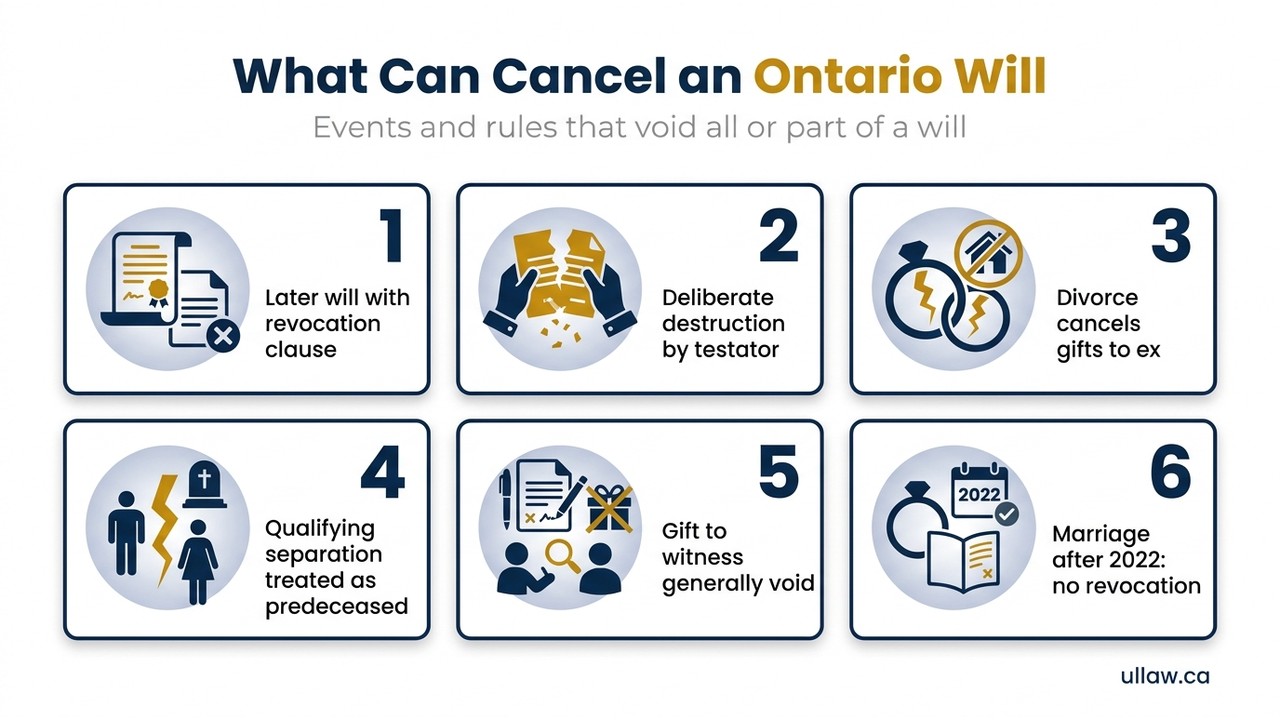
No. For marriages on or after January 1, 2022, getting married no longer revokes a will in Ontario. The Accelerating Access to Justice Act, 2021 changed this long-standing rule.
Before 2022, a marriage automatically revoked any will the person had made, with limited exceptions. One example was a will that stated it was made in contemplation of that marriage. The change is not retroactive. If someone married before January 1, 2022, a will they made before that marriage was likely revoked on their wedding day, and it stays revoked today. Many people never knew this, so an older will found after a death may in fact have no legal effect.
Now, a pre-marriage will survives the wedding. That can cause real problems. Picture a hypothetical: a man makes a will in 2019 leaving everything to his adult children, marries in 2023, and dies without updating it. His will still governs. His new spouse is not named in it.
The spouse is not necessarily without options. A married spouse may be able to elect an equalization of net family property under the Family Law Act, or bring a dependant’s support claim under the SLRA. These claims do not void the will, but they can override it. Strict deadlines apply, some as short as six months, so a spouse should get advice quickly.
Moving in together has never revoked a will in Ontario, before or after 2022.
Practical takeaway: If you married recently, your old will is still in force, so it is worth reviewing.
If a marriage ends in divorce (or is declared a nullity), Ontario law treats the will as if the former spouse died before the testator. Unless the will says otherwise, that cancels:
The rest of the will stays valid. Gifts to children, charities and others still take effect. If the former spouse was to receive the residue, the will’s backup (“gift over”) clause usually applies. If there is no backup clause, that part may pass on intestacy.
Before 2022, a separated but not divorced spouse kept everything the will gave them. That has changed. If the testator dies on or after January 1, 2022, and the spouses were separated at the time of death, the separated spouse is generally treated as having died first if either of these applies:
The same separation rule means a qualifying separated spouse also generally cannot inherit on intestacy. If the couple reconciled before the death, the rule does not apply. Depending on the facts, a separated spouse may still have other rights, such as a Family Law Act claim or a dependant’s support claim.
Not always. It depends on what the new document says.
Most professionally drafted wills open with a clause saying the testator revokes all prior wills and codicils. If the new will is validly signed and contains that clause, the old will is cancelled in full, even if the two documents would otherwise have fitted together.
If a later will says nothing about earlier wills, the earlier will is revoked only to the extent the two are inconsistent. The documents are read together. Suppose a 2015 will leaves the cottage to a daughter and a 2020 will, with no revocation clause, leaves the cottage to a son. The 2020 gift controls. Parts of the 2015 will that do not conflict may still apply. Reading two wills side by side like this often leads to disputes.
A codicil is a formal amendment to an existing will. It must be signed with the same formalities as a will, or be a valid holograph (entirely handwritten and signed) codicil. A codicil changes only what it says it changes. The rest of the will stands.
A later document can revoke an earlier will only if it is valid. Unsigned drafts, notes and half-finished will kits generally will not do it. This becomes important in Section 8 below.
If you revoke Will A by making Will B, and later tear up Will B, Will A does not come back to life. Under the SLRA, a revoked will can be revived only by re-executing it or by a codicil that shows an intention to revive it. Otherwise you may end up with no will at all.
Yes, destroying a will can revoke it. Two things are both required:
Accidental destruction does not revoke a will. Neither does a will lost in a flood or shredded by mistake. A family member who destroys a will on their own, or after the testator dies, does not revoke it either. Crossing out a single clause or writing “cancelled” across a page may or may not be enough, depending on whether the wording is still readable and what the testator intended.
Lawyers usually hold the signed original. Destroying a photocopy does nothing. If you want to revoke a will, the safest route is to make a new will that revokes it expressly.
Ontario courts generally need the original signed will to issue a Certificate of Appointment of Estate Trustee. If the original cannot be found after a careful search, two situations come up:
If the presumption is rebutted, a court may admit a copy or other evidence of the will’s contents to probate. This requires a court application with affidavit evidence. Before you start, search thoroughly. Check the drafting lawyer’s vault, safety deposit boxes, the deceased’s papers, and the will deposit service of the Superior Court of Justice.
Generally, yes. The will itself survives, but the gift fails.
Under section 12 of the SLRA, if a will is witnessed by a beneficiary, or by the spouse of a beneficiary, the gift to that beneficiary (or their spouse) is void. The same applies to a person who signs the will on the testator’s behalf. The witness is still a valid witness, so the will remains in force. They simply cannot take their gift. The rule exists because a witness who stands to benefit has a conflict of interest.
The failed gift usually falls into the residue of the estate and passes to the residuary beneficiaries. If the void gift was itself the residue, that portion may pass on intestacy. In family situations, the gift sometimes ends up with the same person through another route, but you should not assume that.
This rule is mainly a problem with homemade wills, where a family member “helpfully” signs as a witness. Our will-making guide explains how to choose witnesses properly.
Sometimes. Section 21.1 of the SLRA gives the Superior Court of Justice a curative power. For people who die on or after January 1, 2022, the court may order that a document is valid and fully effective as a will, even though it was not properly signed or witnessed. The court must be satisfied that the document sets out the deceased’s testamentary intentions. The same power can apply to a document or writing that shows an intention to revoke, alter or revive a will. This power does not apply to electronic wills.
An authentic document is not enough. The court asks whether it records a deliberate, fixed and final expression of what the person wanted to happen to their property on death. A draft, a list of ideas, or notes for a future meeting with a lawyer usually falls short.
A common problem is the typed will someone later marked up by hand. Under the SLRA, changes made after signing must be signed and witnessed like the will itself. Initials in the margin without a subscribing witness are not enough. In a recent decision about whether handwritten changes to a will can be valid in Ontario (2026 ONSC 4919), the court accepted that the handwriting was authentic. It still found the strikethroughs and notes did not rise to a fixed and final intention. It declared them of no force or effect and refused to validate them. The original typed terms, including a residue clause that was still readable, remained in force.
That decision does not mean informal writings are always worthless. Each case turns on its own facts.
If the latest will fails completely, there are generally two possibilities.
A later will that is invalid cannot revoke anything, including through its own revocation clause, because that clause fails along with the rest of the document. So an earlier, valid will that was never otherwise revoked may still govern the estate.
In a decision on whether incomplete will kit pages could override a valid Ontario will (2026 ONSC 3646), the court held that partial, unsigned kit pages lacked fixed and final testamentary intention. They did not meet the requirements to revoke the existing will. They were missing key parts, such as an executor appointment and a residue clause. The estate was to be administered under the earlier validated will, not on intestacy. The decision does not mean will kits are always invalid. It means incomplete or ambiguous papers will not easily displace a valid will.
If there is no valid will at all, for example because the only will was revoked by a pre-2022 marriage or deliberately destroyed, the estate passes under the intestacy rules in Part II of the SLRA:
Someone must apply to court to be appointed estate trustee without a will.
Sometimes only part of a will fails, such as a void residue gift. The rest of the will operates, and only the failed portion passes under the intestacy rules.
Families often assume a will has been cancelled when it has not. These events do not, on their own, revoke a will:
Ontario respects testamentary freedom: the right to leave your property as you choose. A will that seems unfair is not void for that reason alone. But some claims can override a valid will without voiding it:
Spouses sometimes sign mutual wills and agree not to change them. A survivor who later makes a new will does revoke the old one. However, if a binding agreement not to change them is proven, a court may impose a trust in favour of the original beneficiaries. These cases are complex and turn on the evidence.
Review your will after any of these events:
Also check your beneficiary designations on insurance, registered plans and pensions at the same time.
If the will turns out to be valid, the next step is usually probate. Our guide to probating a will in Ontario covers that process.
To read the legislation and decisions yourself:
Statutes and court rules change. The January 2022 amendments show how quickly settled rules can shift. For an overview of how these rules fit together, see our broader guide to Ontario wills and estate law.
Whether a will still stands often comes down to dates, documents and intentions that are hard to sort out while you are grieving or making plans. If you are unsure whether a marriage, separation, missing original or old codicil has changed things, our Wills & Estates team can review your situation in a free, no-obligation consultation. We serve Burlington, the GTA and families across Ontario, and we will explain your options in plain English.
Frequently Asked Questions
Common questions about wills & estates in Ontario.
A will can fail for two broad reasons. First, it may have been revoked: by a later valid will, a signed written declaration, deliberate destruction, or a marriage before January 1, 2022. Second, a court may find it invalid because of lack of capacity, undue influence, fraud or improper execution. Those grounds require a court challenge, which our contest guide explains. Separately, rules on divorce, separation and gifts to witnesses can cancel parts of a will while the rest stays in force. Which rule applies depends on your circumstances and dates.
No. Ontario's automatic rules for divorce and separation apply to married spouses only. If your will leaves property to a common-law partner or names them as executor, that gift and appointment generally remain valid after you separate, until you change your will. Starting a common-law relationship does not revoke a will either. If your relationship has ended, consider updating your will promptly. Also check your beneficiary designations on life insurance, RRSPs, TFSAs and pensions, which are governed by separate rules and are often overlooked.
Most will challenges are subject to the general two-year limitation period under the Limitations Act, 2002. Courts have generally treated that period as running from the date of death, though discoverability issues can arise in some cases. Other claims have much shorter deadlines. A married spouse's election under the Family Law Act is generally due within six months of the death, and a dependant's support claim generally must be started within six months after a Certificate of Appointment is issued, unless the court allows otherwise. Because deadlines depend on the facts, it is wise to get advice early.
An executor (estate trustee) owes fiduciary duties to the beneficiaries. They must act honestly, impartially and in the estate's best interests, and they must follow a valid will. They cannot ignore a gift because they dislike a beneficiary or treat an old will as current when it has been revoked. If an executor delays, hides information or mismanages assets, beneficiaries may ask the court to order them to pass their accounts, give directions, or remove and replace them. Possible remedies depend on the evidence.
No. Probate (a Certificate of Appointment of Estate Trustee) is needed when an institution or the Land Registry requires court confirmation of the executor's authority. That is common for real estate held in the deceased's sole name and for larger bank or investment accounts. Assets held jointly with a right of survivorship, or with a named beneficiary designation, often pass outside the will. Whether probate is needed depends on the assets. Our probate guide explains the process and Estate Administration Tax.
Generally, no. Once a will has been revoked by a later will, destroying the later will does not revive the earlier one. Under the SLRA, a revoked will can be revived only by re-executing it with the proper formalities or by a codicil showing an intention to revive it. If you destroy your newest will expecting the old one to apply, you may leave no valid will, and your estate could pass on intestacy. If you want an earlier plan back, the safest course is to sign a new will that sets it out.
Relevant next step
If this guide affects probate, wills, or estate planning, get advice before you act on it.
Call 905-744-8888 or email info@ullaw.ca. Consultations are free for injury and disability matters. On other matters, the first 15 minutes are free.
Related services
Related service
When an insurer disputes whether a loss qualifies under an accidental death policy, we review the policy wording and evidence to clarify your rights.
Review an AD&D decisionRelated service
A denied or delayed critical illness benefit can place unexpected financial strain on a family. We help clients understand their coverage and options.
Review a critical illness claimRelated service
When long-term disability benefits are denied or terminated, we examine the policy wording and medical evidence to identify a practical next step.
Review an LTD decisionWhy Us
Recent case law
Plain-English notes on recent decisions related to this guide. Each links to the underlying CanLII ruling.
An Ontario court refused to validate incomplete will kit pages as a new will or revoke an existing one. Learn what this means for estate planning in Ontario.
Read the noteAn Ontario court refused to validate handwritten notations on a typed will. Learn what the ruling means for will alterations and estate planning in Ontario.
Read the noteOntario's Court of Appeal upheld rectification of a will to preserve gifts to grandchildren after a drafting error left out a key remainderman clause. Here's what it means.
Read the noteKeep Reading
Hi, I'm Mira, the virtual assistant for UL Lawyers. Tell me what's going on in plain language and I'll help you understand your options and reach our intake team when you're ready.
General information only, not legal advice.
General information, not legal advice. Messages are saved so our team can follow up. Please don't share sensitive details about your case here. Privacy.