Related service
AD&D claim review
When an insurer disputes whether a loss qualifies under an accidental death policy, we review the policy wording and evidence to clarify your rights.
Review an AD&D decisionWills & Estates

You know you should have a will. Maybe you just had a child, bought a home, remarried, or watched a family go through a messy estate. Then you search for a price and get answers from “free” to “several thousand dollars.” No wonder people put it off.
This guide answers one question: what does a will actually cost in Ontario, and why do quotes vary so much? We explain the usual price bands for a basic will, mirror wills for couples, a will plus powers of attorney, more complex plans such as dual wills, and online or do-it-yourself options. We also cover what pushes a price up or down, and the costs people often forget.
One point before we start. No government body or regulator publishes an official “average” price for a will in Ontario. Lawyers set their own fees. Every dollar figure below is an illustrative, hypothetical range to help you budget and compare quotes. It is not a survey, and it is not a promise of what any lawyer, including us, will charge. The only reliable number is a written quote based on your own situation.
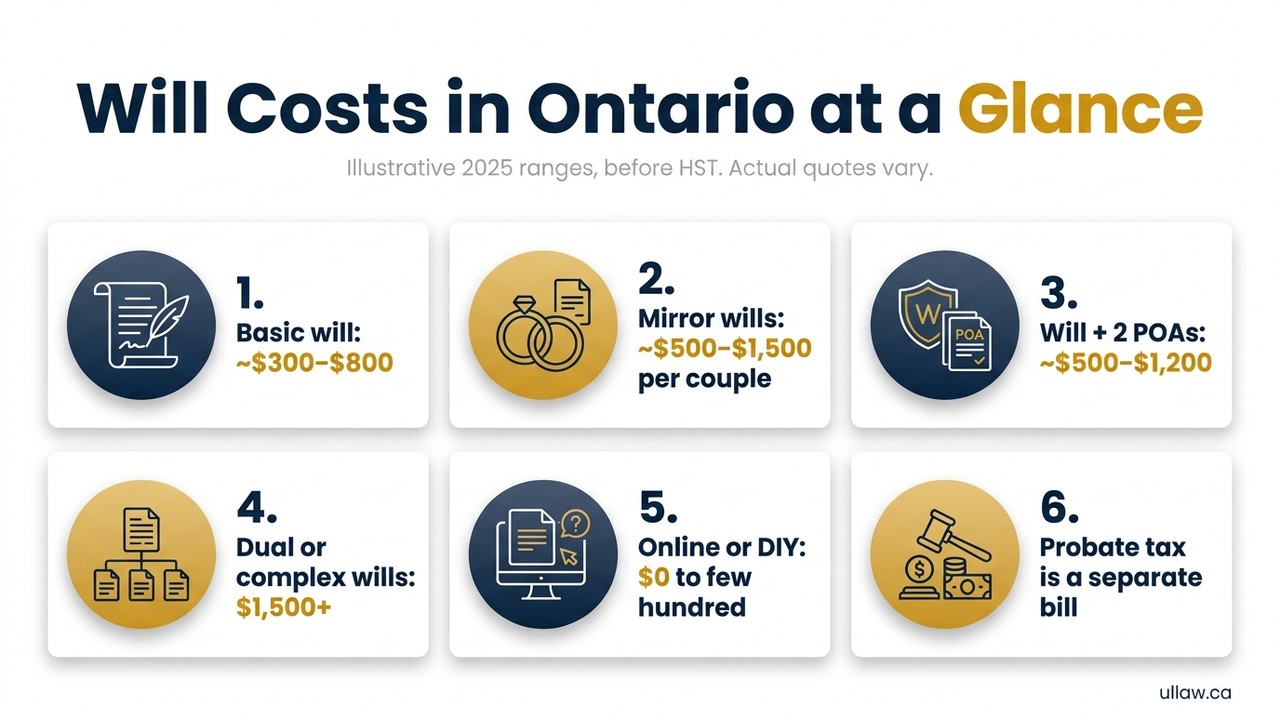
There’s no official average, but most quotes fall into a few predictable groups. The table below shows illustrative ranges. They’re meant to help you judge whether a quote is in a normal zone. They’re hypothetical, they aren’t drawn from a survey, and they’re usually quoted before HST (13% in Ontario) and any disbursements.
| Option | Illustrative range (hypothetical) | Who it usually suits |
|---|---|---|
| Basic single will (lawyer-drafted) | roughly $300 to $800 | One adult, simple assets, straightforward beneficiaries |
| Mirror or spousal wills | roughly $500 to $1,500 per couple | Couples who leave everything to each other, then to children |
| Will plus two powers of attorney bundle | roughly $500 to $1,200 per person (couples often pay less per person) | Most adults who want full incapacity and death planning |
| Complex or multiple wills (including dual wills to reduce probate) | roughly $1,500 to $5,000 or more | Business owners, blended families, trusts, property in other countries |
| Online will services | roughly free to a few hundred dollars | Simple estates, budget-focused, comfortable doing it yourself |
| DIY will kits / handwritten wills | roughly the cost of a kit, or nothing | Very simple situations, with the highest risk of mistakes |
For what firms in Peel Region tend to charge, see our guide to finding a wills lawyer in Mississauga. And keep in mind that the cost of making a will is a separate thing from the estate administration tax your estate may pay later. More on that below.
The price of the will document is only part of the story. The real cost of doing a will covers the whole process, from first call to the original being stored safely. A quote that looks cheap may leave things out. A quote that looks expensive may include everything.
This example is hypothetical and for illustration only. Imagine a married couple in Burlington with two young children, a home owned jointly, RRSPs and a modest savings account. They might be quoted a flat fee for mirror wills plus two powers of attorney each, with a trust for the children and a named guardian. The fee is quoted plus HST and includes one round of revisions and free vault storage. If they later add a cottage held through a corporation, the plan could move into the “complex” range because the structure has changed.
Two Ontarians can both ask for “a will” and get very different quotes. Usually the difference comes from how complex their lives are, not from the paperwork. These are the main things that move the price.
A home, a bank account and an RRSP with a named beneficiary is a simple estate. Rental properties, investment accounts with no beneficiary named, private company shares, or real estate outside Ontario all mean more analysis. Property in another province or country may need advice on whether a separate will is needed there.
Second marriages, common-law partners and children from earlier relationships are some of the biggest reasons a will takes longer to plan. The lawyer has to think about:
This takes careful drafting, and careful drafting takes time.
A will that just says “everything to my spouse, then equally to my children” costs less than one that sets up trusts. Common trusts include:
If you own a business, your will may need to fit with your shareholder agreement and corporate records. That’s often when dual wills come up. Many owners also need to coordinate with an accountant on tax planning.
Dual wills (also called primary and secondary wills, or multiple wills) are a common Ontario strategy. They can lower the estate administration tax an estate pays. They sit at the top of the price range, so it helps to understand what you’re paying for.
Some assets can only be dealt with once a court has confirmed the executor’s authority. That’s probate. Others can often pass without it. Private company shares are a common example, along with some personal belongings.
With dual wills, you sign:
Estate administration tax is generally calculated on the assets that go through probate. Keeping certain assets out of that process may reduce the tax. How much it saves depends on your assets and how they’re held.
Dual wills tend to make most sense for people with significant assets that may not need probate, most often private company shares. For someone whose estate is mostly a home and bank accounts, the extra legal fee may not be worth the possible tax saving. A good lawyer will tell you honestly whether the numbers work for you.
To get a rough idea of what estate administration tax could look like for your estate, try our Ontario probate fees calculator.
This mix-up is very common, so it’s worth its own section. The cost of making a will and the cost of probating it are completely different expenses. They’re paid at different times, by different people, to different places.
| Making a will | Estate administration tax (probate) | |
|---|---|---|
| When | During your lifetime | After death, when the estate applies for probate |
| Who pays | You | Your estate |
| Paid to | Your lawyer or online provider | The Province of Ontario |
| Set by | The provider (market pricing) | The Estate Administration Tax Act, 1998 |
| Can you shop around? | Yes | No. It’s a tax set by law |
Some people choose the cheapest possible will to save a few hundred dollars now, without realizing that good planning may lower costs for their estate later. Planning may reduce the estate administration tax, legal fees after death, or the chance of a costly family dispute. That isn’t true for everyone. For many simple estates, a basic will is exactly right.
We don’t repeat the tax rates here. To estimate what your estate might owe, use our probate fees calculator. For a walkthrough of the court process, see how to probate a will in Ontario. You can read the statute itself on Ontario e-Laws.
Search for will prices and you’ll see a lot of tiered packages: names like “Essentials,” “Premium” and “Ultimate,” “create your own package” builders, and even memberships. Here’s what those labels usually mean and how they compare with a lawyer’s flat fee.
Online providers often structure their offers like this (exact contents vary):
Some platforms charge a one-time fee plus an annual fee, or a recurring subscription, to keep documents stored and editable. Before you sign up, check:
Many Ontario law firms also bundle services, often as will plus two powers of attorney, or as a couples’ package. The difference isn’t so much the paperwork as what comes with it:
Online platforms often sell convenience: all your documents on one dashboard. That’s useful. But having your documents organized isn’t the same as having them right. If your situation includes any of the price drivers in the earlier section, a lawyer’s package may cost more upfront and still give better value.

When you compare quotes, compare like with like. A low price for “a will” isn’t a real deal if your neighbour’s slightly higher quote also includes two powers of attorney and storage. Here’s what a full Ontario estate plan usually includes.
Without powers of attorney, your family may have to go to court or through a government process to manage your affairs if you lose capacity. That can be slow and stressful, and it usually costs far more than the documents would have.
These aren’t always legally binding, but they can make things much easier for your family:
The Ontario government also publishes free power of attorney forms and information through the Office of the Public Guardian and Trustee. You can find them on ontario.ca.
The cheapest options, roughly from lowest to highest cost, are:
(Wills law is provincial, so the rules elsewhere in Canada differ. This section focuses on Ontario.)
The cheapest will isn’t always the cheapest outcome. Common problems with DIY wills include:
Any of these can cost an estate far more in legal fees than a lawyer-drafted will would have cost. That’s not a reason to panic if you already have a DIY will. It’s a reason to have it reviewed.
If money is tight:
No. Ontario law doesn’t require you to use a lawyer to make a valid will. Plenty of valid wills are made without one. The real question is whether a lawyer is worth it for your situation.
Legal services in Ontario are regulated by the Law Society of Ontario. Lawyers can draft wills and powers of attorney and give estate advice. Licensed paralegals’ scope of practice doesn’t include drafting wills. Notaries, will-writing companies and online platforms can’t give you legal advice tailored to your situation unless a licensed lawyer is involved.
You can confirm a lawyer is licensed using the Law Society’s public directory.
If any of these apply to you, our Wills & Estates team can explain your options and give you a clear flat-fee quote before you commit.
You can write your own will in Ontario. But notarization isn’t what makes a will valid. Many people believe a notary stamp “makes it official.” For wills in Ontario, that isn’t how it works.
A will is valid when it follows the formal requirements in the Succession Law Reform Act (and you have the mental capacity to make it). There are two main kinds of homemade will:
We cover the detailed signing rules in our guide on how to make a will in Ontario, so we won’t repeat them here. You can also read the statute on Ontario e-Laws or CanLII.
A notary may:
Neither of these replaces the formal requirements for a valid will. A stamp on a will that wasn’t signed properly doesn’t fix it.
Ontario courts now have some power to accept a document that doesn’t strictly meet the formal requirements, if the evidence shows it reflects the person’s final wishes. Don’t count on that. It usually means a court application, legal fees and delay, all paid for by your estate. That often costs much more than getting the will done right the first time.

What you leave out of a will can matter as much as what you put in. Leaving certain things out can also keep your will simpler and the fee lower. Here are common things to keep out of a will or handle another way.
A tidy, focused will is quicker to draft, easier for your executor to carry out, and less likely to end up in court. Good planning often comes down to putting each asset in the right place, whether that’s the will, a beneficiary designation or a separate memo, rather than cramming everything into one document.
Many online providers offer an “estate planning quiz.” Here’s a quick, honest version. Answer yes or no to each question.
This self-check is a general guide, not legal advice. It’s meant to help you choose the right kind of help, not replace it.
Once you have a few quotes, here’s how to compare them fairly and spot red flags.
Put each quote side by side and check:
Reviews can help, but use them carefully:
Whoever prepares your will, confirm that any legal advice comes from someone licensed by the Law Society of Ontario. For more tips, see our guide to finding lawyers that do wills near you.
A will reflects your life on the day you sign it. As things change, you’ll probably need updates, and those cost money too. Budget for them.
A codicil is a formal amendment to an existing will. It may cost less than a new will for a small change, but it must be signed with the same formalities. For anything beyond a minor change, many lawyers recommend a fresh will. It’s often only modestly more expensive and avoids confusion between documents.
Many people find it helpful to review their will every few years and after any major life event. A short review is often inexpensive. Finding a problem only after death is the costly way. Some firms offer reduced rates to update wills they originally drafted, so it’s worth asking.
For a broader overview of Ontario estate law, see our guide to Ontario wills and estate law.
Every family is different, and so is every estate plan. If you want a clear, upfront price for your will and powers of attorney, with no surprises, we’re happy to help. UL Lawyers offers a free, no-obligation consultation for clients across Burlington, the GTA and Ontario. We’ll talk through your situation, tell you honestly which option makes sense, and give you a written quote before you decide anything. Visit our Wills & Estates practice page or call 905-744-8888 to get started.
Frequently Asked Questions
Common questions about wills & estates in Ontario.
Roughly $300 to $800 for a basic lawyer-drafted will, as an illustrative range, plus HST. Couples doing mirror wills might see something like $500 to $1,500 for both. Complex plans, such as dual wills, trusts or business interests, often start around $1,500 and can go well beyond that. Online services range from free to a few hundred dollars. These are hypothetical bands, not a survey. No official Ontario average exists, and every lawyer sets their own fees. The most reliable number is a written flat-fee quote based on your assets and family. Remember that estate administration tax is a separate cost your estate pays later. You can estimate it with our probate fees calculator.
As an illustrative range, about $500 to $1,200 per person for a will plus two powers of attorney, before HST. Couples often pay less per person when they do their documents together. The bundle usually includes a continuing power of attorney for property and a power of attorney for personal care, alongside the will. Many firms price this package for less than the three documents would cost separately. Online platforms often include powers of attorney in their mid or top tiers. The Ontario government also offers free POA forms through the Office of the Public Guardian and Trustee. Prices depend on your circumstances, so ask each provider exactly what's included.
Usually, yes. Mirror wills are two wills, one for each spouse, that leave everything to each other and then usually to the same people, such as your children. Because the lawyer's advice, questions and drafting largely overlap, many firms charge a couple's rate that is less than two single wills. Keep in mind that mirror wills are still two separate legal documents. Either spouse can change theirs later. If you want gifts to be locked in, for example in a blended family, you may need a different structure, such as a spousal trust. That can affect the price, so raise it at your first meeting.
An online will can be valid in Ontario, but only if the final document meets the formal requirements of the Succession Law Reform Act and you have the capacity to make it. Most online services produce a document that you still have to print and sign properly yourself, often without anyone checking how it was done. That's where many problems start. Online wills can work well for simple estates. They're riskier if you have a blended family, minor children, business interests, property outside Ontario, or anyone likely to challenge the will. A lawyer can review a will you made online, which often costs less than drafting one from scratch.
Relevant next step
If this guide affects probate, wills, or estate planning, get advice before you act on it.
Call 905-744-8888 or email info@ullaw.ca. Consultations are free for injury and disability matters. On other matters, the first 15 minutes are free.
Related services
Related service
When an insurer disputes whether a loss qualifies under an accidental death policy, we review the policy wording and evidence to clarify your rights.
Review an AD&D decisionRelated service
A denied or delayed critical illness benefit can place unexpected financial strain on a family. We help clients understand their coverage and options.
Review a critical illness claimRelated service
When long-term disability benefits are denied or terminated, we examine the policy wording and medical evidence to identify a practical next step.
Review an LTD decisionWhy Us
Recent case law
Plain-English notes on recent decisions related to this guide. Each links to the underlying CanLII ruling.
Learn how Ontario courts decide who pays legal costs in estate disputes, when estates cover fees, and when full indemnity costs are awarded. Plain-English guide.
Read the noteWhen a will challenge is abandoned or lacks evidence, Ontario courts may order the challengers to pay costs. Learn what the 2026 Orde v. Foster decision means for you.
Read the noteAn Ontario court ordered an estate trustee to pay costs personally after delays in tax returns and repeated case conferences. Learn what this means for estates.
Read the noteKeep Reading
Hi, I'm Mira, the virtual assistant for UL Lawyers. Tell me what's going on in plain language and I'll help you understand your options and reach our intake team when you're ready.
General information only, not legal advice.
General information, not legal advice. Messages are saved so our team can follow up. Please don't share sensitive details about your case here. Privacy.