A traumatic brain injury does not always look dramatic from the outside. A person can walk away from a crash, speak clearly at the scene, and still develop headaches, dizziness, memory problems, mood changes, and difficulty working days or weeks later.
That is why brain injury claims in Ontario often turn on documentation. The legal issue is not only whether a crash happened. It is whether the medical records, symptom history, functional evidence, and expert opinions show how the injury changed the person’s life.
For accident victims and families, the first priority is medical care. The second is preserving evidence before the insurer frames the injury as minor, temporary, unrelated, or caused by something else.
Ontario overview: A stronger traumatic brain injury claim connects symptoms to function. Medical records matter, but so do symptom journals, family observations, work limitations, rehabilitation notes, and evidence showing how the injury affects daily life.
This guide explains what to document after a suspected TBI, how Ontario accident benefits fit in, when catastrophic impairment may become relevant, and how compensation claims are built.
Table of Contents
- Quick Answer: What Makes a Brain Injury Claim Stronger?
- Symptoms That Should Not Be Ignored
- Why Brain Injury Claims Are Often Disputed
- Evidence That Matters in a TBI Claim
- Accident Benefits and SABS Support for Brain Injuries
- Catastrophic Impairment and TBI Claims
- Tort Claims and Compensation After a Brain Injury
- Mistakes That Can Weaken a Brain Injury Claim
- Family and Caregiver Checklist
- Speak With UL Lawyers
Quick Answer: What Makes a Brain Injury Claim Stronger?
A brain injury claim becomes stronger when the evidence is early, consistent, and specific. Report symptoms to doctors. Follow treatment recommendations. Keep a journal. Save work, school, and daily-function evidence. Ask family members to write down changes they observe. If symptoms continue, ask whether referral to a specialist, rehabilitation provider, or neuropsychological assessment is appropriate.
The most useful evidence usually answers five questions:
- What happened in the crash?
- What symptoms appeared, and when?
- What treatment was recommended?
- How did the symptoms affect work, school, home life, driving, sleep, mood, memory, or concentration?
- What evidence shows the change compared with before the accident?
If the injury happened in a vehicle collision, the claim may involve both accident benefits in Ontario and a tort claim against an at-fault driver. Serious cases may also raise catastrophic injury and CAT designation issues.
Symptoms That Should Not Be Ignored
This article is legal information, not medical advice. If you suspect a brain injury, seek medical attention promptly.
The CDC explains that mild TBI and concussion symptoms can affect physical health, thinking and memory, emotions, and sleep, and may include headache, dizziness, nausea, fatigue, sleep changes, vision problems, and sensitivity to light or noise. See the CDC’s symptoms of mild TBI and concussion resource for medical background; this article focuses on the legal evidence trail, not medical advice.
In a legal claim, symptoms matter because they help create a timeline. Delayed reporting can give an insurer room to argue that symptoms are unrelated. Early reporting does not guarantee a successful claim, but it makes the record clearer.
Physical symptoms
After a collision, symptoms worth reporting may include:
- headaches or migraines
- dizziness or balance problems
- nausea
- blurred vision
- light or noise sensitivity
- fatigue
- sleep disturbance
- ringing in the ears
- neck pain with concussion-like symptoms
- worsening symptoms with screens, reading, driving, or busy environments
Do not minimize symptoms at the first appointment because you feel lucky to be alive or want to go home quickly. If symptoms appear later, report when they started and how they changed.
Cognitive and emotional symptoms
Brain injuries can also affect thinking and mood. Report symptoms such as:
- difficulty concentrating
- memory lapses
- slower processing speed
- trouble following conversations
- word-finding problems
- irritability
- anxiety or depression symptoms
- personality changes noticed by family
- difficulty planning or completing tasks
These symptoms can be harder to prove than a fracture, but they can be just as disruptive. They also matter for work capacity, school performance, caregiving responsibilities, and quality of life.
Why Brain Injury Claims Are Often Disputed
Insurers often scrutinize brain injury claims because symptoms can be subjective, fluctuate over time, and overlap with other conditions. A person may look fine in a short appointment but struggle badly with fatigue, light sensitivity, multitasking, or memory during a full workday.
Common insurer arguments include:
- the injury was only a minor concussion
- imaging was normal
- symptoms are from stress, anxiety, or a pre-existing condition
- the claimant returned to work, so the injury must have resolved
- treatment gaps mean the symptoms were not serious
- inconsistent reporting makes the claim unreliable
These arguments are why documentation matters. Normal imaging does not necessarily end the analysis. Many mild traumatic brain injuries are assessed through clinical findings, symptom history, functional evidence, and sometimes neuropsychological testing.
Evidence That Matters in a TBI Claim
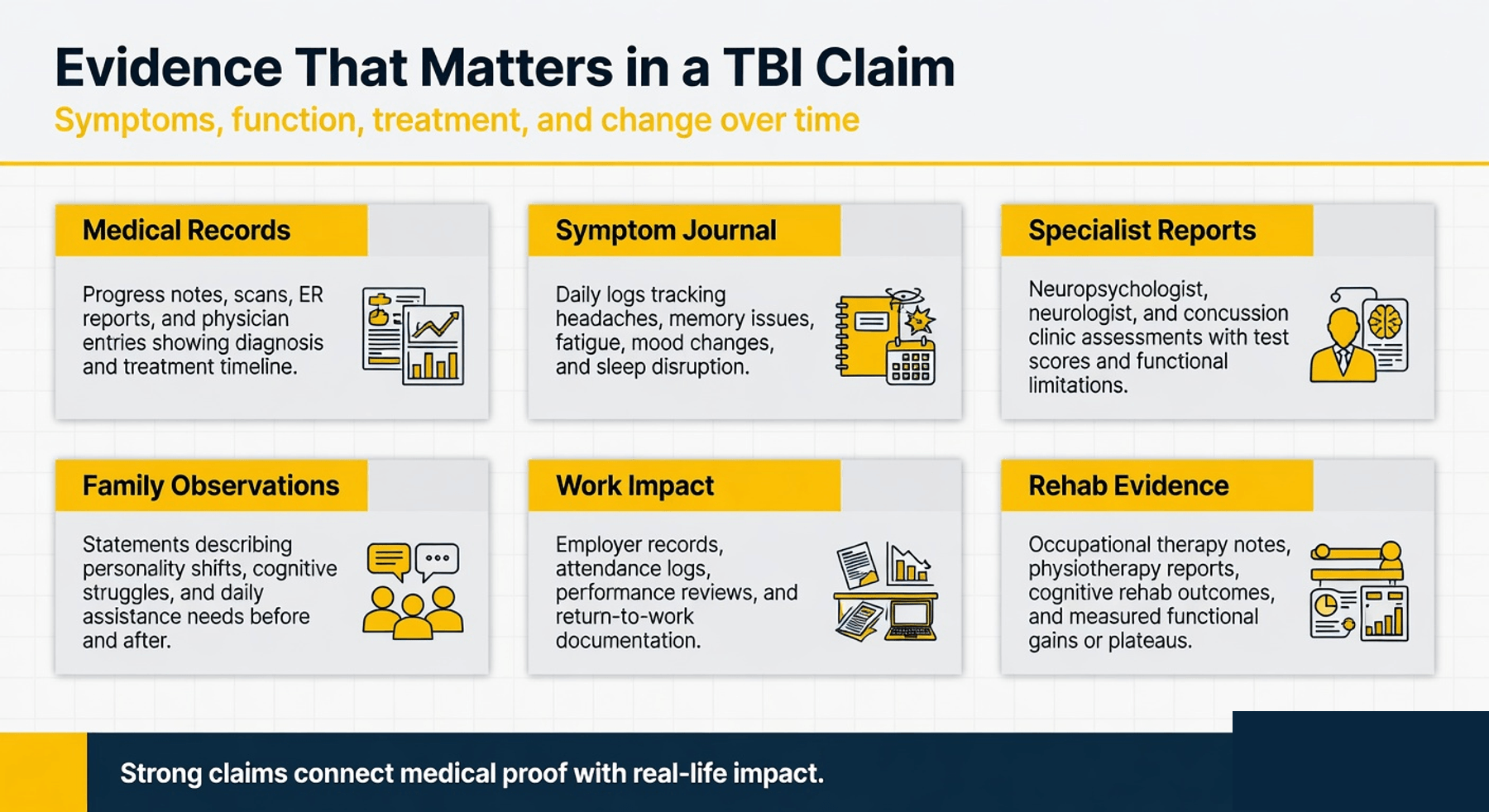
The best brain injury evidence is not one single document. It is a pattern that shows symptoms, function, treatment, and change over time.

Medical records
Emergency records, family doctor notes, specialist referrals, rehabilitation notes, and medication records create the foundation. The records should identify symptoms and functional limits, not just the diagnosis label.
Symptom journal
A short daily or weekly journal can show patterns: headaches after screen time, fatigue after errands, memory problems, sleep disruption, mood changes, or symptom flare-ups after work attempts.
Neuropsychological or specialist assessment
In persistent or complex cases, neuropsychological testing may help document cognitive functioning. Other specialists may assess vestibular issues, vision symptoms, chronic pain, or psychological effects.
Family and coworker observations
People close to the injured person often notice changes the person does not fully see: irritability, forgetfulness, withdrawal, missed appointments, or inability to manage tasks that were easy before.
Work and income evidence
Performance records, missed shifts, reduced duties, failed return-to-work attempts, and employer communications can show real-world impact.
Rehabilitation evidence
Physiotherapy, occupational therapy, vestibular therapy, psychological treatment, and cognitive rehabilitation records can support both the need for treatment and the persistence of limitations.
Accident Benefits and SABS Support for Brain Injuries
Ontario’s Statutory Accident Benefits Schedule, O. Reg. 34/10, provides accident benefits for people injured in automobile accidents, regardless of fault. For a brain injury claimant, accident benefits may include medical and rehabilitation benefits, income replacement benefits, attendant care benefits, and other supports depending on the policy and injury classification.
The exact benefits available depend on the facts, the insurance policy, optional coverage, the accident date, the injury classification, and whether expenses are reasonable and necessary.
FSRA has announced changes to Statutory Accident Benefits coverage in Ontario on July 1, 2026. FSRA states that medical, rehabilitation, and attendant care benefits will remain mandatory, while other accident benefits coverage will become optional. This makes it even more important for injured people and families to understand what coverage is available under their policy.
If an insurer denies or limits accident benefits, disputes can be brought to the Licence Appeal Tribunal’s Automobile Accident Benefits Service. Tribunals Ontario explains that LAT-AABS deals with disagreements about entitlement to statutory accident benefits after automobile accidents.
Catastrophic Impairment and TBI Claims
Some serious brain injuries may qualify for catastrophic impairment designation under the SABS. CAT designation is important because it can unlock much higher medical, rehabilitation, and attendant care limits.
But not every traumatic brain injury is catastrophic. The legal test is specific and evidence-heavy. Ontario’s Statutory Accident Benefits Schedule sets out catastrophic impairment criteria, including brain-injury-related pathways and other impairment categories.
In practical terms, CAT analysis may involve:
- neurological evidence
- cognitive and psychological assessment
- functional impact over time
- Glasgow Coma Scale or imaging evidence where relevant
- whole-person impairment or marked/extreme impairment analysis in some cases
- OCF-19 application evidence
A strong TBI article should not duplicate a full CAT guide. For a deeper explanation, see UL Lawyers’ guide to catastrophic injury and CAT designation in Ontario.
Tort Claims and Compensation After a Brain Injury
Accident benefits are only one part of the picture. If another driver caused the collision, the injured person may also have a tort claim for damages.
A tort claim may seek compensation for:
- pain and suffering, subject to Ontario’s threshold and deductible rules
- past and future income loss
- loss of competitive advantage in the labour market
- future care costs
- out-of-pocket expenses
- housekeeping or home maintenance losses where supported
- family law claims in serious cases
No article can tell you what a TBI claim is worth without reviewing medical evidence, income records, liability, insurance coverage, recovery trajectory, and long-term prognosis. Be cautious of pages that suggest settlement values without knowing the facts.
If your symptoms affect work or daily life, connect your brain injury evidence to concrete losses. A vague statement that you are “not the same” is less helpful than examples: missed deadlines, inability to tolerate screens, needing naps, forgetting appointments, reduced hours, medication side effects, or requiring help with childcare and household tasks.
Mistakes That Can Weaken a Brain Injury Claim
Avoid these common mistakes after a suspected TBI:
Waiting too long to get medical care.
Delays can make it easier for insurers to question causation.
Reporting only physical pain and not cognitive symptoms.
If headaches, memory problems, light sensitivity, or mood changes are part of the injury picture, tell your treatment providers.
Stopping treatment too early.
Treatment gaps can be used to argue recovery, even where the real issue is cost, fatigue, discouragement, or lack of access.
Overstating certainty.
Brain injury claims are medical-legal cases. Avoid exaggeration. Accurate, consistent reporting is more persuasive.
Ignoring family observations.
Family and caregivers may notice changes that the injured person has normalized or forgotten.
Posting carelessly on social media.
Short clips or photos can be taken out of context. Assume insurers may review public posts.
Family and Caregiver Checklist
Family members often become the evidence historians after a brain injury. They see the day-to-day changes that medical appointments may miss.
Families can help by tracking:
- changes in memory, mood, patience, or personality
- headaches, fatigue, and sleep patterns
- missed appointments or repeated questions
- driving anxiety or navigation problems
- difficulty with screens, noise, light, or crowds
- work or school changes
- medication and treatment attendance
- household tasks the person can no longer manage
- childcare or caregiving duties affected by symptoms
Keep notes factual. Dates, examples, and specific observations are more useful than conclusions.
Speak With UL Lawyers
A traumatic brain injury claim can involve medical evidence, accident benefits, LAT disputes, tort damages, income loss, and catastrophic impairment analysis. The earlier the evidence is organized, the harder it is for an insurer to minimize the claim as a temporary concussion or minor injury.
If you or a family member is dealing with ongoing symptoms after a crash, contact UL Lawyers. We can help review the claim path, identify evidence gaps, and explain how Ontario accident benefits and personal injury claims may apply.
Related UL Lawyers resources:
- Motor Vehicle Accident Claims
- Accident Benefits in Ontario
- Catastrophic Injury and CAT Designation in Ontario
- Motor Vehicle Accident Compensation
- Spinal Injury Lawyer
Why Motor Vehicle TBI Claims Face Unique Proof Challenges
Brain injury claims arising from motor vehicle accidents in Ontario carry a distinct evidentiary burden that goes beyond simply proving the injury exists — claimants must also establish that the accident caused the injury, that no pre-existing condition fully explains it, and that symptoms were not the result of intervening events. Insurers operating under Ontario’s Insurance Act and the Statutory Accident Benefits Schedule (SABS) are experienced at identifying and exploiting gaps in medical and documentary records. Understanding how and why these claims are contested is the first step toward building a stronger file.
The Causation Problem in Motor Vehicle TBI Cases
In a car accident TBI claim, causation is a two-part challenge:
- Proving the brain was injured at all — Mild TBI frequently produces no abnormal findings on standard CT or MRI scans. Insurers treat the absence of imaging findings as grounds to dispute the diagnosis entirely.
- Proving the accident caused it — Even where a TBI is accepted, the insurer may argue that a pre-existing condition (prior concussion, anxiety, ADHD, depression, or chronic pain) accounts for the claimant’s current deficits. Ontario courts apply the crumbling skull and thin skull doctrines to these disputes, but claimants must first produce baseline evidence against which any pre-existing condition can be measured.
Securing early neuropsychological testing — ideally within weeks of the accident — creates a contemporaneous baseline that is far harder for an insurer to attribute to prior history.
Why Insurers Are Particularly Skeptical of MVA Brain Injury Claims
Several insurer skepticism patterns appear consistently in Ontario motor vehicle TBI disputes:
| Insurer Argument | What It Targets |
|---|---|
| “Low-impact collision” | Attempts to correlate vehicle damage with injury severity, arguing minor damage equals minor injury |
| “Delayed symptom reporting” | Flags any gap between the accident date and the first medical visit where TBI symptoms were documented |
| “Psychological overlay” | Attributes cognitive complaints to pre-existing mental health conditions rather than neurological trauma |
| “Functional inconsistency” | Uses surveillance footage or social media activity to allege reported limitations are exaggerated |
| “No loss of consciousness” | Misapplies the assumption that TBI requires unconsciousness, when Ontario clinical guidelines recognize TBI without loss of consciousness |
Understanding these patterns allows claimants and their legal representatives to anticipate challenges and address them proactively through documentation strategy.
Delayed Symptom Reporting: A Common Denial Trigger
Adrenaline, shock, and the cognitive effects of the injury itself can cause accident victims to underreport or fail to recognize TBI symptoms in the immediate aftermath of a collision. Insurers treat a gap between the accident date and the first documented medical complaint as evidence that the injury either did not occur or was not caused by the accident.
Practical steps that can mitigate this risk include:
- Seeking medical attention the same day or within 24–48 hours, even if symptoms feel mild.
- Describing every symptom to the treating physician, including headache, dizziness, sensitivity to light or sound, difficulty concentrating, and mood changes — even if they seem minor.
- Asking that all reported symptoms be recorded in the clinical notes, since what is not documented is treated as if it never occurred.
- Informing the emergency room or walk-in physician that the visit is related to a motor vehicle accident, so the encounter is properly linked in the insurer’s timeline review.
What Evidence Do Insurers Demand for Hard-to-Prove MVA Injuries?
For a TBI claim arising from a motor vehicle accident in Ontario, insurers and their assessors typically scrutinize the following categories of evidence:
Medical and clinical documentation
- Emergency room records from the date of the accident
- Family physician notes documenting the evolution of symptoms over time
- Neurologist and physiatrist reports
- Neuropsychological assessment results (standardized cognitive testing)
- Advanced imaging where available (fMRI, DTI, SPECT — though availability and weight varies)
Accident causation evidence
- Police collision report (MTO Form 2473 or equivalent)
- Vehicle damage photographs and repair estimates (to counter “low-impact” arguments)
- Accident reconstruction expert reports in disputed-liability or disputed-mechanism cases
- Dashcam and traffic camera footage where obtainable
Functional impact evidence
- Occupational therapist (OT) assessments of daily living and workplace capacity
- Employer records, performance reviews, and attendance logs pre- and post-accident
- School transcripts or academic records for student claimants
- Statutory Declaration or sworn statements from family members, friends, and coworkers describing observed changes in behaviour, personality, and cognition
Pre-existing condition rebuttal evidence
- Prior medical records demonstrating the claimant’s baseline cognitive and emotional function before the accident
- Records from treating professionals confirming the nature and severity of any pre-existing condition and the degree to which it was stable or well-managed at the time of the collision
Note: The evidentiary demands described above reflect common insurer practices and general legal standards in Ontario. Every claim is fact-specific. This is general information, not legal advice.
The Role of Independent Medical Examinations (IMEs)
Insurers routinely require claimants to attend Insurer Examination appointments (sometimes called IMEs) with assessors selected and paid by the insurance company. In TBI claims, these examinations often produce findings that conflict sharply with the claimant’s treating physicians. Ontario’s SABS dispute resolution process — now administered through the License Appeal Tribunal (LAT) — allows claimants to challenge adverse IME findings with evidence from their own treatment team. Retaining specialists early and maintaining consistent treatment records are critical to withstanding IME scrutiny.