Uber or Lyft accident in Ontario? Coverage is not the same as a regular car crash. It turns on app-on vs app-off: personal auto when the app is off; rideshare commercial coverage when the driver is waiting for a request or carrying a passenger.
Screenshot the trip, driver name, plate, and route before the screen disappears. Accident benefits (SABS) can still apply to passengers, pedestrians, and cyclists even if fault is disputed.
Injured as a passenger, driver, cyclist, or pedestrian? Call 905-744-8888 or email info@ullaw.ca. You can also book a consultation.
Table of Contents
- The Rideshare Boom and the New Face of Car Accident Injury Claims
- The Unique Insurance Framework: App On vs. App Off and the Three Coverage Periods
- Who Can Claim What? A Scenario Breakdown
- Accident Benefits in a Rideshare Accident: No-Fault Coverage That Applies Immediately
- Tort Claims: Pursuing Full Compensation Beyond No-Fault Benefits
- Evidence to Preserve After a Rideshare Collision
- Critical Deadlines and Limitation Periods
The Rideshare Boom and the New Face of Car Accident Injury Claims
Every day, tens of thousands of Ontarians open an app, request a ride, and step into a vehicle with a stranger behind the wheel. Uber and Lyft have transformed the way people move through Toronto, Ottawa, Mississauga, Hamilton and dozens of other communities across the province. Yet behind the convenience of ridesharing lies a deceptively complex insurance system that few passengers—and even some drivers—fully understand until an accident happens.
When a collision involves a rideshare vehicle, the traditional rulebook doesn’t always apply. Standard personal auto policies often exclude coverage when a vehicle is being used to carry paying passengers. At the same time, the commercial insurance that Uber and Lyft arrange for their drivers only activates under specific conditions. The result is a layered, “app‑on/app‑off” framework that determines who pays accident benefits, who can be sued, and how much compensation an injured person may ultimately receive.
If you’ve been injured as a rideshare passenger, a driver working for a platform, a pedestrian, a cyclist, or the occupant of another car struck by an Uber or Lyft vehicle, your rights depend on navigating this framework correctly. The difference between a denied claim and a full recovery often starts with understanding which insurer is on the hook and which legal pathway applies.
At UL Lawyers, we regularly help injured people in Ontario make sense of these intersections between technology, insurance regulation and personal injury law. In this resource, we’ll walk through the mechanics of motor vehicle accident claims in the rideshare context, covering the three coverage periods, the accident benefits system, tort claims, evidence preservation and the deadlines you cannot afford to miss.
The Unique Insurance Framework: App On vs. App Off and the Three Coverage Periods
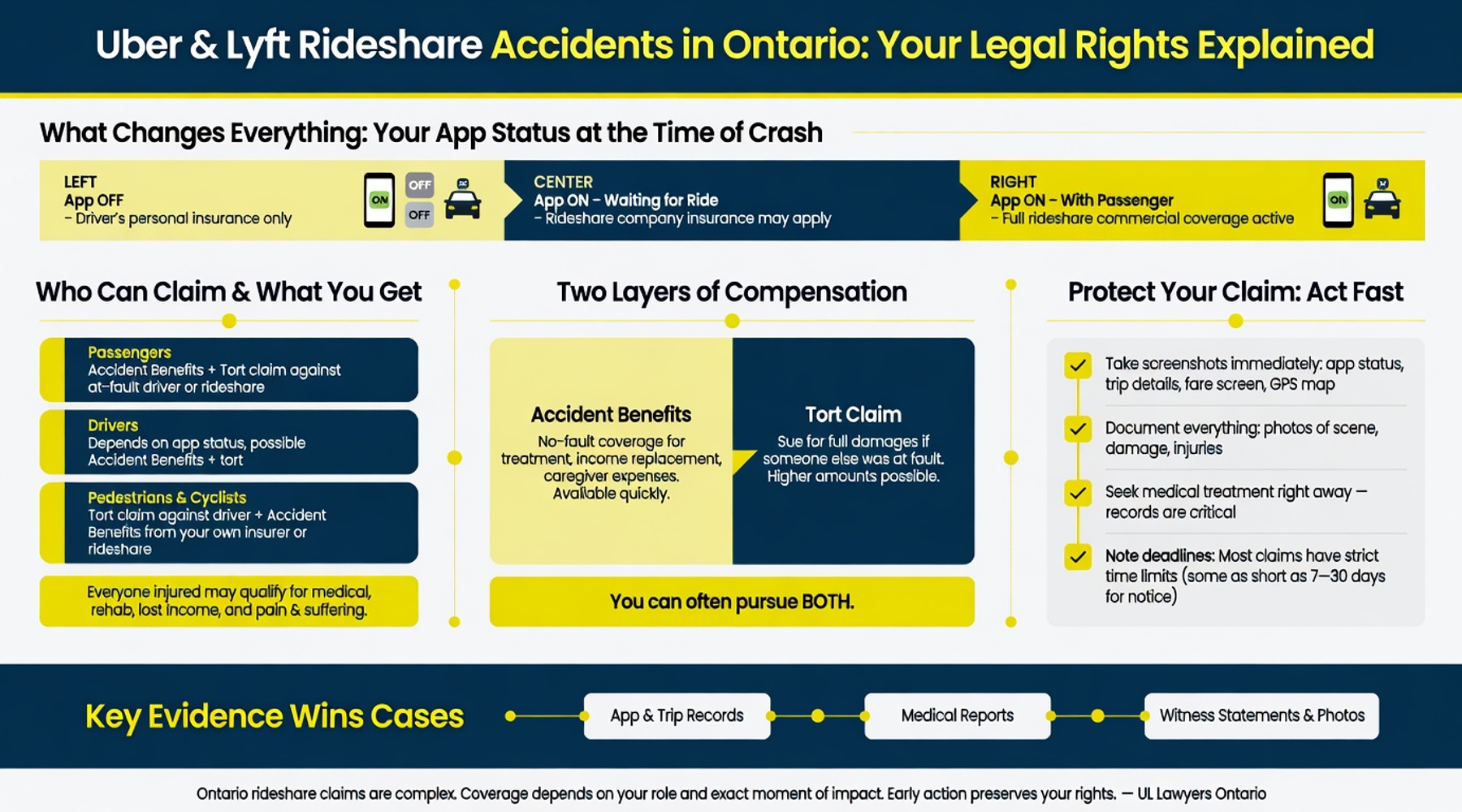
Ontario’s auto insurance regulator, the Financial Services Regulatory Authority of Ontario (FSRA), requires ridesharing drivers to be covered by a combination of personal and commercial insurance that changes depending on the status of the app. FSRA’s model—built into the regulatory framework since 2016—divides a driver’s activity into three distinct periods, and the source and scope of insurance shifts with each phase.
Period 0: App Off When the driver is not logged into the Uber or Lyft app, they are simply using the vehicle for personal purposes. Their personal standard auto policy applies, subject to its usual terms, limits and deductibles. If an accident occurs during Period 0, the driver, passengers and anyone else affected will turn to that personal policy for both accident benefits and liability coverage. However, if the driver does not have an endorsement that allows ridesharing, their personal insurer will almost certainly deny coverage for any accident that happened while the app was on—a fact that makes knowing what period you were in critically important.
Period 1: App On, Waiting for a Ride Request The moment a driver logs into the ridesharing app and makes themselves available to accept trips, they enter Period 1. During this time, the driver’s personal insurer would typically exclude coverage for any claim because the vehicle is being used for commercial purposes. To fill that gap, FSRA requires ridesharing companies to provide contingent insurance through their commercial policy. At minimum, this coverage must include $1 million in third-party liability and statutory accident benefits. Physical damage to the driver’s own vehicle is generally not covered in Period 1 unless the driver carries optional collision coverage purchased through the rideshare company or an endorsed personal policy.
Period 2: En Route to Pick Up a Passenger Once the driver accepts a ride request on the app and is driving toward the pickup location, they are in Period 2. The rideshare company’s commercial policy becomes primary and must provide at least $2 million in third-party liability coverage, along with statutory accident benefits. The same coverage floor applies to any third party who is injured during this period—regardless of whether a passenger is yet in the vehicle.
Period 3: Passenger in the Vehicle, Trip in Progress From the moment the passenger enters the vehicle until the moment the trip is completed in the app, the driver is in Period 3. The same $2 million liability coverage and full accident benefits through the rideshare company’s policy remain in force. Practically, this is the period that matters most for passengers, but it also covers pedestrians, cyclists and other motorists who become entangled in a collision while a rideshare is actively carrying a fare.
Both Uber and Lyft publish details of their Ontario insurance policies. Uber’s Ontario insurance page and Lyft’s insurance policy page confirm these coverage layers, though riders and drivers should always verify the current wording directly with the platform or their legal representative. The FSRA’s ridesharing and carsharing insurance page provides a helpful summary of the overarching requirements.
Understanding which period applied at the time of the collision is the first step in determining which insurer will respond to your claim—and it often dictates how quickly benefits flow and whether a lawsuit against an at-fault driver is properly insured.
Who Can Claim What? A Scenario Breakdown
Rideshare accident claims do not follow a single script. The insurance answer depends on your role in the collision, the app status of the rideshare driver, and the actions of other motorists. Breaking the analysis into the most common scenarios reveals how Ontario law protects each category of injured person.
Passenger Injured in a Rideshare Vehicle
You ordered an Uber or Lyft, got into the back seat, and were injured when the driver rear-ended another car or was struck by a third vehicle. Because you were in the vehicle during Period 3, the rideshare company’s commercial insurance is the primary source of coverage.
You are entitled to accident benefits through that policy—regardless of who caused the crash. These no-fault benefits cover medical and rehabilitation expenses, income replacement, attendant care, and other forms of support under the Statutory Accident Benefits Schedule (SABS), O. Reg. 34/10. You do not need to prove anyone was at fault to access them.
If the at-fault party was someone else—for instance, a driver who ran a red light—you also have a tort claim for pain and suffering and additional economic losses, subject to Ontario’s verbal threshold for non-pecuniary damages. That claim can be brought against the at-fault driver, and their insurer will respond. If the rideshare driver was at fault, your tort claim is covered by the rideshare company’s $2 million liability policy, and you can sue the driver directly, with the insurer defending and indemnifying them.
Crucially, a passenger is almost never at fault and rarely faces a contributory negligence reduction, so your compensation path is typically straightforward. For more details on how accident benefits work in any motor vehicle collision, see our resource on accident benefits in Ontario.
Rideshare Driver Injured While Working
If you are the Uber or Lyft driver and are injured in a collision while the app is on during Period 1, 2 or 3, the primary accident benefits insurer depends on the period. In Period 1, the rideshare company’s accident benefits coverage responds. In Periods 2 and 3, the company’s higher coverage still applies. However, a driver may also have access to their own optional accident benefits coverage if they purchased an endorsed personal policy that extends to ridesharing.
The critical difference for a driver is that they can also be at fault for the collision. If another vehicle caused the crash, the driver can pursue a tort claim against the at-fault motorist. If the driver was partly or wholly responsible, their own tort claim is limited and they may be found contributorily negligent. In such cases, accident benefits remain available, but any tort recovery will be reduced in proportion to their degree of fault.
Additionally, because most rideshare drivers are classified as independent contractors, they are not typically covered by the Workplace Safety and Insurance Board (WSIB) for work-related injuries. That means they cannot turn to workers’ compensation, making the personal injury claim even more important. The motor vehicle accident compensation page outlines the heads of damage a driver might recover in a tort claim.
Other Driver or Occupant of a Third Vehicle
When an Uber or Lyft vehicle strikes your car, or you are the driver of a car that strikes a rideshare vehicle, the usual fault-determination rules apply. The key question becomes: which insurer covers the accident benefits?
If you have your own Ontario auto insurance policy, your own insurer is normally your first point of contact for accident benefits, regardless of fault. That’s a central feature of no-fault insurance in Ontario. If you do not have your own policy—for example, you are a passenger in a friend’s car—you would claim accident benefits from the insurer of the vehicle you were in. If neither source applies, the rideshare company’s accident benefits coverage would step in as the next priority insurer under the priority rules in the SABS.
Your tort claim works the same way as any other motor vehicle accident. If the rideshare driver was at fault, you sue that driver, and the rideshare company’s liability policy responds. If you were at fault, you cannot recover non-pecuniary damages unless you meet the threshold, and your compensation will be reduced by your share of responsibility. In a hit-and-run situation where the at-fault driver cannot be identified, you may need to pursue an uninsured automobile or unidentified driver claim—a topic we cover on our hit-and-run accident page.
Pedestrian or Cyclist Struck by a Rideshare Vehicle
Ontario’s accident benefits system extends to pedestrians and cyclists who are involved in a collision with an insured automobile. When an Uber or Lyft vehicle strikes you, the rideshare company’s insurer—which is the insurer of the vehicle at the time of the crash—becomes your primary accident benefits provider. That is true even if you have your own auto insurance policy; the rules make the insurer of the striking vehicle first in priority.
Because pedestrians and cyclists rarely bear fault in collisions with vehicles, your tort claim against the at-fault driver (the rideshare driver or another motorist) is often strong. Damages can include pain and suffering, lost income, cost of care, and out-of-pocket expenses. And because the rideshare vehicle’s liability coverage is at least $2 million, there is usually ample insurance to compensate even a catastrophic injury.
Preserving evidence in these cases is especially difficult because the app data, license plate and driver identity can vanish quickly if you don’t act. We cover that in detail below.
Accident Benefits in a Rideshare Accident: No-Fault Coverage That Applies Immediately
The Statutory Accident Benefits Schedule (SABS) is the backbone of compensation for anyone injured in an automobile collision in Ontario, and it applies equally to rideshare-related accidents. The beauty of the system, from an injured person’s perspective, is that benefits are available no matter who caused the crash.
After a rideshare accident, the first practical step is to determine which insurer is the priority payer for accident benefits. For passengers, the rideshare company’s insurer—usually a major commercial carrier—will be the priority. For drivers who have their own personal auto policy with a ridesharing endorsement, their own insurer may be first in line; otherwise, the company’s policy takes over. For a pedestrian or cyclist, the rideshare insurer is primary. For the occupant of another car, their own insurer remains primary.
Once the priority insurer is identified, the injured person must submit an Application for Accident Benefits (OCF‑1) along with a Disability Certificate (OCF‑3) if claiming income replacement or attendant care. The benefits available under the SABS can include:
- Income Replacement Benefits: up to 70% of gross weekly income, to a maximum of $400 per week (or higher if optional coverage was purchased), for those who are substantially unable to perform the essential tasks of their employment.
- Non-Earner Benefits: $185 per week for those who are completely unable to carry on a normal life and do not qualify for income replacement.
- Medical and Rehabilitation Benefits: for reasonably necessary medical, surgical, dental, hospital, nursing and rehabilitation expenses, subject to policy limits.
- Attendant Care Benefits: for persons who require assistance with personal care because of their injuries, up to $3,000 per month for non‑catastrophic injuries or up to $6,000 per month for catastrophic injuries (with higher limits possible if optional coverage was purchased).
- Housekeeping and Home Maintenance: up to $100 per week if the injury leads to a substantial inability to perform these tasks.
- Death and Funeral Benefits: for families of those who die as a result of an accident.
The specific dollar figures and limits are set out in O. Reg. 34/10 and are updated periodically. Because the SABS is a regulation under the Insurance Act, the framework is stable, but the priority rules can be intricate when multiple insurers are potentially involved.
An important nuance: if the rideshare driver was in Period 0 (app off) when the collision occurred, the driver’s personal policy is the sole source, and the passenger is treated as a private guest. If the driver’s personal policy excludes coverage for carrying passengers for compensation, the passenger could end up in a coverage gap. Victims in that position should speak to a lawyer immediately to explore alternative sources of recovery, including uninsured motorist provisions.
Disputes over denied or reduced accident benefits are handled by the Automobile Accident Benefits Service (AABS) of the Licence Appeal Tribunal (LAT). The LAT’s AABS page explains the dispute resolution process, which includes a mandatory case conference and a hearing before an adjudicator. Having experienced legal representation at this stage can be decisive, as the insurer’s adjusters are well-versed in the SABS and often push back against expensive treatment plans.
Tort Claims: Pursuing Full Compensation Beyond No-Fault Benefits
Accident benefits, while important, provide only a partial safety net. For many seriously injured victims, the real recovery comes through a tort claim—a lawsuit against the at-fault driver. In Ontario, you can sue for pain and suffering, past and future loss of income beyond the accident benefits cap, out-of-pocket expenses not covered by benefits, loss of enjoyment of life, and loss of guidance, care and companionship for family members.
The gateway to non‑pecuniary damages (pain and suffering) is the “threshold” in section 267.5 of the Insurance Act. You must prove that the injury resulted in a permanent serious impairment of an important physical, mental or psychological function, or that it resulted in death. Many significant injuries—including fractures, spinal injuries, traumatic brain injuries, chronic pain disorders, and lasting psychological harm—can meet this test, but the evidence must be carefully built with medical reports and expert assessments.
When a rideshare driver is at fault, the liability policy Uber or Lyft maintains for Ontario operations (which provides at least $2 million in coverage during Periods 2 and 3) responds to the lawsuit. This level of coverage is generally more than adequate to compensate even life‑altering injuries. In a multi‑vehicle collision where another driver is at fault, your claim is directed to that driver’s insurer, and the rideshare policy becomes a secondary resource only if the at‑fault driver’s limits are exhausted or coverage is inadequate.
If the rideshare driver was partly at fault and another motorist shares blame, Ontario’s joint and several liability rules often allow you to recover the full amount from any at‑fault defendant, then let the insurers sort out contribution among themselves. This helps simplify the litigation from the victim’s perspective.
One common misconception is that you can sue Uber or Lyft directly as a platform. In almost all cases, the rideshare company itself is not a proper defendant in a personal injury lawsuit. The relationship between the platform and the driver is generally structured as one of independent contractor, not employer. Accordingly, the claim is brought against the named driver, and the company’s insurer steps in to defend and indemnify under the commercial auto policy. There are narrow exceptions—for instance, if the platform’s own negligence in hiring, supervising or retaining a driver contributed to the injuries—but these claims are fact‑specific and require careful legal analysis.
The financial difference between accepting accident benefits alone and pursuing a tort claim can be profound. For someone who can no longer return to a previous occupation or who requires lifetime care, a lawsuit is often the only vehicle that can fully address future losses. Our motor vehicle accident compensation guide breaks down typical heads of damage in detail.
Evidence to Preserve After a Rideshare Collision
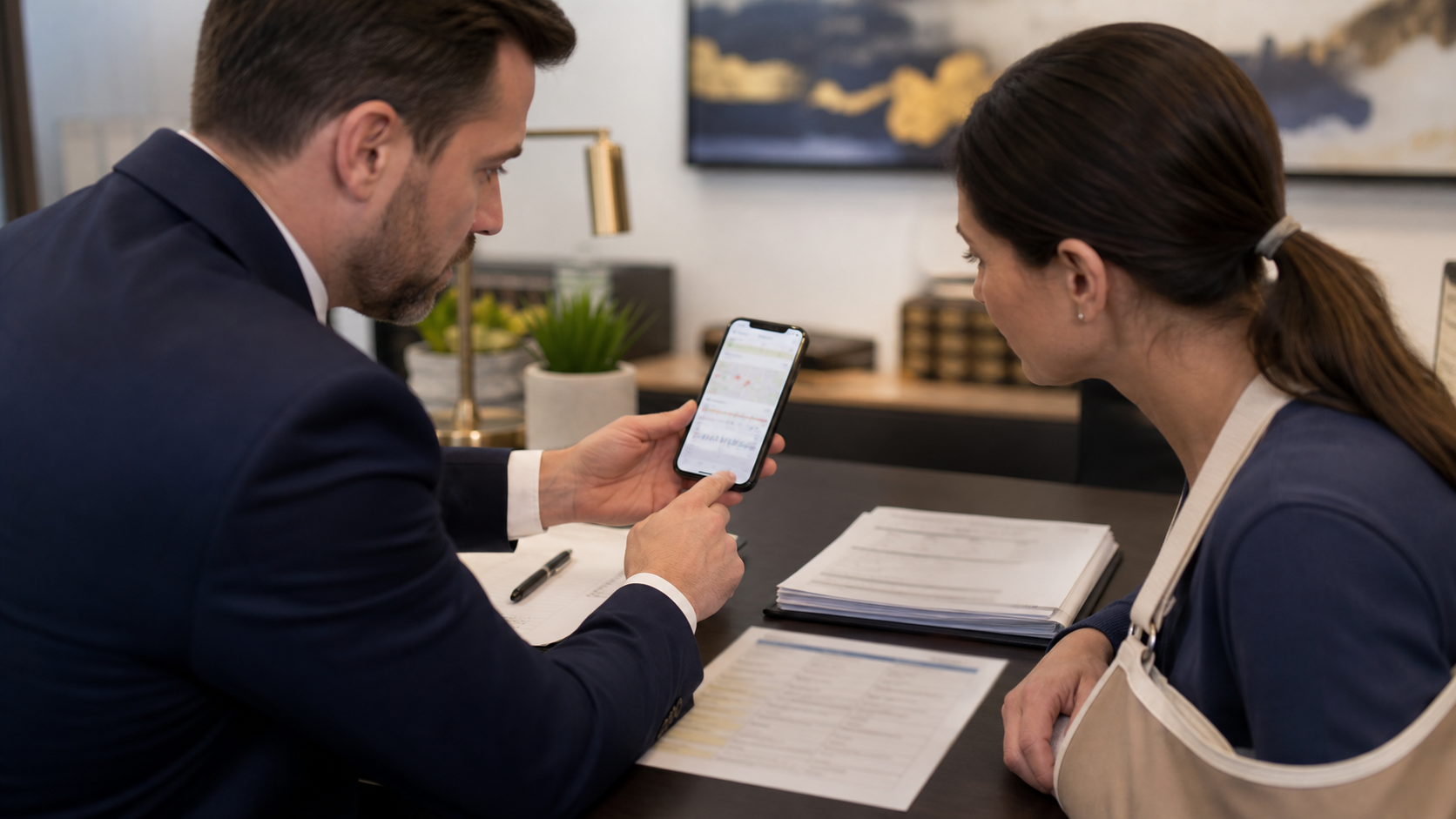
The technology that makes ridesharing possible also creates a unique evidence trail—but that trail can disappear quickly if you don’t act. Unlike a traditional taxi, where a dispatch log and medallion number are on file, the rideshare app’s data is ephemeral from the rider’s perspective. Here is a checklist of what to do in the minutes, hours and days after an Uber or Lyft accident.
At the Scene
- Call 911 and obtain a police report. Even if injuries seem minor, a formal record anchors the time, location and identified parties.
- Screenshot your trip details immediately. Open the app and capture the trip screen showing the driver’s name, vehicle make, license plate, and route. If the app crashes or the trip is cancelled mid‑collision, this information can become difficult to recover later.
- Photograph the accident scene, all vehicles involved, damage points, traffic signals, skid marks and any visible injuries.
- Collect contact information of witnesses and, if another car is involved, the other driver’s insurance and licence details.
- Avoid discussing fault at the scene.
In the Following Days
- Seek medical attention without delay—even for symptoms that seem mild. Medical records created close in time to the accident are powerful evidence.
- Request a copy of the police report or the incident number so your lawyer can obtain it.
- Notify the rideshare platform. Both Uber and Lyft have in‑app or online accident reporting functions. This triggers the insurer’s involvement and creates a contemporaneous record that the collision occurred while a trip was active.
- Preserve all correspondence with the platform, your insurer, medical providers and the police.
- Keep a daily journal of your symptoms, pain levels, sleep quality and any activities you can no longer perform.
- Save Uber receipts, trip history and any post‑accident messages from the driver or platform.
This evidence may be pivotal during the accident benefits application process and, later, at discovery in litigation. The insurance company will scrutinize inconsistencies, gaps in treatment and pre‑existing conditions. A well‑documented file makes it much harder to minimize your claim.
Critical Deadlines and Limitation Periods
Automobile injury claims in Ontario are governed by several overlapping limitation periods. Missing a deadline can extinguish your right to compensation entirely, even if your injuries are severe.
Notice and Application for Accident Benefits Under the SABS, you must notify your accident benefits insurer within 7 days of the accident or, if that is not reasonably possible, as soon as practicable thereafter. While late notice does not automatically bar a claim if there is a reasonable excuse, failing to communicate promptly can give the insurer an argument to reduce or delay benefits.
Tort claims (lawsuit for pain and suffering and other losses) Ontario generally gives you two years from the date you discovered the claim to start a lawsuit. Accident-benefits disputes, OCF forms, and insurer notices have shorter clocks. Do not wait for the two-year date if treatment or income replacement was denied.
Injured in an Uber or Lyft in Ontario? Call UL Lawyers at 905-744-8888 or email info@ullaw.ca. You can also book a free consultation.
Related UL Lawyers resources
- Motor vehicle accident lawyers — accident benefits and tort claims.
- Accident benefits — SABS, OCF forms, and LAT disputes.
- What to do after a car accident in Ontario — first-week evidence and insurer steps.